On This Page
- Why Choosing the Right Web Design Agency Matters
- How to Define Your Business Goals Before Searching
- How to Choose Between Agency, Freelancer, and In-House Team
- How to Evaluate Web Design Agency Process and Workflow
- What Questions to Ask a Web Design Agency
- What Are the Critical Web Design Agency Warning Signs?
- How Much Should a Web Design Agency Cost? Pricing Benchmarks 2026
- What Is the Typical Web Design Agency Project Timeline?
- How a Long-Term Web Design Agency Partnership Improves Results
- How to Use a Practical Checklist When Choosing a Web Design Agency
- Why Strategic Web Design Partnerships Drive Long-Term ROI
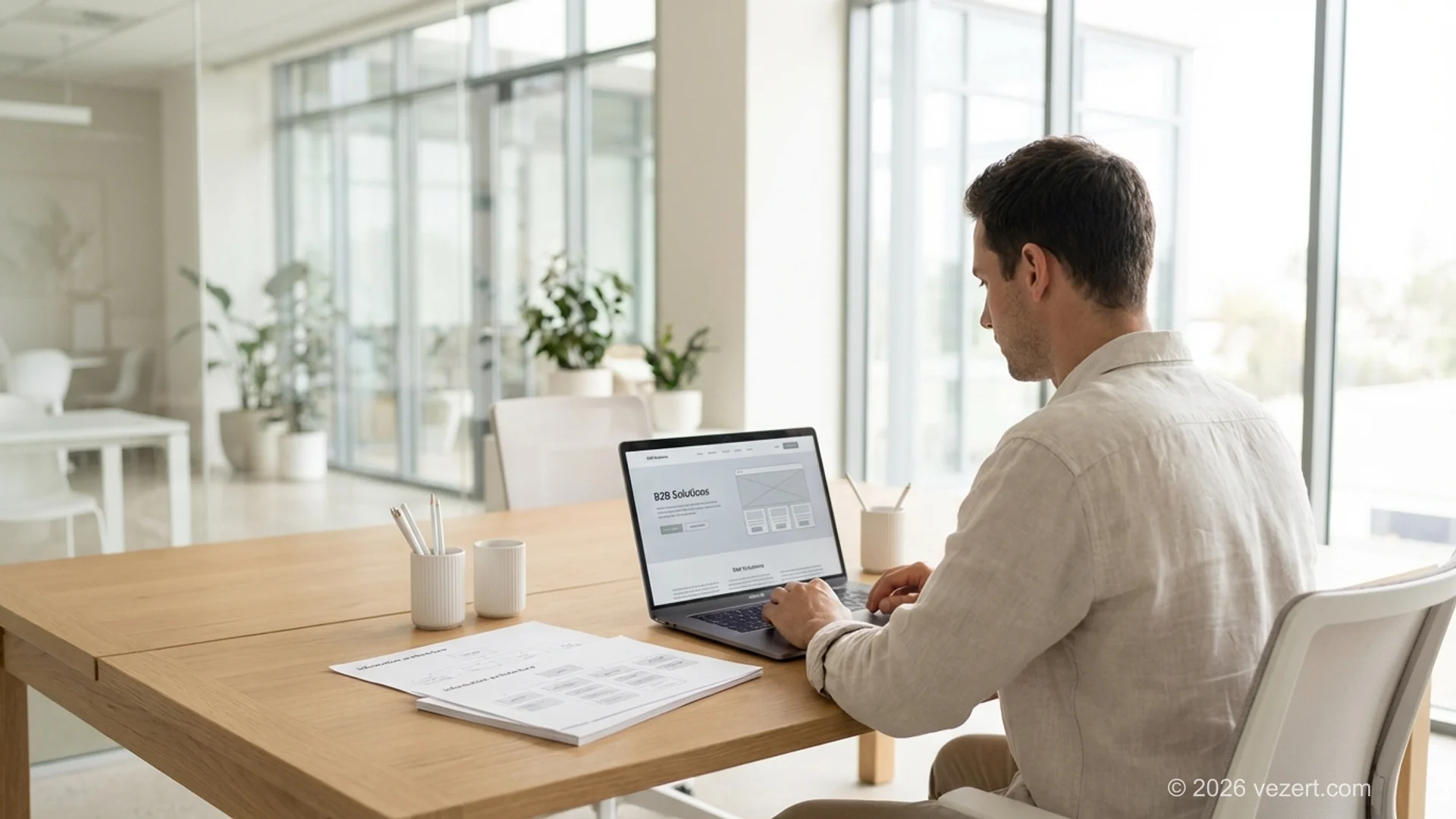
Choosing a web design agency is the buyer process of evaluating studios on portfolio fit, process maturity, pricing transparency, and post-launch support. The right framework reduces RFP cycles from 8–12 weeks to 3–4, and stops the cycle of rebuilding websites every 12–18 months because the original foundation never matched business goals. The partner you select shapes your corporate website, your UX quality, and ultimately your business results.
A poor choice leads to unclear scope, missed deadlines, weak information architecture, and low conversion rates.
This article offers a practical framework for how to choose a web design agency and how to hire a web designer who fits the work. It covers evaluation criteria, vetting questions, pricing benchmarks, red flags, and a structured approach to selecting a partner that delivers measurable ROI and long-term growth.
Why Agency Selection Matters, The Numbers
73% of marketing leaders regret their first web design agency choice (Forrester 2025). Average B2B agency RFP cycle: 8–12 weeks (G2 2024 Agency Buyer Survey). The cost of a wrong choice usually shows up in month 4, not month 1.
Why Choosing the Right Web Design Agency Matters
When choosing a web design agency, businesses are not purchasing a commodity service. They are selecting a partner that will build a long-term digital asset. A website today is an integral component of marketing, sales, lead generation, and brand positioning.
The website must support scalability, performance, accessibility, and measurable results. As Nielsen Norman Group's research on trustworthiness in web design demonstrates, poor execution often results in costly redesigns, budget overruns, and lost opportunities.
Common dangers of choosing the wrong web design agency include:
- Failure to plan a strategy before website development begins.
- Poor alignment between the design direction and business objectives.
- Weak technical execution affecting Core Web Vitals and page speed.
- No plan for long-term website optimization or iterative improvement.
- Lack of responsive design testing across devices and browsers.
The right web design agency builds with purpose. Structure, user flows, navigation, and performance decisions are made with measurable outcomes in mind. This has a direct impact on conversion optimization, as UX quality and technical stability determine how reliably visitors convert into leads or clients.
Choosing carefully reduces long-term risk and increases the chance that your website becomes a scalable digital asset for the business rather than a short-lived project requiring frequent rework.
How to Define Your Business Goals Before Searching
Before you start learning how to choose a web design agency, you need internal clarity on what success looks like for your business. Strong web design agency evaluation criteria begin with defining your business objectives, target audience, and the specific revenue or growth outcomes the website should drive. Without this foundation, it is impossible to know whether an agency is the right fit for your project, no matter how impressive their portfolio looks on the first call.
The website should support specific, measurable results. Vague goals like "modern design" do not provide a useful guiding force for website development. Clear expectations make the selection process rational, structured, and comparable across candidates.
Define:
- The main purpose of the website (lead generation, e-commerce, brand authority).
- The KPIs and metrics that define success.
- The anticipated impact on revenue and business growth.
This preparation helps you assess agencies on strategic alignment, not just visual portfolio appeal.
Identify Business Outcomes for Your Web Design Agency
Start with measurable outcomes. A website should contribute directly to tangible business results.
Typical objectives include:
- Generating qualified leads through optimized landing pages.
- Increasing direct sales or demo bookings.
- Strengthening brand credibility and trust signals.
- Supporting long-term organic growth through SEO-friendly architecture.
When outcomes are defined, it becomes easier to assess whether a web design agency understands conversion optimization, user behavior, and business logic.
Define Project Scope
Scope clarity helps avoid misalignment later. It includes definitions of complexity, resources, budget ranges, and timelines.
Clarify:
- Type of website, corporate website, landing page, or web portal.
- Features needed, integrations, and third-party services.
- Expected degree of customization and design complexity.
- Technical requirements (CMS, API integrations, performance targets).
Having defined goals and scope when contacting agencies helps structure the selection process strategically. It ensures discussions focus on results and long-term website optimization, not just design preferences.
Before evaluating any web design agency, define your business goals, success metrics, and project scope internally. Without this foundation, it is impossible to determine whether an agency is the right fit. Clear expectations make the selection process rational and measurable, focused on results, not just visual style.
How to Choose Between Agency, Freelancer, and In-House Team
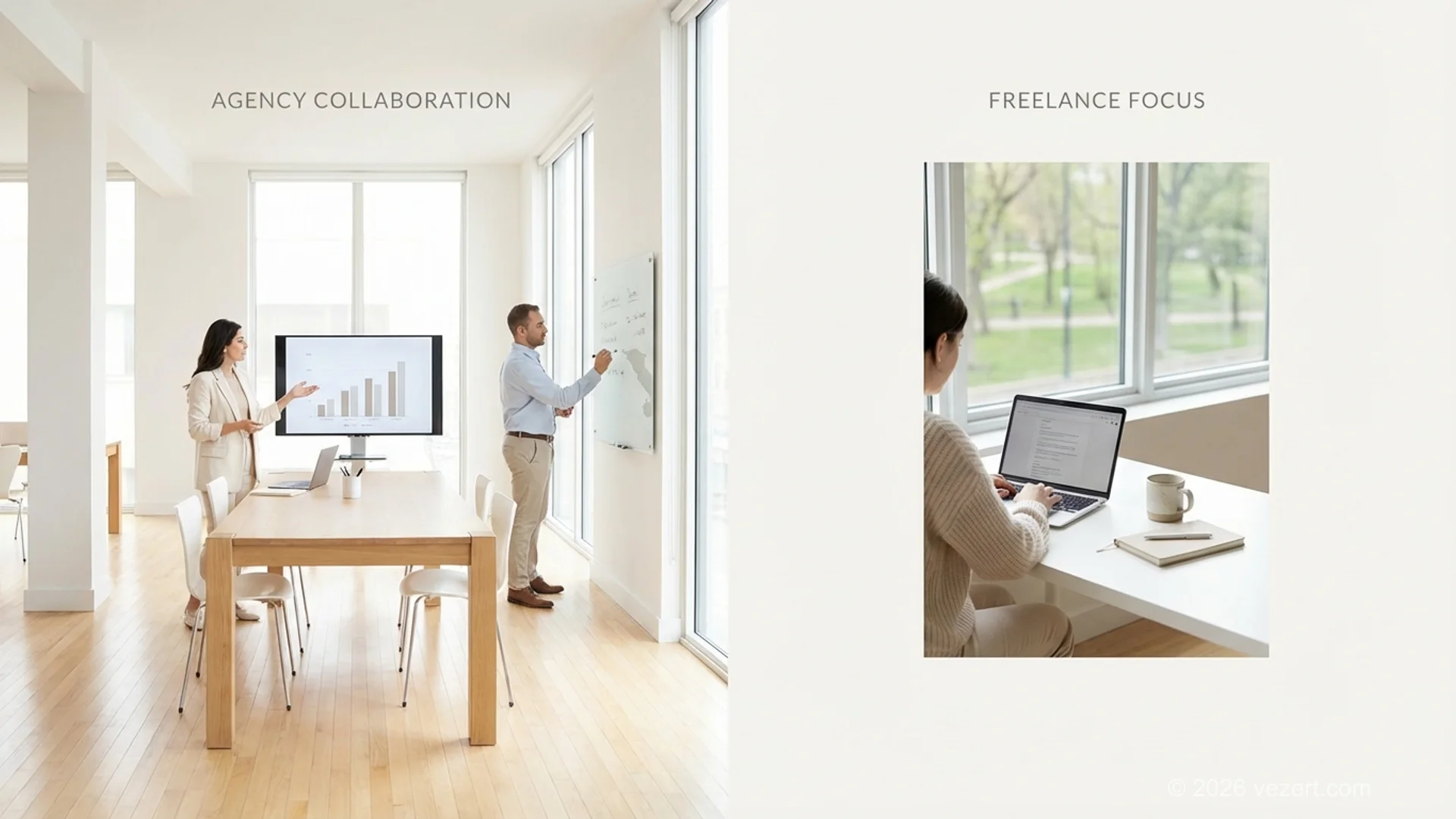
Before making any decision about how to hire a web designer or a full agency, businesses should understand the main collaboration models. Knowing how to choose a web designer starts with knowing which delivery model the project actually needs. As Smashing Magazine's guide to evaluating designers recommends, the choice between a web design agency, freelancer, or in-house team has a direct impact on timelines, scalability, and long-term website optimization.
Each option has distinct advantages and limitations. Understanding these differences helps determine the right web development partner vs freelancer scenario for your project.
Web Design Agency
A web design agency offers a multidisciplinary team with capabilities across strategy, UX/UI design, development, and testing.
Typical strengths:
- Structured website development process with defined milestones.
- Access to diverse expertise (designers, developers, strategists, QA).
- Scalable resources for complex, multi-phase projects.
- Focus on long-term conversion optimization and performance.
Ideally suited for:
- Complex or business-critical websites.
- Projects requiring integrations, scalability, or custom functionality.
- Companies seeking a long-term digital partnership.
Freelancer
Freelancers typically specialize in one or two areas, such as visual design or front-end development.
Typical strengths:
- Lower initial cost for simple deliverables.
- Flexible and informal collaboration.
- Effective for small or well-defined projects.
Limitations:
- Limited capacity for complex, multi-disciplinary projects.
- Higher dependency risk on a single person.
- Less structured processes and documentation.
Ideally suited for:
- Small websites or single landing pages.
- Limited-scope, short-term work.
In-House Team
An internal team works exclusively on company projects and internal priorities.
Typical strengths:
- Deep understanding of the business context and brand.
- Long-term availability and institutional knowledge.
- Direct communication and management control.
Limitations:
- High hiring, salary, and retention costs.
- Slower scaling for large or specialized projects.
- Requires internal management, tools, and processes.
Understanding these collaboration models helps businesses make a rational decision and choose the optimal partner for sustainable growth and effective website optimization.
When to Choose a Web Design Agency
If your project involves a business-critical website, requires multiple skill sets (strategy, UX, design, development, SEO), or you need a long-term optimization partner, a professional web design agency is the most reliable option. Agencies provide structured accountability, defined deliverables, and team redundancy that reduce project risk.
How to Evaluate Web Design Agency Process and Workflow
Understanding how a web design agency operates is one of the most important parts of the selection process. A structured workflow reduces risk, improves predictability, and keeps website development aligned with business goals throughout the project. Agencies without a real playbook quietly improvise, and that improvisation is what blows up the timeline in month three. A repeatable process is the single most reliable predictor of on-time delivery.
When evaluating an agency, pay attention to whether they follow a clear, repeatable process versus an ad hoc approach. A mature web design agency process typically involves discovery, planning, iterative design, development, testing, and post-launch website optimization.
Discovery and Strategic Planning
A strong process starts with discovery. This phase focuses on understanding business objectives, target audience needs, competitor landscape, and project requirements before any design or development begins.
Look for agencies that:
- Conduct thorough business and technical requirements gathering.
- Define scope, priorities, and success metrics from the outset.
- Align project goals with conversion optimization and user journey mapping.
- Perform competitive analysis and content strategy planning.
Discovery ensures that the project begins with strategy rather than assumptions. According to Web.dev's guidance on user-centric performance metrics, measurable goals should be established before development starts.
AI-Powered Development and Testing
Modern web design agencies increasingly incorporate AI-powered development into their workflows. AI supports research, content generation, automated testing, and code optimization, helping teams work faster while maintaining quality.
Signs of a structured approach include:
- Automated testing and quality assurance checks.
- Iterative design and development cycles with client feedback loops.
- Continuous validation during implementation.
- Performance monitoring integrated into the build process.
AI should support execution while human experts make strategic and creative decisions.
Launch and Ongoing Website Optimization
A professional workflow does not end at launch. The web design agency should plan for monitoring, performance tracking, and continuous website optimization.
Key indicators of a mature post-launch process:
- Organized pre-launch testing (cross-browser, responsive, accessibility).
- Performance monitoring and analytics setup post-release.
- Continuous improvements based on real user data and heatmaps.
- Regular reporting on Core Web Vitals, bounce rates, and conversion metrics.
Evaluating a web design agency's workflow reveals how they manage risk, quality, and long-term digital performance.
Common red flags when choosing a web design agency: no discovery phase before development, unrealistic timelines or pricing without scope understanding, focus only on visual design rather than business goals, no discussion of post-launch optimization, no clear testing or QA process, and unclear communication structure or responsibilities.

What Questions to Ask a Web Design Agency
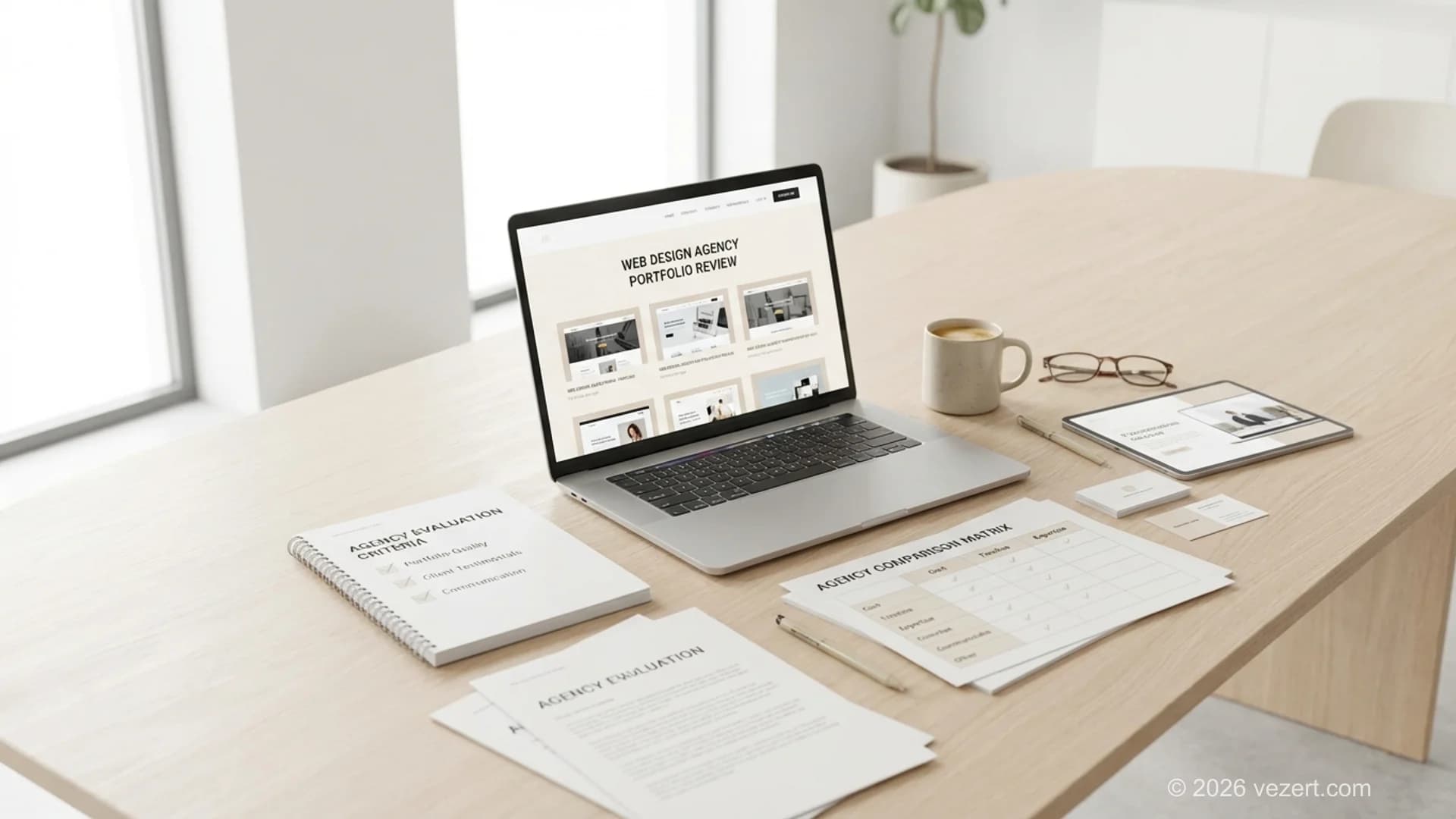
Asking the right questions helps you go beyond a web design agency's marketing promises and assess their actual expertise. The 12 questions below reveal process maturity, expectations management, and collaboration quality before you sign anything. Treat the answers as a stress test: vague answers signal vague execution, specific answers signal a structured team. Most agencies fail at least three of these questions on the first call, and the failures matter more than the wins.
Key questions to ask a web design agency:
- How do you approach discovery and project planning?
- How do you align website development with specific business goals and KPIs?
- What is your process for testing, QA, and quality assurance?
- How do you support website optimization after the site is launched?
- How do you measure project success and conversion optimization impact?
- What is your typical communication cadence and reporting structure?
- How do you handle scope changes, timeline adjustments, and budget overruns?
- How much involvement is required from our internal team?
- How do you handle third-party integrations and technical complexity?
- Can you share case studies or references from similar projects?
The purpose of these questions is not just information gathering, it is understanding how the web design agency thinks, plans, and operates under real conditions. Clear, structured answers are usually signs of a mature process and realistic expectations.
This conversation also helps define roles, responsibilities, and communication channels early in the partnership. Review the agency's portfolio to validate their answers against actual delivered work. Asking the right questions reduces uncertainty and supports a more predictable collaboration.
What Are the Critical Web Design Agency Warning Signs?
Knowing how to choose a web design agency also means knowing what to avoid. Certain behaviors are red flags, clear signs of weak processes, unrealistic expectations, or short-term thinking that consistently derails projects in month four when scope creep meets a missed milestone. The patterns below are not theoretical: they appear in every project post-mortem we run with clients who came to us after a failed agency engagement, and they are usually visible during the first or second sales call if you know what to listen for.
Common red flags when evaluating a web design agency:
- No discovery or strategy phase before website development begins.
- Unrealistic timelines or pricing provided without understanding the project scope.
- Focus exclusively on visual design with no discussion of business goals or user experience.
- No plan for website optimization, monitoring, or iteration after launch.
- No clear testing, accessibility, or quality assurance process.
- Unclear communication structure or undefined team responsibilities.
- No measurable success criteria or KPIs discussed during the proposal stage.
Another warning sign is the absence of data-driven results. If a web design agency cannot explain how the website will drive signups, demos, or sales, the project lacks strategic direction.
Portfolio and Reference Checks
Always review the agency's portfolio for projects similar to yours in scope and industry. Ask for client references and follow up on them. Look for evidence of measurable improvements, not just attractive visuals. A structured corporate website design process backed by named-client outcomes beats any portfolio shot.
Identifying these risks early prevents expensive mistakes and leads to a more confident decision when selecting your web design agency partner.
From the trenches
"The agencies that lose money for clients almost never look bad in a pitch deck. They look polished. The signal we now check first: do they have one named, verifiable outcome from their last 3 projects? If they can't say it on a sales call, they don't have it.", Vezert engagement lead
How Much Should a Web Design Agency Cost? Pricing Benchmarks 2026
Web design agency pricing is the elephant most agency comparison articles refuse to put on the table, even though it is the single most important factor in the decision after process maturity. Pricing transparency is also a strong signal of agency confidence, agencies that bury their numbers usually have something to hide. Here are the actual 2026 ranges we see across mid-market and enterprise B2B engagements, plus the four factors that compress or expand each bracket:
- Landing page (single): $1,000 – $5,000 with a freelancer; $5,000 – $15,000 with a structured agency.
- Small business website (5–10 pages): $5,000 – $20,000 with a small agency.
- Corporate website (10–50 pages, CMS, integrations): $20,000 – $80,000 with a mid-market B2B agency.
- Enterprise / multilingual / complex integrations: $80,000 – $250,000+ with an enterprise digital agency.
- Web portal or custom application: $50,000 – $300,000+, depending on scope and integrations.
What Drives the Range
The range inside each bracket is wide because four factors compress or expand it:
- Scope creep risk: agencies with mature discovery processes quote tighter ranges because they understand the scope before pricing it.
- Process maturity: agencies that ship in 6–9 weeks (instead of 12–18) cost less per project even at higher hourly rates.
- Tech stack: headless / Jamstack stacks are more expensive upfront, cheaper over 24 months. WordPress is the reverse.
- Post-launch model: retainer-included pricing looks higher but usually delivers better TCO than "project + change requests."
Hidden Costs to Watch
- Stock photography and licensed assets: $500 – $3,000 typically not included in headline pricing.
- Third-party tools: CMS license, hosting, analytics, A/B testing, monitoring, usually $50 – $500/month total.
- Content creation: copywriting and SEO content is often quoted separately at $200 – $500/page.
- Translation / localization: $0.10 – $0.30/word per locale, plus $1,000 – $3,000/locale for QA.
- Year-2 maintenance: budget 15–25% of the build cost annually for ongoing optimization.
For a transparent breakdown of what each tier includes, see the Vezert corporate website design pricing page. We map every price point to a specific deliverable scope and timeline window, no "starting at" trap.
Choose Your Web Design Agency Partner
Get a structured approach to website development, from discovery and strategy to launch and long-term optimization. See how a [corporate website design agency](/corporate-websites) actually delivers in 6–9 weeks.
Start a ConversationWhat Is the Typical Web Design Agency Project Timeline?
Understanding the typical timeline for a web design agency project helps set realistic expectations and plan resources accordingly. While every project is unique, most professional agency engagements follow a similar structure across discovery, design, development, testing, and launch. The timeline below assumes a mid-complexity B2B project with a structured agency partner and a moderately responsive client team, both factors directly affect delivery date by 2–4 weeks.
A standard corporate website project with a web design agency typically takes 8 to 16 weeks from kickoff to launch, depending on scope and complexity. Here is a general breakdown:
Discovery and Strategy Phase (Weeks 1-2)
This phase includes stakeholder interviews, competitive analysis, content audits, and strategic planning. The web design agency defines project goals, target audience personas, site architecture, and success metrics. Expect 1 to 2 weeks for this critical foundation.
UX/UI Design Phase (Weeks 3-6)
Wireframing, prototyping, and visual design typically take 3 to 4 weeks. This phase includes user flow mapping, responsive layouts, and iterative feedback rounds. A professional web design agency will present 2 to 3 design concepts and refine the selected direction.
Development and Integration (Weeks 5-10)
Front-end and back-end development often overlap with the final design phase. This includes CMS setup, API integrations, form handling, and performance optimization. Development typically takes 4 to 6 weeks for a mid-complexity project.
Testing and Launch (Weeks 9-12)
QA testing covers cross-browser compatibility, responsive behavior, accessibility compliance (WCAG), performance benchmarks, and content review. Allow 2 to 3 weeks for thorough testing and launch preparation.
Post-Launch Optimization (Ongoing)
After launch, a strong web design agency provides 30 to 90 days of active monitoring, bug fixes, and performance tuning. Long-term retainer agreements typically cover ongoing conversion optimization, content updates, and feature enhancements.
For simpler projects like a single landing page, expect 3 to 6 weeks total. For complex web portals with custom functionality, timelines can extend to 16 to 24 weeks or more.
Timeline Expectations
Be wary of any web design agency that promises a complex business website in under 4 weeks. Quality discovery, design, development, and testing require adequate time. Rushed timelines often result in technical debt, poor UX, and costly rework within the first year.
How a Long-Term Web Design Agency Partnership Improves Results
A website is not a one-time project. It evolves continuously based on business goals, market changes, and user behavior data. A long-term relationship with a web design agency keeps website optimization moving and compounds the value of every iteration over time. Switching agencies mid-cycle is one of the most expensive mistakes B2B companies make, onboarding costs alone usually run 4–6 weeks of slowed delivery, and institutional knowledge resets to zero.
Working with the same web design agency as a permanent partner provides continuity and stability. Instead of onboarding new teams repeatedly, businesses benefit from accumulated knowledge, deeper understanding of goals, and faster iteration cycles.
A partnership approach with a web design agency typically includes:
- Continuous performance monitoring and Core Web Vitals optimization.
- Iterative UX improvements based on real user data and analytics.
- Support for new features, integrations, and content updates.
- Alignment with evolving marketing and growth strategies.
- Regular conversion optimization audits and A/B testing.
The Vezert web design agency adopts a partnership-based approach centered on sustainable website development and long-term results. Ongoing collaboration maintains performance, supports conversion optimization, and ensures the website evolves as the business grows.
Compare our approach with insights from our article on content's role in web design to understand how strategic content planning complements the technical partnership.
How to Use a Practical Checklist When Choosing a Web Design Agency
Use this web design agency selection checklist to evaluate potential partners before you sign anything. Run each candidate through the same criteria so the comparison is rational rather than emotional. The checklist is structured around the five areas that consistently separate agencies that deliver from agencies that ship slide decks: business alignment, process, communication, technical capability, and long-term partnership potential.
Business alignment:
- Clear understanding of your business goals and target audience.
- Focus on measurable results and conversion optimization.
- Ability to explain how the website will support revenue growth.
- Experience in your industry or comparable project complexity.
Process and workflow:
- Structured and transparent website development process.
- Defined discovery and strategic planning phase.
- Testing, QA, and accessibility compliance before launch.
- Clear plan for ongoing website optimization post-launch.
Communication and collaboration:
- Defined communication channels and reporting cadence.
- Clear roles and responsibilities for both sides.
- Realistic timelines and proactive scope management.
- Regular progress updates and milestone reviews.
Technical and strategic capability:
- Ability to handle integrations, APIs, and scalability requirements.
- Use of AI-powered development tools to improve efficiency.
- Experience with performance optimization (LCP, CLS, FID).
- SEO-friendly architecture and responsive design expertise.
Long-term partnership potential:
- Post-launch support and maintenance options.
- Continuous improvement mentality with data-driven decisions.
- Alignment with long-term business strategy and growth plans.
- Transparent pricing model with no hidden costs.
This checklist helps make choosing a web design agency a structured, rational decision rather than a subjective one based solely on visual appeal.
Ready to Choose Your Web Design Agency?
Use the framework from this guide and see how an [AI-powered corporate website design](/corporate-websites) team delivers structured, results-driven website development in 6–9 weeks.
Get a Free ConsultationWhy Strategic Web Design Partnerships Drive Long-Term ROI
Selecting a web design agency is not a short-term procurement task. It is a long-term business decision that impacts performance, scalability, SEO visibility, and strategic growth. The right web design agency partner ensures that website development supports measurable outcomes from the very beginning.
A strong web design agency does not stop at launch. Continuous website optimization is necessary for maintaining performance, improving user experience, and driving ongoing conversion optimization.
A partnership approach creates stability and long-term value. When collaboration is aligned with business objectives, the website becomes a sustainable digital asset, not a temporary project. Use the framework, checklist, and evaluation criteria in this guide to make a confident, informed decision about your next web design agency partner. Once you have selected an agency, our guide on what to expect when working with web designers walks through the collaboration process from the first discovery call to launch, helping you get the most from the partnership.
On This Page
- Why Choosing the Right Web Design Agency Matters
- How to Define Your Business Goals Before Searching
- How to Choose Between Agency, Freelancer, and In-House Team
- How to Evaluate Web Design Agency Process and Workflow
- What Questions to Ask a Web Design Agency
- What Are the Critical Web Design Agency Warning Signs?
- How Much Should a Web Design Agency Cost? Pricing Benchmarks 2026
- What Is the Typical Web Design Agency Project Timeline?
- How a Long-Term Web Design Agency Partnership Improves Results
- How to Use a Practical Checklist When Choosing a Web Design Agency
- Why Strategic Web Design Partnerships Drive Long-Term ROI