


On This Page
- What You Are Actually Buying When You Commission a Website
- Compare the Three Ways to Get a Website Built
- What a Quote Has to Contain Before You Can Compare It
- How a Website Project Runs, Week by Week
- What You Have to Prepare on Your Side
- How Much Corporate Website Development Costs
- Where Website Projects Go Wrong
- What to Ask a Vendor Before You Sign
- How to Run Acceptance Before You Pay the Final Invoice
- Corporate Website Development Checklist
Corporate website development is the project of building the permanent site of a company: the pages, the system that runs them, the content that fills them and the handover that keeps them alive. Commissioning one is a purchase, and like any purchase it goes wrong in predictable places: an incomparable quote, a scope that grows quietly, and content nobody was assigned to write.
This guide is written from the buyer's side of the table. It covers what you are actually paying for, how to compare three quotes that look nothing alike, how the project runs week by week, what your own team has to deliver, what it costs, and what to check before you approve the final invoice.
Nothing here requires you to understand a tech stack. The decisions that decide whether the project succeeds are business decisions: which pages exist, who writes them, who signs off, and what counts as done.
What You Are Actually Buying When You Commission a Website
A website quote covers four different things, and most disputes come from a buyer assuming all four are included while the supplier priced two. Separating them turns a vague number into something you can negotiate. The four are structure, design, build and content, and only the first three are usually in the price.
Structure is the page list and how pages connect. It is the cheapest thing to change and the most expensive to ignore, which is why it should be a named deliverable rather than a step someone does silently.
Design is the templates, not the pages. A site of 25 pages usually needs six or seven templates, and the quote should say how many.
Build is turning templates into a working site with a content management system your team can actually use.
Content is the words and images. This is the item most often missing from a quote and the one that delays launches most, because it needs people who are busy selling.
If you want the specification of what a finished company site has to contain, our guide to what a corporate website needs lists the pages and the legal obligations that apply in Europe.
Compare the Three Ways to Get a Website Built
The table above decides the budget before any conversation about design. Choosing the wrong route is the most expensive mistake available at this stage, and it is usually made for the right-sounding reason: the cheapest option looked like it covered everything.
A builder subscription is genuinely enough for a single page with a form, and a brochure website covers most small businesses. It stops being enough the moment you need a second language, a CRM connection, or a content structure that someone other than the founder can maintain. A freelancer is excellent value when the brief is clear and you are willing to project-manage; the risk is bus factor, because holidays and illness become your delays.
An agency costs more because the price includes coordination: someone whose job is to keep design, build and content moving together. That is worth paying for above roughly ten pages, and worth nothing below three. If you are still choosing, our guide to choosing a web design agency covers the selection itself.
What a Quote Has to Contain Before You Can Compare It
Three quotes for the same project routinely differ by a factor of four, and the difference is almost never quality. It is scope written at different levels of detail. A quote you can compare states the same eight things, and if one supplier leaves them out, ask before you compare numbers rather than after.
Ask every quote to name: the number of pages and the number of templates; who writes the content and how many revision rounds are included; which integrations are in scope, named individually; whether the CMS is included and who trains your team; what happens to your existing URLs; the performance and accessibility targets; the launch date and what it depends on from your side; and the support arrangement after launch with its price and response time.
Two of those eight decide most overruns. Revision rounds, because "until you are happy" is not a scope and every supplier interprets it differently. And content, because a quote that stays silent on it has priced a site with placeholder text.
Put the answers in a table with one column per supplier. The cheapest quote usually turns out to be the one with the most blank cells.
The two lines that cause most overruns
Revision rounds and content are where quotes quietly differ. "Until you are happy" is not a scope, and every supplier reads it differently, so ask for a number. And a quote that says nothing about who writes the copy has priced a site full of placeholder text, which means the bill for the real thing arrives later or the launch waits for your team.
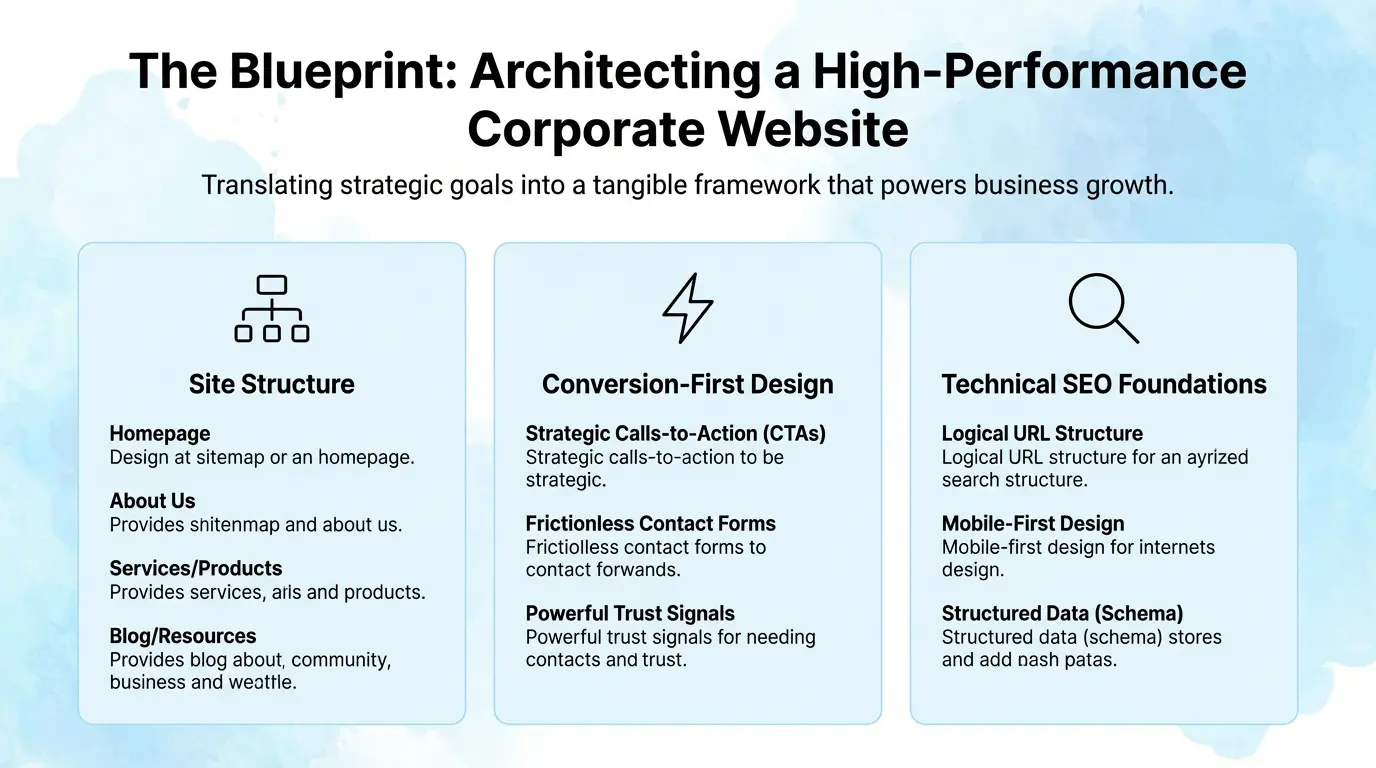
How a Website Project Runs, Week by Week
A ten to thirty page corporate site takes one to three weeks of build once the decisions are made, and the decisions take longer than the build. The rhythm below is what a well-run project looks like, and the parts that depend on you are marked.
- Kickoff and structure. The page list is agreed and signed. Your input required.
- Content plan. Every page gets an owner and a deadline. Your input required.
- Design of templates. Six or seven templates rather than 25 pages.
- Build. Templates become a working site, content goes in as it arrives.
- Integrations and tracking. Forms, CRM, analytics, consent.
- Review round. One consolidated list of changes, not five people emailing separately. Your input required.
- Pre-launch checks. Performance, accessibility, forms, redirects.
- Launch and handover. Training, documentation, access credentials.
The step that slips is almost always the content plan. If your team cannot commit to writing dates, buy the content from the supplier instead. A delay of three weeks on copy costs more than the copy would have.
What You Have to Prepare on Your Side
Suppliers ask for these in week one and get them in week five, which is where most of the calendar disappears. Preparing them before the project starts is the single cheapest way to pull a launch date forward, and none of it requires technical knowledge.
Access. Domain registrar login, current hosting, DNS control, and admin access to your analytics and any tools that will be connected. Finding out who holds the domain is a project in itself at some companies.
Decisions. Who approves design, who approves copy, and who breaks a tie. One name each. Committees are the reason projects take three months.
Content raw material. Existing case studies, client permission to name them, team photos, certifications, legal texts.
Constraints. Brand guidelines if they exist, mandatory legal wording, anything that cannot change for compliance reasons.
If the project also replaces an existing site, add the URL inventory to that list. Our guide to website migration explains what happens to your search traffic when addresses change and why the redirect map belongs in the contract.
How Much Corporate Website Development Costs
Price follows the page count, the number of templates and the integrations, in that order. Published prices give you an anchor to check quotes against, and a supplier who cannot explain a difference from those anchors is worth asking twice.
Our own pricing starts at €1,500 for a landing page delivered in two to three days, €4,500 for a corporate website of 10 to 30 pages delivered in one to three weeks, and €9,000 for a portal of 50 pages or more delivered in one to three months. Figures are current as of August 2026.
Three items sit outside most quotes and belong in your budget from the start. Content writing, if your team is not doing it. Photography, because stock images of anonymous people in meeting rooms are the cheapest way to look like everyone else. And the first year of maintenance, which covers updates, small changes and the security patches that keep the site online.
For the full breakdown of where the money goes, including what changes the number most, see our website cost breakdown.
Want a quote you can actually compare?
We scope corporate websites the way this guide describes: page list first, templates counted, content and integrations named, one price with no blank cells.
See our pricingWhere Website Projects Go Wrong
Five failures account for most unhappy projects, and four of them are decided before any code is written. Each one is visible early if you look for it, and each one is cheaper to prevent than to argue about at the end.
Scope written as adjectives. "A modern, professional site" is not a scope. Page counts, template counts and named integrations are.
No single approver. Every extra approver adds a review round, and review rounds are where timelines die.
Content assumed. The most common single cause of a late launch, and it is always discovered in week four.
The old site forgotten. If URLs change and nobody built a redirect map, the search traffic you already paid for disappears at launch. According to Google Search Central, a site move with URL changes needs its redirects kept for at least a year.
No plan for after. The supplier leaves, nobody owns the site, and in six months it describes a company that no longer exists. A maintenance arrangement with a named response time solves it and belongs in the original budget.
What to Ask a Vendor Before You Sign
Six questions, asked in writing to every supplier, turn a pile of proposals into a comparison. Ask all six even when you already like one supplier, because the answers tell you how they run projects rather than how they sell them.
- How many pages and how many templates are in this price, and what does a seventh template cost?
- Who writes the content, and how many revision rounds are included?
- Which integrations are in scope, named one by one?
- What targets do you commit to for page speed and accessibility, measured on real devices, and will the site meet WCAG 2.1 Level AA?
- What happens to our existing URLs, and will we get a redirect map before launch?
- Who supports the site after launch, at what price, with what response time?
An answer of "we handle all of that" to question three is the one to push on. Named integrations are a scope; a promise is not. If you want the document that makes proposals comparable in the first place, our guide to writing a design brief provides it.

How to Run Acceptance Before You Pay the Final Invoice
Acceptance is where a buyer has the most negotiating power and uses it least. The test is not whether the site looks like the designs; it is whether the things you will depend on for the next three years actually work. Run these checks yourself, on production, before the final payment leaves.
Submit every form and confirm it arrives in the inbox and in the CRM, including the confirmation email. Check the consent banner in all three states: accept, reject, withdraw. Confirm analytics records a visit and a goal. Load the homepage and one service page on a phone on mobile data, not office wifi. Run a public performance check and compare against the thresholds published on web.dev: 2.5 seconds for Largest Contentful Paint, 200 milliseconds for Interaction to Next Paint and 0.1 for Cumulative Layout Shift, all measured at the 75th percentile of real loads.
Then ask for the files: CMS credentials for two named people, the redirect map, the content source files and any design source files you paid for. Those are yours, and the moment to collect them is before the final invoice, not a year later when you change supplier.
Accessibility is now part of acceptance in Europe
Since 28 June 2025 the European Accessibility Act applies to the services it covers, and a site built after that date counts as new rather than legacy. If your business falls within scope, put WCAG 2.1 AA conformance and an accessibility statement in the acceptance criteria rather than in a later phase.
Corporate Website Development Checklist
Copy this into your project tracker and give every line an owner. It takes about an hour to fill in and it removes most of what suppliers usually have to guess.
Before you ask for quotes
- Page list agreed, with a rough word count per page.
- One named approver for design, one for copy.
- Domain, hosting and DNS access located.
- Integrations listed by name, not by category.
- Existing URLs exported if a site already exists.
In every quote
- Number of pages and number of templates.
- Content responsibility and revision rounds.
- Named integrations, CMS and training.
- Performance and accessibility targets.
- Redirect map, if URLs change.
- Support after launch with price and response time.
Before the final invoice
- Every form tested to inbox and CRM.
- Consent tested in accept, reject and withdraw states.
- Analytics recording visits and goals on production.
- Speed checked against the published thresholds on a real device.
- CMS access handed to two named people.
- Redirect map, content and design files delivered.
Planning a corporate website this quarter?
We take the project end to end: page list, templates, content, build, integrations and a monitored launch, with maintenance available afterwards.
Talk to usOn This Page
- What You Are Actually Buying When You Commission a Website
- Compare the Three Ways to Get a Website Built
- What a Quote Has to Contain Before You Can Compare It
- How a Website Project Runs, Week by Week
- What You Have to Prepare on Your Side
- How Much Corporate Website Development Costs
- Where Website Projects Go Wrong
- What to Ask a Vendor Before You Sign
- How to Run Acceptance Before You Pay the Final Invoice
- Corporate Website Development Checklist