

Working with professional web designers is a structured 4-to-12-week delivery process spanning discovery, information architecture, tokenized Figma design systems, Next.js frontend engineering, and cross-device QA testing, with 2026 European agency budgets ranging from €1,500 to €3,000 for conversion landing pages and €4,500 to €9,000 for multi-language corporate websites.
Selecting a design agency often feels difficult when every portfolio displays polished visuals without explaining the commercial outcome. Decision-makers rightly worry about spending thousands of euros on a decorative digital brochure that fails to convert qualified traffic. By understanding how UX/UI design connects with conversion engineering, milestone sign-off gates, and technical implementation, you can evaluate agency proposals objectively and manage your project from initial discovery through launch.
This guide breaks down the exact deliverables, client responsibilities, contract governance clauses, and sprint allocations required to turn your website budget into a predictable revenue channel.
Why This Guide Matters
According to research, 75% of users judge a company's credibility based on its website design. Choosing the wrong design partner can cost you thousands in lost revenue and missed opportunities. This guide ensures you make an informed decision.

What Modern Web Designers Actually Do
Modern web designers operate as commercial architects whose work is measured by conversion rates, pipeline velocity, and Core Web Vitals rather than subjective visual appeal alone. The discipline has expanded far beyond static graphic layouts, as this web design overview illustrates, integrating user research, information architecture, and component-level interaction systems to turn your site into a measurable revenue channel.
AI-assisted research and prototyping tools further accelerate this workflow. Contemporary product teams combine heatmaps, session recordings, and structured usability testing to validate layout hypotheses before writing a single line of production code. Every engagement is divided into three interdependent pillars that specialized UX/UI design teams execute in sequence.
User Experience (UX) Design: The Blueprint for Success
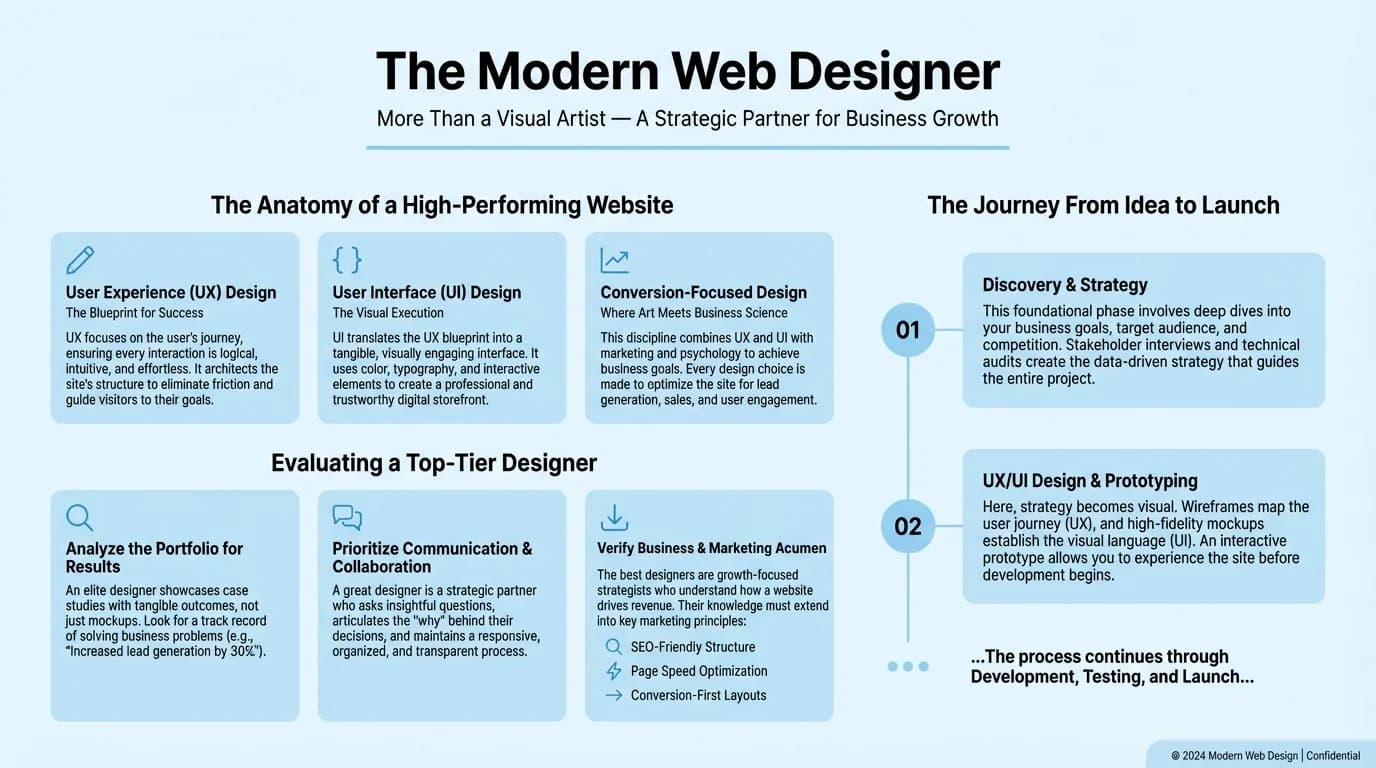
A high-performing website starts with rigorous UX architecture. UX specialists map every step of the buyer journey so that navigation, taxonomy, and page hierarchy feel logical and frictionless. Through stakeholder interviews, ideal customer profile (ICP) analysis, user flow mapping, and interactive wireframing, UX designers eliminate cognitive overload and guide visitors toward a clear conversion action. According to Nielsen Norman Group, usability is a foundational quality attribute that determines how quickly and accurately users accomplish their goals.
User Interface (UI) Design: The Visual Execution
While UX defines the structural blueprint, UI design translates wireframes into a cohesive visual system. UI designers establish tokenized Figma component libraries covering color contrast ratios, fluid typographic scales, 8-pixel spacing grids, and interactive states for buttons, forms, and navigation menus. Every visual token is engineered to meet WCAG 2.2 Level AA accessibility requirements while reinforcing brand authority across desktop, tablet, and mobile viewports.
The Conversion-Focused Web Designers: Where Art Meets Science
Conversion-focused web designers merge UX structure and UI craft with behavioral psychology and B2B buyer enablement. They position call-to-action hierarchies, quantified social proof, pricing tables, and lead capture forms where high-intent visitors make decisions. Whether building standalone campaign pages or multi-language corporate websites, conversion-first design ties every layout decision directly to qualified pipeline generation and lower customer acquisition costs.
The Conversion Advantage
Businesses that invest in conversion-focused web design see an average 200% increase in lead generation compared to sites built purely for aesthetics. The difference lies in strategic placement of CTAs, trust signals, and user flow optimization.

Essential Skills to Look For in Web Designers
Selecting the right web designers is a commercial procurement decision that directly affects customer acquisition cost and brand trust. A visually impressive site that loads slowly or obscures the primary call to action wastes both media spend and sales opportunities. Evaluating a design partner requires inspecting their measurable business outcomes, communication governance, and technical fluency.
Analyzing the Portfolio: Look for Results, Not Just Visuals
When reviewing agency work, look past static Dribbble shots and ask for documented case studies with before-and-after metrics. Strong partners demonstrate how they solved concrete commercial problems, such as lifting demo request conversion rates by 35%, reducing bounce rates on mobile, or restructuring complex B2B product catalogs. Check live URLs from their portfolio on a physical smartphone to test real-world responsiveness, interaction speed, form validation clarity, and visual hierarchy across viewports.
Communication and Collaboration Skills
Technical talent fails when project governance is disorganized. Experienced web designers run structured discovery workshops, challenge vague assumptions, and document every design rationale against your commercial KPIs. They establish a predictable weekly cadence with async Loom walkthroughs, shared Figma workspaces, and written milestone sign-off criteria so your internal stakeholders always know what is being built and what feedback is required.
Understanding of Business Goals and Marketing
High-performing web designers think like growth strategists who treat the website as your primary acquisition engine. Their day-to-day methodology must integrate three technical and marketing fundamentals:
- SEO & Information Architecture: Structuring semantic HTML headings, clean URL slugs, schema.org JSON-LD entities, and internal linking hierarchies so search engines and AI answer engines index every service page accurately.
- Page Speed & Core Web Vitals: Designing lightweight asset pipelines, modern WebP/AVIF imagery, and zero-layout-shift skeletons that pass Google web.dev performance thresholds (
LCP < 1.8s,INP < 120ms,CLS < 0.05). - Conversion-First Architecture: Engineering frictionless multi-step forms, trust badges, and clear value propositions aligned with NN/g web design standards from the earliest wireframe to production launch.
Requesting a technical architecture walkthrough during the agency pitch reveals whether candidates build these standards into their base scope or treat performance and SEO as paid afterthoughts.
The Web Design Process: From Idea to Launch
A high-converting website is the outcome of a disciplined engineering and design workflow with explicit milestone sign-off gates. Professional web designers divide delivery into four weighted phases so budgets stay predictable, stakeholder feedback remains consolidated, and scope creep is prevented before code is written.
Phase 1: Discovery, ICP Alignment & Sitemap/IA (20% of Timeline)
The initial phase establishes the commercial and structural blueprint across one to two weeks. The agency conducts stakeholder interviews, audits analytics and competitor positioning, defines ideal customer profile (ICP) objections, and maps the complete XML and visual sitemap. Key deliverables include the information architecture diagram, URL slug taxonomy, SEO keyword mapping, and technical integration specification. Client sign-off gate: formal approval of the sitemap and page-type inventory before any wireframes begin.
Phase 2: UX Wireframing, Copywriting & Tokenized Figma Design System (30% of Timeline)
Over two to four weeks, strategy becomes interactive structure. Designers build low-fidelity UX wireframes paired with actual conversion copywriting rather than placeholder Lorem Ipsum text. Once page hierarchy and messaging are validated, UI specialists construct a tokenized Figma design system with responsive breakpoints for desktop (1440px), tablet (768px), and mobile (375px). You review a clickable Figma prototype through our UX/UI design service. Client sign-off gate: written design freeze sign-off after two structured feedback rounds.
Phase 3: Frontend Development, Headless CMS Integration & CRM/GA4 Wiring (35% of Timeline)
Representing the largest share of effort (three to six weeks), engineers translate frozen Figma components into production TypeScript and Next.js code through custom web development. The team configures custom content models in a headless CMS, wires bidirectional webhooks to HubSpot or Salesforce, and implements GDPR-compliant GA4 Consent Mode v2 event tracking. When projects require authenticated dashboards or role-based workflows, this phase expands into custom web application development. Client sign-off gate: content population completion and staging environment functional verification.
Phase 4: Cross-Device QA, WCAG 2.2 AA Audit, 301 Redirects & Go-Live (15% of Timeline)
During the final one to two weeks, QA engineers test layouts across physical iOS, Android, macOS, and Windows devices. The team runs automated and manual WCAG 2.2 Level AA accessibility checks (verifying 4.5:1 color contrast, keyboard focus rings, and ARIA labels), validates the 1:1 HTTP 301 redirect map to protect organic rankings, and executes zero-downtime DNS cutover alongside recorded CMS editorial training.
Typical effort and schedule distribution across a 6-to-12-week custom B2B website project, showing why engineering and UX prototyping represent 65% of total delivery. Source: Vezert 2026 Agency Delivery & Sprint Allocation Benchmarks.
Web Designers vs. Web Developers: Key Differences
One of the most frequent procurement mistakes B2B companies make is confusing the responsibilities of web designers and web developers. Understanding how these two disciplines divide ownership and where their workflows intersect helps you hire the right team structure and avoid handover bottlenecks during production.
Web designers own the commercial user journey, information architecture, visual hierarchy, and tokenized Figma component library. They define how a prospect perceives your brand, navigates complex service offerings, and completes a lead form. Web developers own the technical runtime: translating those Figma tokens into semantic HTML, modular TypeScript and Next.js components, headless CMS schemas, server-side API integrations, and automated security policies.
When you hire an isolated freelance designer and a separate freelance developer, friction often appears at the handover boundary. Designs may rely on animations that degrade mobile Interaction to Next Paint (INP), or developers may approximate spacing and typography without matching the Figma specification. In an integrated agency workflow, designers and engineers review wireframes together during Phase 2 so every component is architected for sub-2.0-second load speed and clean CMS editing before code begins.
| Delivery Dimension | Professional Web Designers | Frontend & Full-Stack Developers |
|---|---|---|
| Primary Responsibility | Information architecture, UX wireframes, UI tokens, conversion hierarchy | Next.js/TypeScript code, headless CMS schema, API integrations, Core Web Vitals |
| Core Tooling | Figma, FigJam, Maze usability testing, Hotjar/Clarity heatmaps | React, Next.js, Tailwind CSS, Sanity/Payload CMS, Git, Vercel CI/CD |
| Key Deliverables | Sitemap, clickable Figma prototype, tokenized design system, WCAG contrast specs | Production repository, webhook middleware, 301 redirect map, automated QA suite |
| Commercial KPI Impact | Time on page, scroll depth, form completion rate, buyer trust | Largest Contentful Paint (< 1.8s), Interaction to Next Paint (< 120ms), uptime |
Evaluating both roles through this matrix clarifies why mid-market and enterprise redesigns require shared technical governance rather than disconnected handoffs.
Common Mistake
Many business owners hire backend developers expecting UX design expertise, or hire graphic designers expecting production Next.js engineering. For predictable commercial results, partner with an integrated team offering both UX/UI design and custom web development under one roof.

How to Maximize Your Investment With Web Designers
A high-converting website is co-created through disciplined collaboration and clear contract governance. When client teams prepare structured inputs, designate a single decision-maker, and establish transparent contractual guardrails, projects finish on schedule and avoid expensive mid-sprint rework.
Provide a Clear Brief and Realistic European Budget
The precision of your initial brief directly determines the accuracy of agency proposals. Before requesting quotes, document your primary conversion KPIs, target buyer personas, required CRM or ERP integrations, and content delivery dates. Align your internal stakeholders around realistic 2026 European agency pricing bands:
- Conversion Landing Page (€1,500 to €3,000): Custom UX/UI, persuasive copy hierarchy, fast Next.js frontend, and CRM form webhook integration delivered in 2 to 4 weeks.
- Custom Corporate Website (€4,500 to €9,000): Multi-page B2B architecture, tokenized Figma design system, headless CMS, multi-language localization, and technical SEO setup delivered in 6 to 10 weeks.
- B2B Web Portal or Custom Platform (€9,000 to €25,000+): Authenticated user roles, custom database schemas, ERP/API middleware, and interactive dashboards.
Establish Contract Governance, IP Ownership, and Revision Guardrails
Before signing a statement of work, verify three contractual protections. First, ensure 100% intellectual property transfer: upon final payment, your company must own the complete Figma source files, custom design tokens, and the production Git code repository with zero proprietary agency lock-in. Second, lock in revision round guardrails, typically two consolidated feedback rounds per milestone phase, so uncoordinated requests do not trigger hourly change orders. Third, define post-launch SLA handover terms, including a 30-day bug-fix warranty, editorial team CMS training, and optional ongoing maintenance at 15% to 20% of the initial build budget per year.
Deliver Consolidated, Goal-Oriented Feedback
Subjective, fragmented feedback is the primary cause of timeline delays. Appoint a single authorized project owner on your side to gather internal comments, resolve contradictions, and submit one unified feedback document per milestone within 48 hours. Frame every revision around user behavior, ICP objections, and conversion goals rather than personal aesthetic preference. Preparing brand guidelines, customer testimonials, product screenshots, and legal privacy texts during Phase 1 also prevents content bottlenecks during staging verification. Ready to collaborate with a team built around transparent milestones? Let's talk.
Pro Tip for Working With Web Designers
The most successful web design projects share one trait: a single authorised decision-maker on the client side. Committee-driven design often leads to diluted results and extended timelines. Appoint one person to consolidate feedback and make final decisions.
Partner With Web Designers Who Drive Growth
Selecting your web designers is one of the highest-return commercial investments your company will make in 2026. When discovery, UX architecture, tokenized UI systems, and Next.js engineering operate as one unified process, your website transforms from a static cost center into a predictable lead-generation asset.
At Vezert, our Conversion-First Design Process and AI-Accelerated Engineering give B2B and growth-focused companies complete transparency from day one. Whether you are launching high-velocity campaign pages, scalable multi-language corporate websites, or enterprise web portals, every milestone is backed by measurable performance targets and full code ownership.
For a deeper breakdown of design deliverables, component token libraries, and sprint pricing, explore our complete guide to UI/UX design services. Start Your Project With a Conversion-First Design Team and turn your next website launch into a lasting commercial advantage.
Ready to Work With Expert Web Designers?
Partner with Vezert for a conversion-focused website that drives real business growth. Our design team combines strategic UX/UI expertise with AI-powered development.
Start Your Project