

On This Page
- Why Most Web Design Trends Fail to Deliver
- Trend 1: Efficiency-First Design
- Trend 2: Realism Over Decorative Design
- Trend 3: AI-Native Design and Development
- Trend 4: Clarity-Driven UX
- Trend 5: Performance-First Design
- Trend 6: Design Systems and Component Architecture
- Trend 7: Purposeful Micro-Interactions and Motion
- Trend 8: Accessibility as a Standard
- Trend 9: Bold Typography and Variable Fonts
- Trend 10: Dark Mode and Adaptive Color Schemes
- Trend 11: Data-Driven Personalization
- Trend 12: Sustainable and Lightweight Web Design
- Web Design Trends 2026: Comparison Table
- How These Trends Influence Conversion Optimization
- Practical Checklist: Which 2026 Trends Matter for Your Site
- Conclusion: Web Design Trends 2026
Browse any "web design trends 2026" roundup and you will see the same thing: experimental layouts nobody will ship, maximalist palettes that would give a brand manager a headache, and AI-generated imagery that looks great until you try to build it. These ideas get likes on Dribbble. They do not get results in production.
The trends that actually matter tend to be the boring ones. They shorten timelines. They make more people click the button. They make your site cheaper to maintain a year from now.
We put together 12 website design trends for 2026 that hold up in real projects, not just mood boards. You will find everything from AI-native workflows to accessibility compliance, from performance budgets to purposeful motion. Each trend is evaluated against a simple question: does it help users get things done, and does it make website development more effective? If you are building or redesigning a site this year, this is the only trends list you need.
Why Most Web Design Trends Fail to Deliver
Here is the pattern we keep seeing: a design team picks up a trend from a conference talk or a competitor's site. They ship it. Traffic does not change. Conversions do not change. Six months later, someone has to rip it out because it slowed down the page or confused users.
Trends fail when they are about appearance, not function. Research from Baymard Institute keeps confirming the same thing: simpler interfaces beat cluttered ones in both task completion and conversions. Heavy animations and parallax effects look impressive in a demo but tend to tank Core Web Vitals, the signals Google actually uses for ranking.
Bad UX kills SEO, conversions, and trust all at once. No amount of visual polish fixes confusing navigation or a 5-second load time.
That context filters every trend in this article. If a web design trend does not improve usability or support conversion optimization, we left it out.
Trend 1: Efficiency-First Design
The fastest growing demand we see from clients is not about how the site looks. It is about how quickly and predictably it can be built.
Efficient teams rely on shared design systems, tight handoffs between designers and engineers, and component libraries that produce consistent results without reinventing the wheel each time. When a project uses defined standards and automated testing, the development timeline stops being a guessing game.
The less obvious part: efficiency also comes from saying no early. Simple page structures mean fewer future redesigns. Clear layouts leave less room for misinterpretation during development, which means fewer revisions and a tighter project budget.
Where to Start
- Find the steps repeated manually on every project and automate or templatize them
- Move to a component-first approach where UI elements are built once and reused
Building efficiency into the process pays off on every project after the first one. It is a boring trend. It also works.
Trend 2: Realism Over Decorative Design
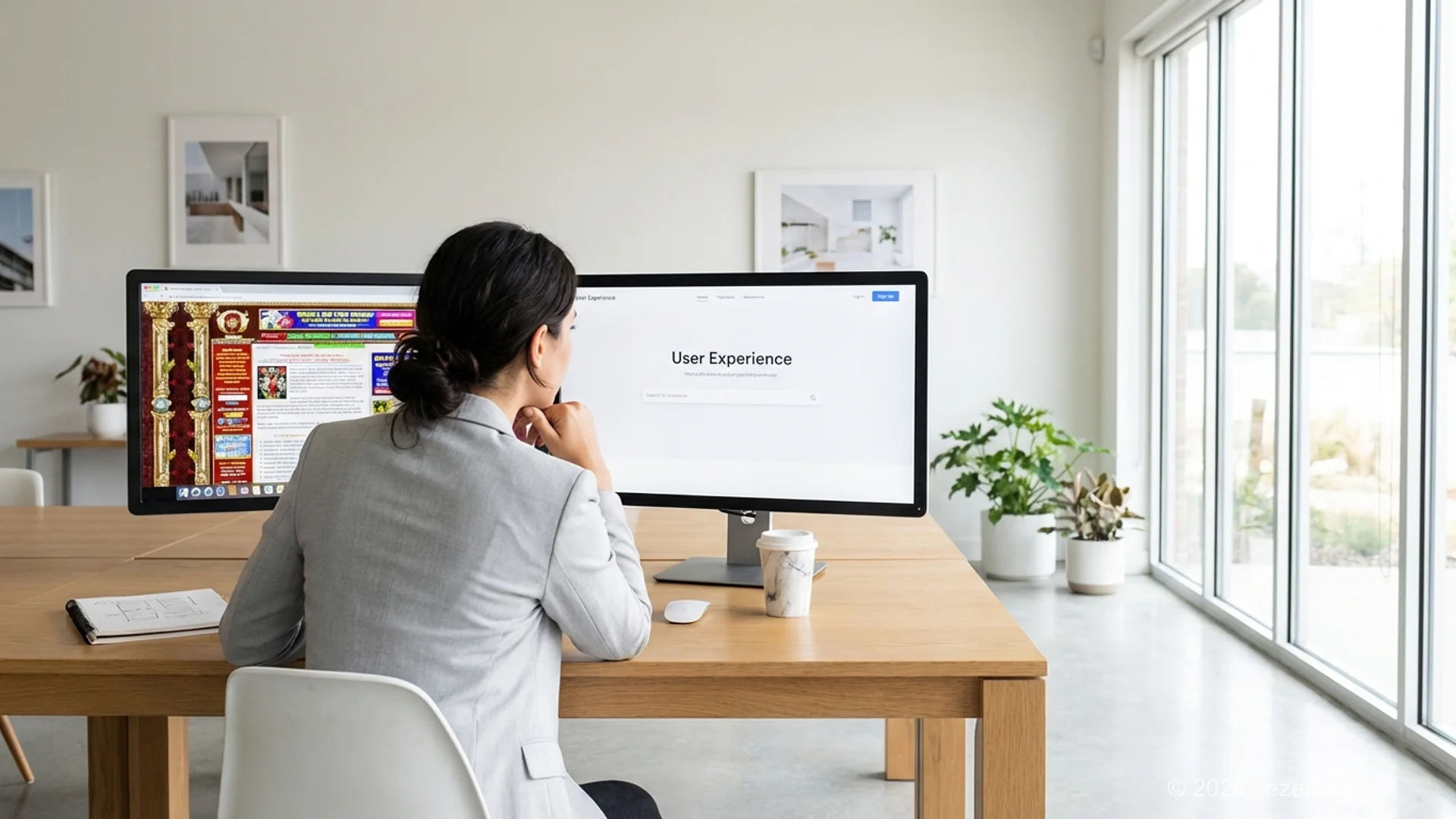
We have watched the pendulum swing. A few years ago, everything was gradients and 3D illustrations. Now the sites that convert best are the ones that just tell you what the product does.
That is what realism means here: specific promises instead of vague marketing language, minimal visual noise so content can actually do its job, and layouts that guide your eye to the information you came for.
Users notice when a site oversells. Over-designed interfaces raise more questions than they answer. Real product screenshots beat polished mockups. Actual customer data lands harder than hypothetical scenarios. According to Google's page experience research, trust is measurable, and it directly affects whether people convert.
This shift touches everything from hero sections to landing page design.
What This Looks Like in Practice
- Swap stock photos for authentic product visuals or real team photography
- Write headlines about specific outcomes rather than aspirational promises
- Cut any animation or effect that does not serve a clear functional purpose
That pendulum has already swung twice. Skeuomorphism sold digital buttons as physical objects until the metaphor stopped teaching anyone anything new. Flat design stripped the shadows back out, then discovered that users could no longer tell what was clickable. Both corrections kept the part that carried information and dropped the part that was decoration, which is the same test this trend applies today.
Honest interfaces earn trust faster. That is the whole trend.
Trend 3: AI-Native Design and Development
AI is not a plugin you add at the end anymore. In 2026, the teams shipping fastest have AI woven into every stage of the workflow. AI-first web development means using it during research, prototyping, coding, testing, and content creation.
In practice, this looks like: AI analyzing design patterns and catching usability problems before anything ships. AI generating first drafts for content, running layout comparisons, suggesting copy improvements, and flagging accessibility issues. On the engineering side, AI-augmented development speeds up component scaffolding, code review, and test coverage.
We have seen this firsthand at Vezert. Teams that bake AI into their pipeline through our AI-first studio approach ship meaningfully faster without cutting corners on quality.
The important part: AI supports decisions. It does not make them. Design choices still require context and judgment that tools cannot replicate. The team owns the quality, not the model.
How to Apply This Trend
- Use AI in your design review process for consistency and pattern checks
- Generate first-draft content with AI, then edit with human judgment
- Run AI-powered accessibility and performance testing on every build
- Importantly: document what works. AI workflows compound because each project inherits the patterns from the last one.
AI is the web design trend with the highest compounding returns in 2026. Teams that integrate it now will ship 2-3x faster within a year, not by replacing people, but by eliminating the repetitive work in design, coding, and QA.
Trend 4: Clarity-Driven UX
Digital products keep getting more complex. Users have not gotten more patient. They expect interfaces that tell them what to do next without making them think about it.
This is about structure: a logical information hierarchy that matches how people actually make decisions, and predictable interface behavior that does not require a learning curve. NNGroup's research on visual hierarchy shows that layout structure directly controls how users read, scan, and decide.
Most UX mistakes that hurt conversions, buried CTAs, competing visual elements, confusing navigation, trace back to one root cause: lack of clarity. Fix that, and conversion numbers tend to move immediately. No redesign needed.
Good website navigation is a perfect example: visible labels, logical grouping, predictable behavior. Nothing flashy. It just works.
Quick Wins
- Map your most important user flows and count the steps. Then cut some.
- Test your navigation labels with real people, not assumptions from a whiteboard
- Make sure every page has one primary action that is visually obvious
When structure is clear, people move forward without overthinking it. Conversions follow.
Trend 5: Performance-First Design
Every visual choice has a performance cost. Every custom font, every animation, every hero image at 4000px wide. And that cost directly affects Core Web Vitals, your search rankings, and whether people stick around.
Sites that load under two seconds convert significantly better than slower ones. Google's own data says a one-second delay on mobile can cut conversions by 20%. That is not a rounding error.
The shift we are seeing: design teams set performance budgets before they start designing. Maximum page weight, image count, script size, all defined upfront. The question changes from "what looks best" to "what delivers the best experience we can serve fast."
Lightweight CSS, WebP/AVIF images, efficient variable fonts: these are design decisions now, not engineering cleanup. Building a high-performance website means treating speed as a feature.
Where to Start
- Set a performance budget before opening Figma (under 200KB for critical resources is a good target)
- Default to modern image formats and keep hero images under 1200px wide
- Test with Lighthouse after every major design change, not just before launch
Trend 6: Design Systems and Component Architecture
This one is not new, but it has hit a tipping point. Most serious web teams in 2026 are not designing individual pages anymore. They are building component libraries.
A design system defines spacing, typography, colors, and interaction patterns as tokens, shared values that stay the same across every page. This kills visual drift, cuts QA time, and makes it possible to plan a website structure that actually scales.
For businesses, the math is simple: new pages get assembled from existing components instead of built from scratch. Updates propagate everywhere instantly. A well-planned architecture on top of a design system is easier to maintain and performs better in search.
The catch is the upfront investment. Building a design system takes time. But the payoff starts on the second page and compounds from there.
How to Apply This Trend
- Start small: define tokens for colors, spacing, and type hierarchy before anything else
- Build 10-15 core components that cover ~80% of your page layouts
- Document it properly so anyone on the team can build new pages without guessing
Scalability stops being a problem when the system does the heavy lifting, and that is the difference between adding a page type and paying for a website migration two years later.
These 12 trends have one thing in common: they trade short-term visual wow for long-term business value. Efficiency, clarity, performance, and accessibility are not limits on creativity. They are what makes good design last.
Trend 7: Purposeful Micro-Interactions and Motion
Animation on the web has gone through an identity crisis. For a while, everything moved. Parallax scroll effects, bouncing icons, animated backgrounds. Most of it slowed pages down without helping anyone.
The 2026 version of this trend is more disciplined. Motion is feedback now: a button confirms your click, a skeleton loader shows something is happening, a transition orients you when the page changes. Every animation has a job. If it does not improve understanding or provide feedback, it goes.
The technical side matters too. CSS animations are lighter than JavaScript libraries on both CPU and battery. Respecting prefers-reduced-motion is not optional for accessibility. And 200-300ms is the sweet spot for animations that feel responsive without creating lag.
The Rule of Thumb
Go through your existing animations. If you cannot explain what a specific animation communicates to the user, remove it. Use motion for state changes, loading states, and hover feedback. Keep durations under 300ms. And always honor prefers-reduced-motion.
Trend 8: Accessibility as a Standard
This stopped being a "nice to have" a while ago. In many jurisdictions, it is a legal requirement. Our accessibility compliance guide for 2026 breaks down the specifics, but the headline: WCAG 2.2 AA is the expected baseline now.
The part people miss is that accessible design makes everything better for everyone. Proper color contrast means text is readable in sunlight, not just for screen readers. Keyboard navigation helps power users who prefer not to touch a mouse. Clear focus states help anyone keep track of where they are on a page.
Companies that build accessibility into their design process from the start spend far less than the ones trying to retrofit it after complaints roll in. W3C's WCAG guidelines give you the technical spec. The principle is simpler: build for the widest audience and the whole audience benefits.
Where to Start
- Run axe or Lighthouse accessibility audits on every build, not just at the end
- Add keyboard and screen reader testing to your QA routine
- Pick color palettes that meet AA contrast ratios before you finalize any design
Trend 9: Bold Typography and Variable Fonts
The landing page examples that convert rely on type to do the heavy lifting. Big headings, clear hierarchy, generous white space. No decorative graphics needed when the typography is confident enough.
Variable fonts are a big part of why this works. A single variable font file contains multiple weights, widths, and styles, replacing four to six separate font files. Fewer HTTP requests, smaller payload, faster loads, better Core Web Vitals scores. The performance argument alone makes the switch worthwhile.
This trend works especially well for corporate websites and startup sites where brand personality needs to come through in the text itself.
How to Apply This Trend
- Switch your primary typeface to a variable font and measure the payload difference
- Limit your type scale to four or five sizes, max. Fewer sizes means clearer hierarchy.
- Let font weight and size do the structural work. If you are reaching for a colored box or an icon to show importance, your typography is not doing its job.
Trend 10: Dark Mode and Adaptive Color Schemes
Every major OS, browser, and app supports dark mode now. Users have come to expect websites to respect their system preference. If yours does not, it feels a little behind.
Implementation is simpler than it sounds, especially with a design system. Use semantic color tokens (--background, --text-primary) instead of hardcoded hex values, and the prefers-color-scheme CSS media query handles the rest. Maintaining two color schemes becomes almost as easy as maintaining one.
Dark mode cuts eye strain at night, uses less battery on OLED screens, and gives sites a polished feel. It also sends a quiet signal that someone is paying attention to the details.
How to Apply This Trend
Set up a semantic color palette with light and dark variants before you write any component styles. Test every UI component in both modes for readability and contrast. Use prefers-color-scheme so the site automatically matches what the user has set. If you already have a design system with tokens, this is a weekend project. If you do not, it is a reason to build one.
You do not need all 12 trends at once. If your site loads in 5 seconds, fix performance before you think about dark mode. Start with whatever is losing you the most users right now.
Trend 11: Data-Driven Personalization
The static website that shows the same thing to every visitor is starting to feel dated. Personalization in 2026 is practical and privacy-conscious: adjusting content and CTAs based on what you can observe, not invasive tracking.
Simple examples that work: different hero messaging for returning visitors versus new ones. Surfacing relevant case studies based on what someone browsed before. Shortening a form for users who have already filled one out. Conversion optimization is increasingly about testing these variations systematically instead of guessing.
The caveat: personalization without measurement is just guesswork with extra engineering. You need UX metrics that track real behavior, task completion rate, time on task, error rate, to know if your personalization is actually working.
Where to Start
- Run A/B tests on your highest-traffic pages before building anything complex
- Personalize CTAs based on traffic source or visit frequency
- Track behavior metrics, not just page views, so you can tell what is actually improving
Trend 12: Sustainable and Lightweight Web Design
The average web page now weighs over 2MB according to the HTTP Archive. That is a lot of bandwidth for what is often a marketing page with five sections and a contact form.
Lightweight design asks harder questions about every asset: does this image need to be this large? Is this JavaScript library necessary? Can this interaction work without a third-party script? The answers usually point to something smaller, faster, and cheaper to serve.
Lighter sites load quicker, cost less to host, work better on slow connections, and are easier to maintain over time. This is not about sacrifice. It is about being intentional with what goes on the page. Every kilobyte you cut is a real, measurable improvement for users on any device.
How to Apply This Trend
- Check your total page weight and set a reduction target (under 1MB is a reasonable goal)
- Replace heavy JS libraries with native browser APIs where you can
- Be aggressive with image optimization: right format, right size, proper compression
Web Design Trends 2026: Comparison Table
Here is how all 12 trends stack up against each other. Use this to decide where to invest first.
How These Trends Influence Conversion Optimization
All 12 trends point in the same direction: removing the gap between what a user wants to do and actually doing it.
Some of them work directly. Clarity-driven UX, performance optimization, and realism remove barriers at the point where someone decides to act. People who understand the offer, trust the interface, and do not wait for the page to load are far more likely to convert.
Others work indirectly. Design systems, AI workflows, and efficiency-first processes make it easier to iterate after launch. When post-launch optimization is part of how you work rather than an afterthought, improvements stack up.
No site needs all 12 trends at the same strength. The better move is figuring out where your biggest losses are and fixing those first. A website audit is the fastest way to find out where users give up and which trends would make the biggest difference.
Design That Drives Measurable Results
Get a website built on the web design trends that actually work in 2026, with efficiency, performance, and structure that move the numbers.
Start Your ProjectPractical Checklist: Which 2026 Trends Matter for Your Site
Not every trend belongs on every project. Run through these questions to figure out where your site has the most room to improve.
Performance and Speed
- Does your site load in under 2 seconds on mobile?
- Are you using WebP/AVIF images and lazy loading?
- Do your Core Web Vitals pass Google's thresholds?
If you answered no to any of these, performance-first design and sustainable practices should be at the top of the list.
User Experience and Clarity
- Can a first-time visitor reach their goal in three clicks or fewer?
- Is your navigation usable without tooltips or instructions?
- Does every page have one obvious primary CTA?
Clarity-driven UX and realism close these gaps.
Design Consistency
- Do you have a documented design system or component library?
- Can you add new pages without a designer building them from scratch?
- Is your website structure easy to extend?
Design systems and an efficiency-first approach solve consistency problems before they multiply.
Accessibility
- Does your site meet WCAG 2.2 AA?
- Is every interactive element keyboard-accessible?
- Do you test with actual assistive technologies?
Accessibility as a standard fixes these while improving the experience for everyone.
AI and Workflow Efficiency
- Are you using AI to speed up any part of design or development?
- Is your delivery timeline getting more predictable over time?
- Can you iterate quickly after launch?
AI-native workflows and efficiency-first processes make teams faster without adding headcount.
Prioritize the category where you scored worst. Trends that address problems you do not actually have can wait.
Ready to Apply the Right Web Design Trends for 2026?
We will help you figure out which trends matter most for your business and build a site that actually delivers.
Get a Free ConsultationConclusion: Web Design Trends 2026
Twelve trends, one takeaway: the web design trends 2026 that last are the ones tied to what users and businesses actually need. Efficiency, AI-native workflows, accessibility, performance, typography, design systems. None of these are flashy. All of them work.
You do not have to adopt everything at once. Start with a website audit to find your biggest gaps. Pick 3-4 trends that address those gaps. Ship, measure, iterate.
Choosing the right web design agency matters here. The good ones do not chase every trend. They figure out which ones solve your specific problems and apply them with discipline. That is how we work at Vezert, and it is the difference between following trends and using them to get results.
On This Page
- Why Most Web Design Trends Fail to Deliver
- Trend 1: Efficiency-First Design
- Trend 2: Realism Over Decorative Design
- Trend 3: AI-Native Design and Development
- Trend 4: Clarity-Driven UX
- Trend 5: Performance-First Design
- Trend 6: Design Systems and Component Architecture
- Trend 7: Purposeful Micro-Interactions and Motion
- Trend 8: Accessibility as a Standard
- Trend 9: Bold Typography and Variable Fonts
- Trend 10: Dark Mode and Adaptive Color Schemes
- Trend 11: Data-Driven Personalization
- Trend 12: Sustainable and Lightweight Web Design
- Web Design Trends 2026: Comparison Table
- How These Trends Influence Conversion Optimization
- Practical Checklist: Which 2026 Trends Matter for Your Site
- Conclusion: Web Design Trends 2026