
On This Page
- What Is a Customer Portal — And Why Does Your Business Need One?
- What Features Does a High-Impact Customer Portal Need?
- How Does the Customer Portal Development Process Work?
- Custom Development vs. Off-the-Shelf Software: Which Is Right for You?
- Why Partner with Vezert for Your Portal Development?
- The Strategic Imperative: Your Next-Generation Customer Portal
A customer portal is a secure, authenticated digital workspace that gives your clients on-demand access to their account data, support resources, invoices, and communication tools — all without involving your support team. According to Salesforce's State of the Connected Customer report, 61% of customers now prefer to resolve issues themselves via self-service rather than contacting a live agent. Yet most businesses still rely on email threads and manual back-and-forth.
Do you have a support team that is lost in an ocean of monotonous tickets? Do customers walk away because of long response times and disconnected digital experiences? In today's on-demand economy, these operational drags are more than an inconvenience — they are a direct threat to your growth. Optimal customer portal development is the key to turning customer service from a costly liability into a powerful engine for loyalty and efficiency.
This strategic guide is your roadmap for 2026 and beyond. We will show you precisely how to build a modern, AI-driven self-service hub that empowers your customers with 24/7 access and a truly seamless experience — and how to choose the right build path for your business.
Key Takeaways
- A modern customer portal is a strategic asset that empowers users with self-service, directly reducing your support overhead and increasing customer retention.
- Discover the essential AI-driven features, from personalized dashboards to predictive support, that transform a basic portal into a high-impact user experience.
- A structured customer portal development process ensures your project aligns with key business goals, moving from initial strategy to a successful launch without costly missteps.
- Learn how to decide between off-the-shelf software and a custom solution to ensure your portal delivers a unique brand experience and scales with your future growth.
What Is a Customer Portal — And Why Does Your Business Need One?
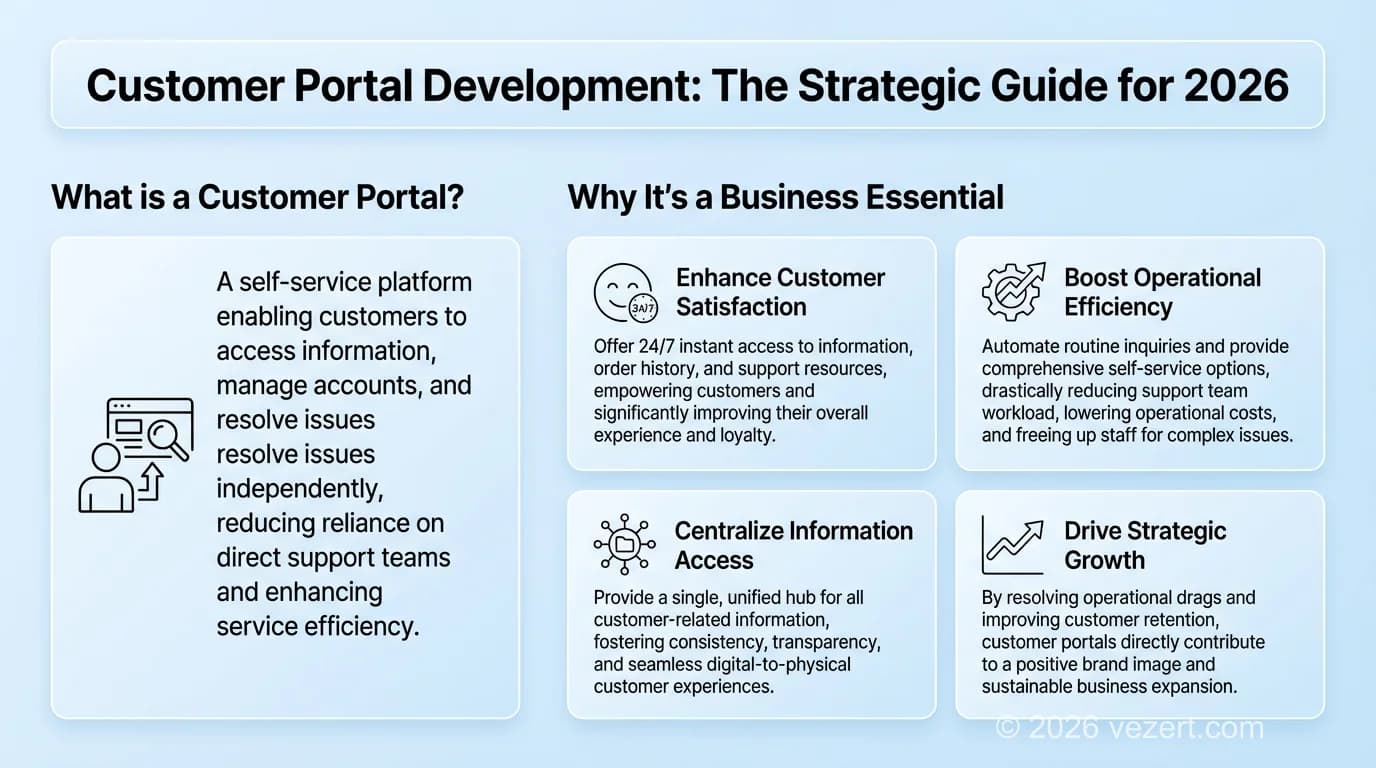
A customer portal is much more than a mere login page; it is a secure and integrated digital gateway which offers your clients direct access to their data, support resources, and account management. Its primary goal is to empower users with on-demand, self-service capabilities, transforming the customer relationship from reactive to proactive. While the foundational answer to "what is a customer portal" points to a simple information gateway, today's portals are dynamic experience hubs designed to build long-term loyalty, not just close support tickets.
Effective customer portal development moves beyond static information and creates a centralized, high-value ecosystem for your users. It's the digital handshake that reinforces your brand promise 24/7.
The Evolution: From Simple FAQ to AI-Powered Command Center
The customer portal experience reflects the development of digital expectations. Early portals were ordinary pages with basic ticket forms and knowledge bases. Today, they are interactive hubs featuring personalized dashboards, real-time order tracking, and integrated communication tools. The future is even more intelligent: AI-driven portals will proactively suggest solutions, predict user needs, and deliver data-backed insights directly to the customer, turning a support tool into a strategic business asset.
Core Business Benefits of a Modern Customer Portal
Investing in a custom portal delivers measurable, high-impact results that directly affect your bottom line and brand perception. According to Gartner, companies that invest in self-service portals reduce their customer service costs by up to 25% on average. It's a conversion-first strategy focused on customer retention and operational efficiency.
- Drastically Reduce Costs: By enabling self-service for common queries like order status or invoice retrieval, you slash support ticket volume and lower operational overhead.
- Increase Customer Satisfaction: Instant access to information and tools improves CSAT and NPS scores by giving customers the autonomy and speed they expect.
- Boost Customer Retention: A seamless, valuable, and personalized portal experience becomes a competitive differentiator that keeps customers loyal.
- Create New Revenue Opportunities: Leverage user data to offer personalized recommendations, creating organic opportunities for upselling and cross-selling within the portal.
Key Use Cases: B2B vs. B2C Portals
Strategic customer portal development recognizes that different business models require different features. The architecture must be tailored to the specific needs of the end-user to be effective.
- B2C (Business-to-Consumer): Focus is on a clean UX for high-volume activities like personal account management, order tracking, loyalty programs, and community engagement.
- B2B (Business-to-Business): Emphasizes complex functionality such as bulk order management, detailed invoicing, tiered pricing, and role-based access for different team members within a client's organization. According to Forrester Research, 72% of B2B buyers expect a self-service portal to be available by the second year of engagement with a vendor.
- SaaS (Software-as-a-Service): Provides critical access to subscription details, usage data, API documentation, and in-app support resources.
For businesses in the ecommerce space, our Ecommerce Portal: The Complete Guide to Building a High-Growth Platform explores the platform architecture in detail.
Self-Service by the Numbers
According to Salesforce, 61% of customers prefer to resolve issues via self-service. Gartner reports companies with mature self-service portals reduce support costs by up to 25%. A well-built customer portal pays for itself within the first year of operation.

What Features Does a High-Impact Customer Portal Need?
A customer portal cannot be simply a list of functions, but a carefully crafted online experience that is effectively designed to be efficient. Effective customer portal development focuses on a strategic feature set that aligns with your business objectives and streamlines the entire user journey. While the perfect combination depends on your unique goals, a high-impact portal is built on three core pillars of functionality.
Foundational Self-Service & Account Management
These are the non-negotiable elements that empower users and reduce your operational load. They constitute the foundation of user freedom — providing instant access to essential information and care without requiring your team to be involved.
- Secure Login & Profile Management: Effortless and secure access with options like Single Sign-On (SSO), coupled with simple tools for users to manage their own contact details and preferences.
- Centralized Knowledge Base: An intelligent, searchable repository of articles, FAQs, and guides that provides 24/7 answers, deflecting common support queries.
- Support Ticketing System: A transparent system for submitting, tracking, and reviewing support requests, eliminating email clutter and providing a clear audit trail.
Engagement & Communication Tools
Your portal should not be a mere place of activity, but an interactive one. These tools convert a passive resource into a proactive communication medium, ensuring better customer relationships and data to optimize from.
- Secure Messaging Center: Enables direct, two-way conversations within the portal, ensuring sensitive information remains secure and communication is centralized.
- Automated Notifications: Keeps users informed with real-time updates on ticket statuses, upcoming invoices, or new feature announcements, enhancing transparency.
- Feedback & Surveys: Integrated tools to capture user sentiment directly, providing invaluable insights to improve your products and services.
Advanced & Business-Specific Functionality
This is where a portal stops being a support tool and becomes a business asset. For B2B companies, features like Role-Based Access Control (RBAC) are a business essential, as they allow different team members to have specific permissions, directly improving client productivity. Such customized features are automated and provide grounded value.
- Invoice & Payment Management: Allows clients to view billing history, download PDF invoices, and make secure online payments, accelerating your cash flow.
- Order & Subscription Management: Provides real-time visibility into order statuses and shipment tracking or allows users to manage service tiers independently.
- Role-Based Access Control (RBAC): Critical for B2B clients, this grants different levels of access and permissions to various users within the same client account.
Avoid Feature Bloat
The most common mistake in customer portal development is building every possible feature at once. Start with the 3–5 features your users need most — identified through user research — then expand. Portals with too many underused features have 34% lower adoption rates than focused, well-designed ones.
How Does the Customer Portal Development Process Work?
Transforming an idea into a high-performing customer portal requires more than just code; it demands a strategic partnership and a proven methodology. Our structured approach to customer portal development demystifies the journey from concept to launch, ensuring every decision is aligned with your business goals and delivers measurable results.
Step 1: Discovery & Strategic Planning
This foundational step is where we align the portal's functionality with your core business goals. We collaborate with your team to define clear Key Performance Indicators (KPIs), map out critical user personas and their journeys, and conduct a thorough technical audit of your existing systems to plan for seamless integration.
Step 2: Conversion-Focused UX/UI Design
Our Conversion-First Design philosophy takes center stage here. We articulate strategy into an actual user experience by developing intuitive wireframes and user flows for important tasks. The result is a clean, on-brand UI that builds trust and an interactive prototype that allows for real-world user testing and feedback before development begins.
Step 3: AI-Powered Agile Development
This is where efficiency is found in engineering. Leveraging our AI-powered workflows, we build your portal using the optimal technology stack (such as React, Node.js, or Laravel) in agile sprints. This iterative approach provides flexibility and quick progress. A structured Secure Software Development Framework (NIST SSDF), backed by research, emphasizes building robust security measures from day one, not as an afterthought. Discover how AI is reshaping the industry in our article AI-First Web Development: How Modern Agencies Build Websites Faster and Better.
Step 4: Critical System Integrations
Integration is the key to a portal. We connect your platform with your core business tools to create a single source of truth between your customers and staff. Key integrations include:
- CRM (e.g., Salesforce, HubSpot): For a 360-degree customer view.
- ERP/Billing Systems: For real-time access to invoices and account data.
- Helpdesk Software (e.g., Zendesk, Jira): For streamlined support ticket management.
Step 5: Launch & Continuous Optimization
Launch is not the ending point but the beginning of optimization. Once testing is complete and smooth deployment is ensured, we track performance against the KPIs defined in Step 1. Our user behavior and feedback analysis identifies opportunities for continuous improvement so your portal delivers the highest ROI long-term.
Typical Project Timeline
A well-scoped customer portal development project typically takes 10–18 weeks from kickoff to launch: Discovery (2–3 weeks), UX/UI Design (3–4 weeks), Development & Integrations (4–8 weeks), Testing & Deployment (1–3 weeks). Our AI-powered workflows compress timelines by up to 30% compared to traditional agency processes.
Custom Development vs. Off-the-Shelf Software: Which Is Right for You?
The question of how to build your portal is the same as the question of renting an apartment or building a custom home. Renting is fast and affordable, yet you follow the landlord's design. Building your own has higher upfront costs, but everything is tailored to your needs and fits the situation well in the long run. The best decision for your business depends on your long-term goals, not the initial price tag.
When to Use Off-the-Shelf Portal Software
For startups or businesses with highly standardized processes, a pre-built solution can be a practical entry point. It provides fast market access at a reduced upfront price. However, this speed comes with significant trade-offs that can hinder growth.
- Pros: Lower initial investment and faster setup time.
- Cons: Limited customization, potential for vendor lock-in, and recurring subscription fees that increase the total cost of ownership over time. For a strategic perspective on corporate web projects, see our Corporate Website Development: A Strategic Guide for 2026.
The Case for Custom Customer Portal Development
Growth-focused companies with unique workflows or complex integration needs quickly outgrow the limitations of generic software. This is where custom customer portal development delivers unparalleled ROI. A bespoke portal is more than a tool — it's a strategic asset engineered to enhance efficiency and drive conversions.
- Pros: Complete control over features and UX, perfect brand alignment, and a scalable architecture built to support your future growth.
- Cons: Higher upfront investment and a longer development timeline.
It is ultimately a decision about operational efficiency and customer experience. While an off-the-shelf solution provides a temporary fix, a custom portal is built to be a lasting competitive advantage. Not sure what strategy will provide the most effective outcome for your business? Get a free consultation to see which path is right for you.

Why Partner with Vezert for Your Portal Development?
It is one thing to know what a great customer portal entails, but yet another to make it come to life. The right development partner is the critical link between your vision and a high-performing digital asset. At Vezert, we do not just execute. We architect intelligent, conversion-focused platforms that solve real business challenges and deliver a superior customer experience from day one.
Choosing a partner for your customer portal development is a decision that impacts efficiency, customer satisfaction, and your bottom line. Our approach is designed to maximize your return on investment by focusing on what truly matters: results.
An AI-First, Conversion-Driven Approach
We do not merely create portals — we create business tools. Our AI-powered development process accelerates timelines and enhances code quality, allowing us to deliver sophisticated solutions faster. Every element, from the user flow to the interface design, is meticulously crafted with one goal in mind: maximizing user adoption and seamless task completion. This is our "Conversion-First Design" philosophy in action.
Deep Integration Expertise
The real power of a customer portal is unlocked when it interacts perfectly with your core business systems. This is our area of expertise: we build this integrated data stream, connecting your portal with CRMs, ERPs, and other essential platforms. This deep integration eliminates data silos and manual workarounds, and provides a unified source of truth that drives an authentic, seamless, and personalized customer experience.
With Vezert, you get more than a platform — you get a strategic asset engineered for growth. Our clients see tangible outcomes, including:
- Increased Efficiency: Automating routine tasks and empowering customers with self-service tools to reduce support overhead.
- Enhanced User Adoption: Building intuitive, valuable portals that customers actually want to use.
- Unified Data: Creating a central hub for customer interactions that provides valuable business insights.
Ready to create a portal that works as hard as you do? Let us transform your customer experience. Start your project with Vezert today.
The Strategic Imperative: Your Next-Generation Customer Portal
As we look toward 2026, a high-performing customer portal is not just an asset — it's an essential engine for growth. The key takeaway is clear: success hinges on a strategic approach that prioritizes user-centric features and chooses the right development path — custom or off-the-shelf — for your unique business goals. This investment will be your direct channel for increasing customer loyalty and operational excellence.
At Vezert, we transform this strategic vision into a high-conversion reality. Our unique approach to customer portal development combines an AI-Powered Development Process with a relentless focus on Conversion-First UX/UI Design. Backed by deep integration expertise, we build portals that don't just serve users — they drive business outcomes. We create seamless, powerful, and future-ready platforms that become a core part of your digital ecosystem.
Ready to build a portal that delights users? Start Your Project Today.
On This Page
- What Is a Customer Portal — And Why Does Your Business Need One?
- What Features Does a High-Impact Customer Portal Need?
- How Does the Customer Portal Development Process Work?
- Custom Development vs. Off-the-Shelf Software: Which Is Right for You?
- Why Partner with Vezert for Your Portal Development?
- The Strategic Imperative: Your Next-Generation Customer Portal