


On This Page
- How Much Does a Website Redesign Cost in 2026?
- What a Redesign Quote Contains, Line by Line
- Why Two Quotes for the Same Brief Differ Threefold
- How to Read a Redesign Quote
- When a Low Quote Hides an Incomplete Project
- How to Compare Three Quotes Without Guessing
- What Pushes the Price Up
- Why Content Costs More Than Design
- How to Prepare Your Request for Quotes
A website redesign cost is the price of rebuilding an existing site's structure, content and interface, and in 2026 it lands somewhere between €6,000 and €80,000 depending on how many pages change, how much copy has to be written rather than moved, and whether other systems are connected to it.
That range is wide enough to be useless on its own, which is the actual problem with most pricing articles. What follows is the breakdown underneath it: which line items make up a quote, which of them agencies leave out, and how to tell a lean quote from an incomplete one. The process itself is covered in our website redesign guide.
How Much Does a Website Redesign Cost in 2026?
Agency quotes cluster into three bands, and the spread inside each band is wide enough that a single average is misleading. The figures below are observed agency proposals as of August 2026, not a Vezert price list. Our own published starting points are on the pricing page.
A small corporate redesign of roughly ten to twenty pages, staying on the existing CMS with content carried across, generally lands between €6,000 and €15,000. A mid-size B2B redesign with a new structure, newly written commercial pages and a proper migration plan generally lands between €15,000 and €35,000. A complex redesign involving a platform change, several languages, or integration with a CRM or ERP generally starts around €35,000 and runs past €80,000.
Two things about those bands are worth stating plainly. The bottom of each band assumes your content already exists and is approved. And the bands describe scope, not quality: a €10,000 project done well beats a €30,000 project with no migration plan.
Where these ranges come from
These are observed agency proposals as of August 2026 across European markets, not a market rate and not a Vezert price list. Published sources disagree with each other substantially, in some cases by a factor of five. Treat any single figure, including these, as the opening of a scoping conversation.
What a Redesign Quote Contains, Line by Line
Most disputes about a redesign invoice trace back to a quote that never itemised what it covered. A quote worth comparing separates the work into discrete lines, each with an amount and an assumption attached, so that removing a line visibly removes work rather than quietly removing quality.
The table below is the structure we use. Read the third column first: it says what the price depends on, which is the part that actually varies between suppliers.
Why Two Quotes for the Same Brief Differ Threefold
Two agencies given the same brief will routinely quote €12,000 and €38,000, and both can be acting in good faith. The gap almost never comes from hourly rates. It comes from four assumptions that the brief did not pin down and each supplier resolved differently.
Who writes the content. One quote assumes you deliver approved copy for 40 pages. The other assumes they write it. That single assumption can be a third of the total.
Whether migration is in scope. URL mapping, redirect implementation and post-launch verification are real engineering hours. A quote that never mentions them has either absorbed them silently or excluded them, and you cannot tell which by looking at the number.
How many templates. Six templates and forty pages is a different project from forty bespoke layouts, even though the page count is identical.
What happens to integrations. A contact form is not the same as a CRM sync, and neither is the same as a product feed. Each connected system adds discovery, build and testing.
Pin those four down in the brief and the spread between quotes usually collapses to something reasonable. Leave them open and you are comparing four different projects that happen to share a title.
How to Read a Redesign Quote
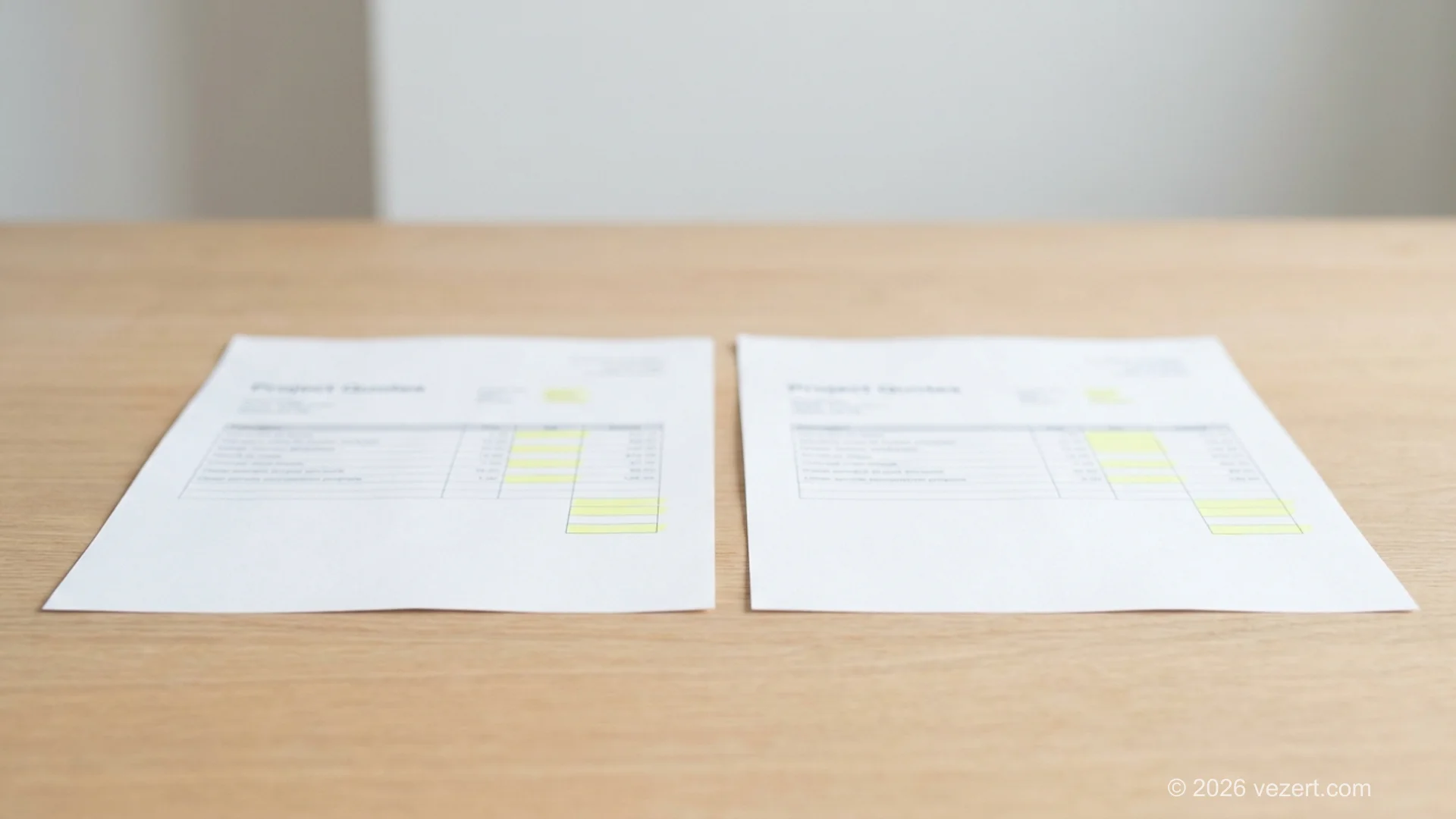
Read a quote from the assumptions rather than the total. The number at the bottom is the least informative part of the document, because it only means something once you know what it assumes about your content, your page count and your systems.
Five questions turn a quote into something comparable:
- How many pages, and how many templates? Pages tell you volume, templates tell you cost.
- Who writes each page, and by when? If the answer is you, that work has a price too, even if it is not on this invoice.
- Is the redirect map included, and who verifies it? According to Google Search Central, redirects should resolve in a single hop, and someone has to build and test that list.
- What is explicitly excluded? A good quote has an exclusions section. Its absence is the signal, not its content.
- What happens after launch, and for how long? Support windows vary from zero to three months and rarely appear in the headline figure.
If a supplier cannot answer these in writing, the number is an estimate wearing a quote's clothing.
When a Low Quote Hides an Incomplete Project
A low quote is not automatically a bad one. It is only a problem when the price is low because work has been removed rather than because the supplier is efficient, and the difference is visible if you know which omissions to look for.
The omissions that cost the most later, roughly in order:
- No migration line. The single most expensive omission, because it surfaces as lost search traffic weeks after the invoice is paid. Google's guidance on site moves sets out what the work involves, and none of it happens by itself.
- No content production. Forty pages of copy quietly become your problem, and the schedule slips until they arrive.
- No performance budget. Sites get slower during redesigns unless someone is accountable for that. According to Google's guidance on Core Web Vitals, these are field measurements of real user experience, so they can only be verified after launch, which is exactly when nobody is left on the project.
- No accessibility work. Retrofitting contrast, focus states and semantic structure costs several times what building them in does.
- No testing time. The line that gets cut first and creates the most post-launch work.
Ask the supplier to price the missing lines as options rather than arguing about the total. A quote that grows honestly when you add scope back is a good sign.
How to Compare Three Quotes Without Guessing
Comparing three quotes is straightforward once they describe the same project, and impossible before that. The work is in normalising them, not in judging them, and it takes about an hour.
Build a single sheet with one row per line item from the table above and one column per supplier. Fill in every cell, including the empty ones, because an empty cell is the finding. Where a supplier has not quoted a line, ask them to price it rather than assuming it is free or included.
Then normalise the assumptions. Set the same page count, the same number of templates, the same answer to who writes the content, and the same integration list for all three. Re-request the numbers on that basis. Most of the apparent spread disappears at this step, and what remains is a genuine difference in approach that you can actually judge.
Only after that does the total mean anything. Comparing headline figures before normalising is how organisations end up choosing the supplier who understood the brief least.
Want a quote you can actually compare?
We itemise by the lines above, state the assumptions behind each one, and list what is excluded.
What Pushes the Price Up
Some things raise a redesign price for good reasons and some raise it for avoidable ones. Knowing which is which is the difference between a budget that grows and a budget that was wrong from the start.
Legitimate cost drivers: number of templates, volume of new writing, number of languages, connected systems, migration complexity when the URL structure genuinely changes, and any regulated content that needs legal review. Each of these is real work that someone has to do.
Avoidable cost drivers: bespoke layouts for pages that could share a template, changing the brief after design approval, adding approvers mid-project, and changing URLs because a new CMS generates them differently rather than because the structure changed. That last one is pure cost with no benefit, since every changed URL needs a redirect and carries a small risk.
Each additional language deserves its own note. It multiplies content, quality assurance and the redirect map at once, so a five-language site is not five times the pages but closer to five times the coordination.
Why Content Costs More Than Design
Content is the most underestimated line in every redesign budget, and the one most likely to be missing from the quote entirely. Design is bounded work: six to ten templates, approved once, reused everywhere. Writing forty service pages is unbounded until someone scopes it.
This is also why content is the main cause of schedule slippage. Design and development can run against a known target. Copy that has not been written yet has no target, and the project waits. Our redesign checklist puts a named writer and a date against each new page for exactly this reason.
The practical consequence for a budget: decide who writes before you request quotes, not after. If it is your team, put a real cost against their time rather than treating it as free. If it is the agency, expect it to be one of the largest lines in the quote, and be suspicious when it is not.
How to Prepare Your Request for Quotes
A good request for quotes costs you an afternoon and saves the spread between suppliers collapsing into guesswork. Four documents are enough, and none of them requires a designer.
First, the page inventory: every current page with its traffic and conversions, plus the pages you know you need and do not have. Second, the answer to who writes each new page. Third, the list of systems the site must connect to, named specifically. Fourth, the business metric the redesign should move, with today's value beside it.
Send the same four documents to every supplier and ask for the quote itemised by the lines in the table above. You will get comparable numbers, which is the entire objective, and the conversations will be about approach rather than about what was or was not included.
If you would rather start with a conversation than a document, that is what our corporate website work usually begins with.
On This Page
- How Much Does a Website Redesign Cost in 2026?
- What a Redesign Quote Contains, Line by Line
- Why Two Quotes for the Same Brief Differ Threefold
- How to Read a Redesign Quote
- When a Low Quote Hides an Incomplete Project
- How to Compare Three Quotes Without Guessing
- What Pushes the Price Up
- Why Content Costs More Than Design
- How to Prepare Your Request for Quotes