

On This Page
- Why Does AI-First Web Development Matter for Modern Businesses?
- What Are the Key Milestones in AI-First Web Development From 2020 to 2026?
- How Does the 5-Stage AI-First Delivery Pipeline Work in Practice?
- AI-First Web Development for Routine Task Automation
- Faster Analysis, Planning, and Prototyping
- Stability and Accuracy Through AI-Assisted QA Delivery
- How Does AI-First Development Reallocate Time Into CRO and UX?
- Why Does Human Architectural Governance Remain Essential?
- What Are the Measurable Benefits and 2027 Budget Tiers?
- Where Does AI-First Web Development Deliver the Highest ROI?
- How Should You Plan Your Next AI-First Website Launch?
AI-first web development is an engineering methodology that integrates generative code assistants, automated design-token pipelines, and LLM-powered QA into professional Next.js and headless CMS delivery, cutting boilerplate sprint time by 35% to 55% while preserving human architectural governance, Core Web Vitals performance, and GDPR security.
Rather than treating artificial intelligence as a superficial plug-in or relying on fragile no-code site generators, an AI-first engineering studio embeds automation across research, Figma token synchronization, TypeScript component scaffolding, and Playwright end-to-end testing. According to McKinsey's State of AI research, organizations that integrate generative tools into core software workflows reduce routine engineering cycle times by 20% to 30% while improving release stability.
In this technical guide, we break down the five-stage delivery pipeline behind modern corporate websites and custom B2B platforms, examine how saved boilerplate hours are reallocated directly into UX/UI design and conversion rate optimization (CRO), and clarify how agency engineering differs from the trade-offs discussed in our AI vs. human web designer analysis.
Why Does AI-First Web Development Matter for Modern Businesses?
AI-first web development matters for commercial organizations because traditional manual agency builds spend up to half of their billable engineering hours on repetitive setup, CSS token translation, and manual regression testing before solving a single business problem. By automating those mechanical layers, teams ship production-grade platforms in weeks rather than quarters.
Enterprise buyers and growth-stage companies no longer view a website as a static digital brochure. Modern B2B platforms must pass strict Core Web Vitals thresholds (LCP < 1.8s, INP < 100ms), comply with the European Accessibility Act (EAA 2025 / WCAG 2.2 Level AA), synchronize leads with CRM pipelines in real time, and expose clean structured data for both search engines and generative answer engines.
According to the McKinsey State of AI report, 65% of organizations now deploy generative AI across core operational functions, nearly double the prior year's adoption rate. Simultaneously, the GitHub Developer Survey demonstrates that 92% of professional software engineers use AI coding assistants, completing complex scaffolding tasks up to 55% faster. In web engineering, that velocity gap separates agencies that iterate on live user conversion data from teams stuck debugging boilerplate templates.
What Are the Key Milestones in AI-First Web Development From 2020 to 2026?
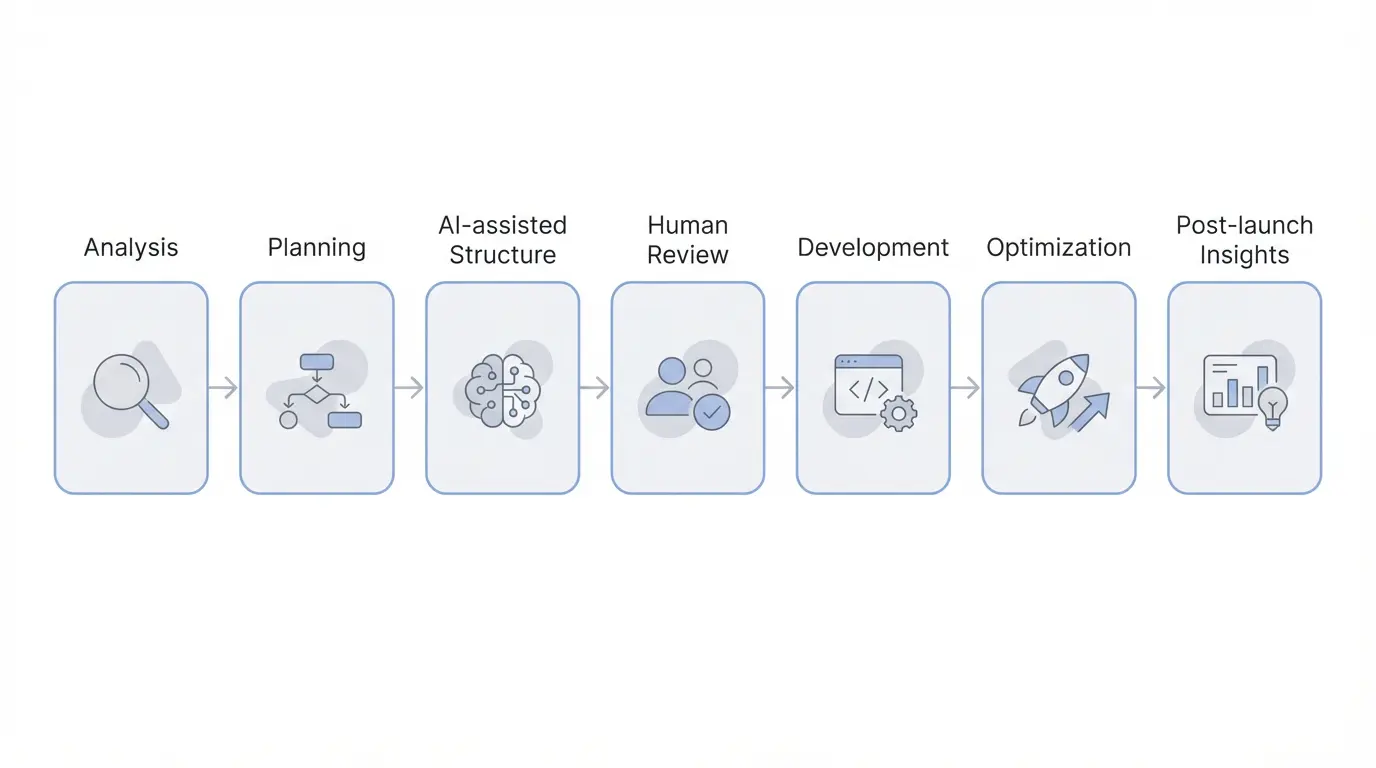
The evolution from experimental code autocomplete in 2020 to integrated multi-stage engineering pipelines in 2027 reshaped how professional agencies scope, price, and deliver software. Understanding these seven technical milestones clarifies why AI-first delivery has become the baseline standard for modern web engineering teams.
Engineering Velocity Without Template Lock-In
The shift from AI-assisted coding to a full AI-first pipeline took six years of tooling maturity. In 2027, clients no longer have to choose between fast delivery and clean, maintainable custom TypeScript architecture.
How Does the 5-Stage AI-First Delivery Pipeline Work in Practice?
A mature AI-first web development pipeline operates across five sequential engineering stages: automated SERP and ICP research synthesis, Figma design-token synchronization, AI-assisted TypeScript and Next.js component scaffolding, automated Playwright and WCAG 2.2 AA verification, and generative engine optimization (AIO/GEO) for LLM citability.
According to Google's Web.dev performance engineering guidance, automated performance budgets and continuous auditing are critical because every 100ms improvement in load speed lifts conversion rates by up to 1%. Furthermore, usability research from Nielsen Norman Group confirms that AI-accelerated UX workflows compress early iteration cycles by 30% to 40%, allowing human specialists to test interactive prototypes with real buyers days earlier. To evaluate whether an external partner genuinely ships clean TypeScript and static rendering rather than bloated client bundles, walk through the technical audit questions in our Next.js web development company guide.
The 5-Stage AI-First Agency Delivery Pipeline:
- Stage 1: AI-Accelerated Competitor SERP, ICP, and Wireframing Synthesis: Before drawing a single pixel, language models ingest top-ranking competitor pages, customer support transcripts, and sales call objections to map the Ideal Customer Profile (ICP) information hierarchy.
- Stage 2: Figma Design-System Token Generation With Human UX Hierarchy: Automated token pipelines convert typography scales, spacing primitives, and WCAG-compliant color palettes from Figma directly into CSS custom properties, while senior UX designers craft the conversion flow through professional UI/UX design services.
- Stage 3: AI-Assisted TypeScript, React, and Next.js Scaffolding With Human Code Review: Coding assistants generate type-safe component props, Zod validation schemas, and headless CMS data fetchers in minutes, followed by strict senior engineer review for bundle size, server-side rendering, and API security.
- Stage 4: Automated Playwright E2E, WCAG 2.2 AA, and JSON-LD Schema Validation: Continuous integration pipelines execute automated Playwright browser journeys, verify W3C WCAG 2.2 Level AA keyboard focus and contrast rules, and validate nested JSON-LD entity graphs (
Organization,Service,FAQPage). - Stage 5: AIO/GEO Entity Optimization (
llms.txt, Passage Citability, Hreflang Parity): Prior to launch, automated scripts verify self-contained 40 to 50 word answer passages, synchronize multilingualhreflangclusters across all active locales, and publish structured Markdown mirrors viallms.txtfor AI search crawlers.
Measured reduction in engineering hours across 5 delivery stages when comparing AI-first Next.js agency pipelines against traditional manual web development workflows. Source: GitHub Copilot & McKinsey Software Engineering Productivity Benchmarks.

AI-First Web Development for Routine Task Automation
Automating repetitive mechanical tasks eliminates the hidden billing bloat that slows traditional web agencies down. In an AI-first sprint, intelligent tooling handles three high-volume engineering chores:
- TypeScript interface and CMS schema generation: Automatically mapping headless CMS content models into strict TypeScript definitions and Zod runtime validators.
- Responsive layout and token propagation: Translating approved Figma spacing, breakpoint, and dark-mode variables across dozens of secondary page templates without manual CSS drift.
- Multilingual localization and metadata scaffolding: Preparing synchronized translation keys, Open Graph tags, and localized URL segment maps across English, German, Spanish, French, and Dutch.
Senior software engineers govern every automated commit. They define the system architecture, enforce strict Content Security Policy (CSP) headers, audit third-party dependencies, and ensure zero client-side JavaScript bloat reaches production. This structured workflow eliminates manual copy-paste regressions across multi-environment staging and production deployments while keeping repository commit histories clean, auditable, and straightforward for internal client engineering teams to maintain long after launch.
Faster Analysis, Planning, and Prototyping
During the discovery and architecture phase, AI-first tooling compresses weeks of fragmented spreadsheet research into structured engineering specifications within 48 to 72 hours:
- Competitor SERP and intent clustering: Analyzing top-ranking domain structures, heading hierarchies, and entity gaps to build a data-backed sitemap before design begins.
- Interactive wireframe and user-flow synthesis: Generating clickable multi-step funnel prototypes that model how technical buyers, procurement leads, and executives navigate the site.
- API contract and data-model blueprinting: Drafting OpenAPI specifications and webhook payloads for HubSpot, Salesforce, or ERP integrations during week one so frontend and backend tracks run in parallel.
Because stakeholders review interactive prototypes backed by real industry copy in week one rather than static lorem-ipsum wireframes in week four, architectural sign-off happens twice as fast with significantly fewer late-stage scope revisions.
Stability and Accuracy Through AI-Assisted QA Delivery
Shipping fast only creates commercial value when the production release is stable, accessible, and bug-free. AI-assisted quality assurance strengthens custom web development stability through three automated verification gates:
- Automated Playwright end-to-end regression suites: Every pull request triggers headless browser tests across mobile and desktop viewports to verify form validation, OTP verification, and dynamic routing.
- Continuous WCAG 2.2 Level AA and DOM hygiene audits: Automated linters inspect semantic landmark nesting, keyboard focus order, ARIA attributes, and color contrast ratios before staging deployment.
- Core Web Vitals performance budgets: Build pipelines block any commit that pushes Largest Contentful Paint (
LCP) above 1.8 seconds or Interaction to Next Paint (INP) above 100 milliseconds across the UX/UI design system.
How Does AI-First Development Reallocate Time Into CRO and UX?
The primary commercial advantage of AI-first web development is budget reallocation: by cutting 35% to 55% of the hours traditionally spent on boilerplate setup, agencies redirect that engineering capacity directly into conversion rate optimization (CRO), custom micro-interactions, and security auditing.
In a conventional manual build, up to 60% of the budget is consumed simply getting static pages to render across browsers, leaving minimal time at the end of the project for conversion testing or speed tuning. When automated pipelines handle the mechanical scaffolding, senior designers and engineers invest their hours where revenue is actually won:
- Empirical funnel and objection engineering: Structuring multi-step lead capture forms, interactive ROI calculators, and role-specific proof blocks that lift B2B lead conversion rates by 25% to 45%.
- Custom hardware-accelerated micro-interactions: Crafting high-precision interactive product walkthroughs, SVG data visualizations, and smooth state transitions that differentiate the brand without hurting
INPlatency. - Deep GDPR and API security hardening: Conducting thorough penetration checks, server-side rate limiting, zero-PII analytics configuration, and strict cookie consent governance.
By combining rapid hypothesis generation with senior human direction through our UX/UI design workflow, clients launch digital products that are engineered to convert from day one.
Reallocating 35% to 55% of Boilerplate Hours Into Revenue Levers
When AI pipelines automate repetitive component scaffolding and regression testing, 35% to 55% of project engineering hours shift directly into CRO experimentation, custom interactive UX, and Core Web Vitals optimization.
Why Does Human Architectural Governance Remain Essential?
In AI-first web development, machine automation supplies execution velocity while senior human engineers and designers provide architectural governance, security accountability, and brand strategy. Without experienced human oversight, unguided AI code generation quickly produces fragmented dependencies, security vulnerabilities, and generic user interfaces.
As we examined in our comparison of an AI vs. human web designer, statistical models excel at recombining known patterns from training data, but they cannot evaluate business trade-offs or own production uptime.
What AI Automation Executes Best:
- Scaffolding repetitive TypeScript interfaces, Tailwind CSS token maps, and unit test stubs in seconds.
- Scanning multi-locale JSON bundles for missing translation keys, broken links, or schema syntax errors.
- Generating initial wireframe variations and synthetic test datasets for staging environments.
Where Senior Human Specialists Are Non-Negotiable:
- Designing scalable Next.js rendering architectures (SSG, ISR, and edge middleware) tailored to traffic and SEO goals.
- Translating complex B2B value propositions into distinctive visual identity through professional UI/UX design services.
- Auditing authentication flows, API rate limits, GDPR data residency, and European Accessibility Act compliance.
This disciplined division of labor explains why AI-first agency teams consistently outperform both slow manual shops and fragile no-code site builders.

What Are the Measurable Benefits and 2027 Budget Tiers?
Adopting an AI-first web development methodology delivers four quantifiable commercial benefits for B2B organizations: 34% to 55% faster time-to-market, verified Core Web Vitals pass rates, native SEO and AI search readiness at launch, and predictable European project pricing across every scope tier.
1. Compressed Time-to-Market and Predictable Sprints
Automated discovery synthesis, token generation, and CI/CD regression checks cut overall delivery timelines by 34% to 50%. High-converting campaign pages launch in 5 to 10 business days, while corporate platforms ship in 2 to 4 weeks (4 to 8 weeks for multilingual builds).
2. Superior Core Web Vitals and Lower Bounce Rates
Automated performance linting catches render-blocking scripts, unoptimized image payloads, and layout shifts before code merges. According to Google's Core Web Vitals research, sites that meet strict LCP and INP thresholds experience 24% fewer session abandonments.
3. Built-In Technical SEO and AIO/GEO Citability
Every page ships with clean semantic HTML5 landmarks, validated JSON-LD structured data, synchronized hreflang alternates, and llms.txt Markdown mirrors so your brand is cited accurately by Google, ChatGPT, Perplexity, and Claude.
4. 2027 European AI-First Project Budget Tiers
- AI-First Landing Page Sprint (€1,500 to €3,000): 5 to 10 business days delivery including ICP messaging, custom Figma UX, responsive Next.js build, and CRM webhook integration.
- Custom Corporate Website (€4,500 to €9,000): 2 to 4 week delivery (4 to 8 weeks for multilingual corporate) for B2B companies requiring a full Figma design system, multi-locale architecture, WCAG 2.2 AA compliance, and headless CMS governance.
- Enterprise Web Portal & Custom Platform, from €9,000 (€12,000 to €25,000+ for enterprise scope): 6 to 8 week engineering delivery (8 to 12 weeks for compliance-heavy portals) for authenticated client portals, bidirectional ERP/CRM middleware, and custom business logic.
For a closer look at when a builder stops paying off, read when to move from Webflow to Next.js.
Where Does AI-First Web Development Deliver the Highest ROI?
AI-first web development delivers the highest return on investment on projects where launch speed, structural scalability, and conversion precision directly impact revenue pipeline: growth-focused landing page sprints, multi-language corporate websites, and data-intensive enterprise web portals.
High-Velocity B2B Landing Pages (€1,500 to €3,000)
Paid acquisition and product launch campaigns require sub-second load times and razor-sharp message hierarchy. AI-first workflows allow teams to synthesize competitor offers, prototype multiple value proposition angles, and deploy fast Next.js pages with integrated A/B testing hooks in days.
Scalable Multi-Language Corporate Websites (€4,500 to €9,000)
Established European companies operating across English, German, Spanish, French, and Dutch markets need strict visual consistency and localized SEO parity. Automated token bridges and schema validators keep dozens of service pages, case studies, and knowledge hubs synchronized without manual editorial bottlenecks.
Custom Web Portals and Integrated Platforms (€12,000 to €25,000+)
When an organization requires authenticated customer dashboards, dynamic pricing calculators, or deep middleware connections via custom web development, AI-assisted automated testing and static type checking prevent regression bugs across complex multi-layer architectures.
Why Solo AI Code Generation Fails Without Senior Engineering
Prompting an LLM to generate raw code without senior human architecture leads to exposed API keys, broken accessibility states, and unmaintainable state logic. True AI-first development pairs automated velocity with strict human code review and automated CI/CD gates.
How Should You Plan Your Next AI-First Website Launch?
Planning your next website around an AI-first engineering methodology allows your organization to capture the speed of modern automation without sacrificing custom UX differentiation, Core Web Vitals speed, or regulatory compliance. Instead of funding months of manual boilerplate coding, your budget goes directly into strategy, conversion architecture, and long-term technical stability.
Whether you need a high-converting campaign sprint, a multi-language corporate website, or a deeply integrated B2B platform, combining senior human specialists with a mature five-stage AI delivery pipeline is now the most capital-efficient path to market.
To compare exact deliverables, sprint timelines, and investment tiers for your upcoming project, review our transparent agency pricing packages or explore our UX/UI design capabilities to see how we turn complex business requirements into measurable digital growth.
Explore how specialized B2B teams combine autonomous workflows with vertical positioning in our 2027 AI automation for niche websites guide.
Accelerate Your Website Project With AI-First Engineering
Vezert combines a 5-stage AI-first engineering pipeline with senior UX/UI designers and Next.js architects to ship fast, WCAG 2.2 AA compliant websites that convert.
Explore Corporate Website ServicesOn This Page
- Why Does AI-First Web Development Matter for Modern Businesses?
- What Are the Key Milestones in AI-First Web Development From 2020 to 2026?
- How Does the 5-Stage AI-First Delivery Pipeline Work in Practice?
- AI-First Web Development for Routine Task Automation
- Faster Analysis, Planning, and Prototyping
- Stability and Accuracy Through AI-Assisted QA Delivery
- How Does AI-First Development Reallocate Time Into CRO and UX?
- Why Does Human Architectural Governance Remain Essential?
- What Are the Measurable Benefits and 2027 Budget Tiers?
- Where Does AI-First Web Development Deliver the Highest ROI?
- How Should You Plan Your Next AI-First Website Launch?
From €4,500 · 2 to 4 weeks
Planning a New B2B Corporate Website?
Custom Next.js architecture, multilingual SEO foundations, and enterprise trust signals engineered to generate qualified pipeline.
Explore Corporate Website Design →