

On This Page
- What Custom Web Development Actually Means
- When a Template Stops Being the Cheaper Option
- How Much Custom Web Development Costs
- What You Get That a Site Builder Cannot Give You
- How a Custom Build Runs, Stage by Stage
- Why Custom Projects Overrun, and What Prevents It
- How to Choose Between Custom, WordPress and a Builder
- What Belongs in the Brief Before You Ask for Quotes
Custom web development is building a site on its own codebase instead of assembling it from a purchased theme or a drag-and-drop builder. The distinction is not about quality or ambition. It is about who controls the structure: with a template, the vendor decided how pages nest, how content is modelled and what the markup looks like, and you work inside that decision.
That trade is often worth making. Most sites should be templates. This article is about the cases where it stops being worth it, what the alternative costs, and how to tell the two apart before you have spent the budget.
What Custom Web Development Actually Means
In practice the term covers three different things, and quotes vary wildly because agencies rarely say which one they are pricing. A fully custom build writes the front end, the content model and the templates from scratch. A custom theme keeps a familiar CMS underneath and replaces everything the visitor sees. A customised template starts from a bought theme and modifies it.
The third is the one that causes arguments. A modified template is sold as custom because it looks unique, but the underlying content model, the page hierarchy and much of the markup still belong to the theme author. That matters later, when you want a page type the theme never anticipated, or when the theme's next update overwrites your changes.
When you ask for a quote, ask which of the three you are being offered. The word "custom" alone does not narrow it down, and the price gap between the first and the third is often threefold.
When a Template Stops Being the Cheaper Option
A template is cheaper until the work of fighting it exceeds the work of replacing it. Four signals reliably mark that crossing point, and none of them is about how the site looks.
Your content does not fit the page types on offer. Themes ship with posts, pages and maybe a portfolio. If your business needs a structured catalogue where each entry has fifteen fields that filter and cross-reference, you will end up storing that in free-text fields and rebuilding the filtering in JavaScript. That is a custom build with extra steps.
You are paying for plugins to undo the theme. A page builder plus a performance plugin plus a caching plugin plus a script manager, all installed to make one theme behave, is a recognisable pattern. Each is a dependency, a licence and a thing that breaks on update.
Performance targets are contractual. Google's Core Web Vitals set a Largest Contentful Paint threshold of 2.5 seconds, and heavy themes routinely miss it because they load everything on every page. You can optimise a theme a long way, but you cannot remove code you do not control.
Two systems have to talk. The moment your site has to read from an ERP, a booking engine or a pricing service in real time, you are writing application code. At that point the theme is scaffolding you are paying to work around.
How Much Custom Web Development Costs
European agency pricing as of August 2026 clusters into three bands, and what moves a project between them is the number of distinct page types and integrations, not the number of pages. A forty-page site with three templates is cheaper than an eight-page site with eight bespoke layouts.
Our own tiers sit at €1,500 for a focused marketing site, €4,500 for a corporate website with custom templates and a proper content model, and €12,000 upward where integrations, multiple locales or an application layer are involved. Numbers from other European agencies land in the same range, with the top band opening wide depending on scope.
The number that is missing from most quotes
A build price without a running cost is half a quote. Custom code needs dependency updates, hosting and someone on call when something breaks, and that is typically 15% to 20% of the build cost per year. Ask for it in writing before you compare offers. Our website maintenance cost breakdown covers what that line should contain.
What You Get That a Site Builder Cannot Give You
Builders have closed most of the visual gap. What they have not closed is structural, and the four differences below are the ones that show up eighteen months in rather than at launch.
A content model that matches your business. Fields, relationships and validation defined around your objects, not around blog posts. This is what makes a catalogue filterable and a case study reusable in three places without copy-paste.
Markup you own. Semantic HTML you can fix. According to the WebAIM Million survey of the top million home pages, over 94% carry detectable accessibility failures, and a large share of them originate in theme and builder output that the site owner cannot reach.
Performance as a design decision. You ship the CSS and JavaScript the page needs. No bundled slider library on a page with no slider.
A migration path. Your content lives in a schema you defined, so moving platforms is an export, not a rebuild. Sites built on proprietary builders are the ones that get rewritten from scratch every five years.
How a Custom Build Runs, Stage by Stage
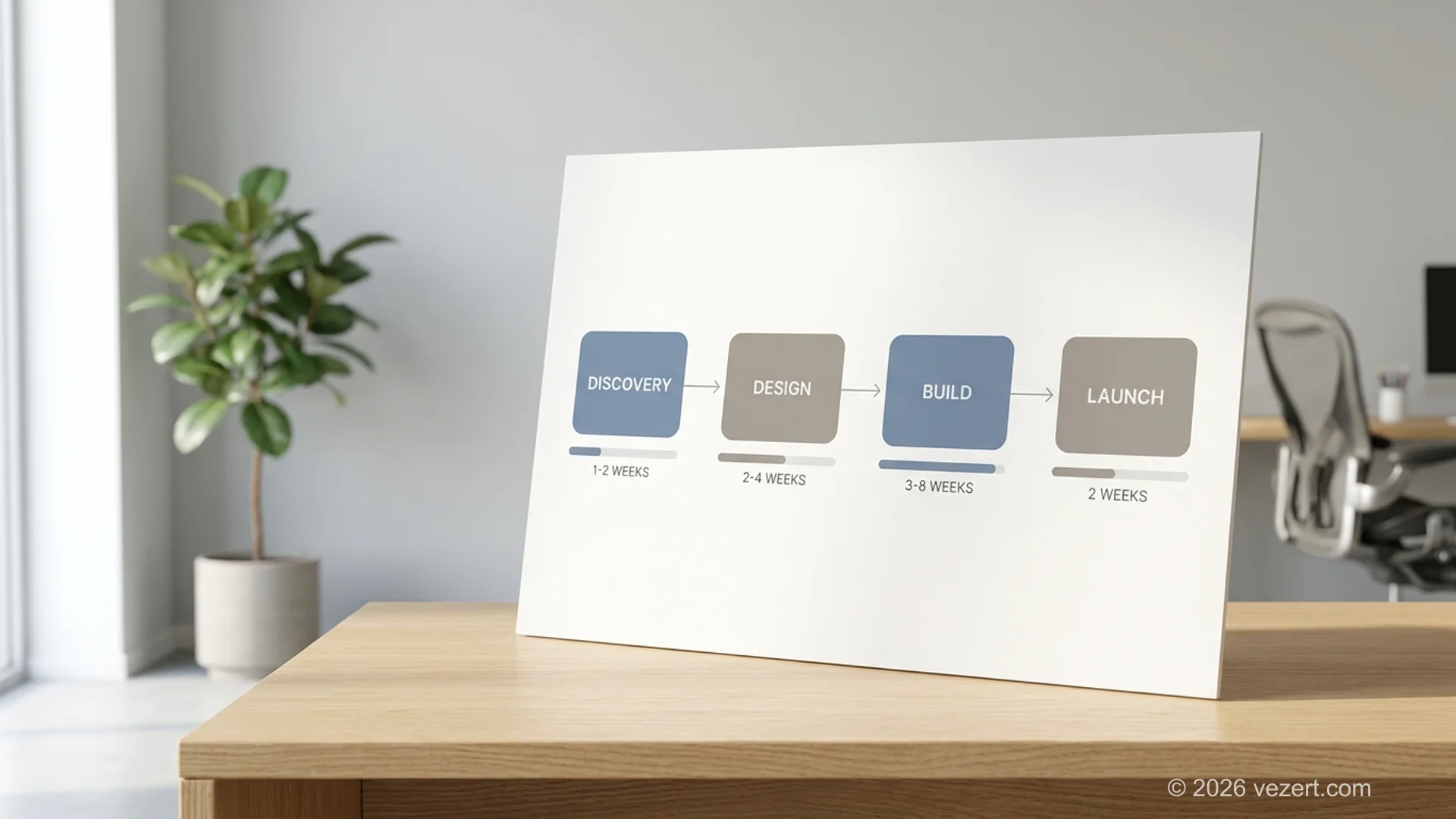
A custom project has four stages, and the first one is where the money is saved or lost. Skipping straight to design is the single most common cause of overrun, because every decision deferred at the start returns later as rework at three times the cost.
Discovery and content model, one to two weeks. Page types, fields, relationships, and the list of things the site must integrate with. The deliverable is a document you can hand to a different agency and get a comparable quote.
Design, two to four weeks. Templates rather than pages: what does a catalogue entry look like, not what does page 14 look like.
Build, three to eight weeks. Front end, CMS configuration, integrations. Content entry runs in parallel and is almost always underestimated by the client side.
Launch and stabilisation, two weeks. Redirects, analytics, real-device testing. If you are replacing an existing site, redirect mapping deserves its own owner. Our website migration guide covers what gets lost when it does not.
Why Custom Projects Overrun, and What Prevents It
Overruns rarely come from developers working slowly. They come from decisions that were never made, arriving late and forcing rework. Three causes account for most of it, and all three are visible before the contract is signed.
Content arrives last. The build finishes and then waits six weeks for copy, which means the layout was designed against placeholder text and does not survive contact with the real thing. Fix: agree the content deadline before the design deadline.
The integration was assumed to be simple. "It just needs to pull from our ERP" hides whether that system has an API, whether anyone still supports it, and who owns the credentials. Fix: a technical spike in week one, before the estimate is fixed.
Approval has no named owner. Four stakeholders reviewing at different times produce contradictory feedback and a design that satisfies nobody. Fix: one decision-maker, named in the contract.
How to Choose Between Custom, WordPress and a Builder
The decision is usually made on brand preference when it should be made on the content model and the integration list. A short version: choose a builder when the site is small and the team is non-technical, choose a themed CMS when your content fits standard page types, and choose custom when neither is true.
WordPress deserves separate mention because it sits in both camps. According to W3Techs it runs roughly 43% of all websites, and a custom WordPress build, meaning own theme, own fields and no page builder, is a legitimate middle path that keeps a familiar editing experience while giving you control of the output.
The honest test is a question about the future, not the present: in two years, will you be adding content of a shape that exists today, or a shape that does not? Templates handle the first case well and the second case badly. Our platform comparison works through the same decision with specific stacks.
What Belongs in the Brief Before You Ask for Quotes
Agencies price risk. A vague brief gets a padded number, because the estimator has to cover what you did not say. Six items remove most of that padding and let you compare quotes that are actually comparable.
The page types, not the page count. List the kinds of page, with the fields each one needs.
Every system the site must talk to, with a named contact for each and whether an API exists.
Who writes the content, and by when. With a date.
The languages, at the start. Retrofitting a second locale into a finished build costs far more than including it.
The performance and accessibility targets you will actually test against, if any.
Who signs off. One name.
If you want a longer template, our website design brief guide has the full structure. The short version above is enough to make three quotes comparable, which is most of the value.
On This Page
- What Custom Web Development Actually Means
- When a Template Stops Being the Cheaper Option
- How Much Custom Web Development Costs
- What You Get That a Site Builder Cannot Give You
- How a Custom Build Runs, Stage by Stage
- Why Custom Projects Overrun, and What Prevents It
- How to Choose Between Custom, WordPress and a Builder
- What Belongs in the Brief Before You Ask for Quotes