

An ecommerce portal is a centralized digital platform that unifies complex commerce operations — B2B sales cycles, multi-vendor management, ERP integration, and personalized buyer workflows — into a single, high-performance system. Unlike a standard online store, a portal is engineered for relationship-driven business models that demand custom roles, tiered pricing, and deep integrations with core enterprise software.
According to Statista, global ecommerce sales surpassed $5.8 trillion in 2023 and are projected to reach $8 trillion by 2027 — yet most growing businesses hit a ceiling with off-the-shelf tools long before they reach that scale. If your team is managing B2B orders manually, struggling to offer contract pricing, or losing time reconciling ERP data with your store, a custom ecommerce portal is likely the right next step.
This guide covers everything you need: the core features a high-growth platform requires, the strategic choice between custom and off-the-shelf development, and a clear four-phase roadmap you can use to plan your build. You'll find the context you need to make confident decisions — and to commission a conversion-first platform ready to scale.

What Is an Ecommerce Portal?
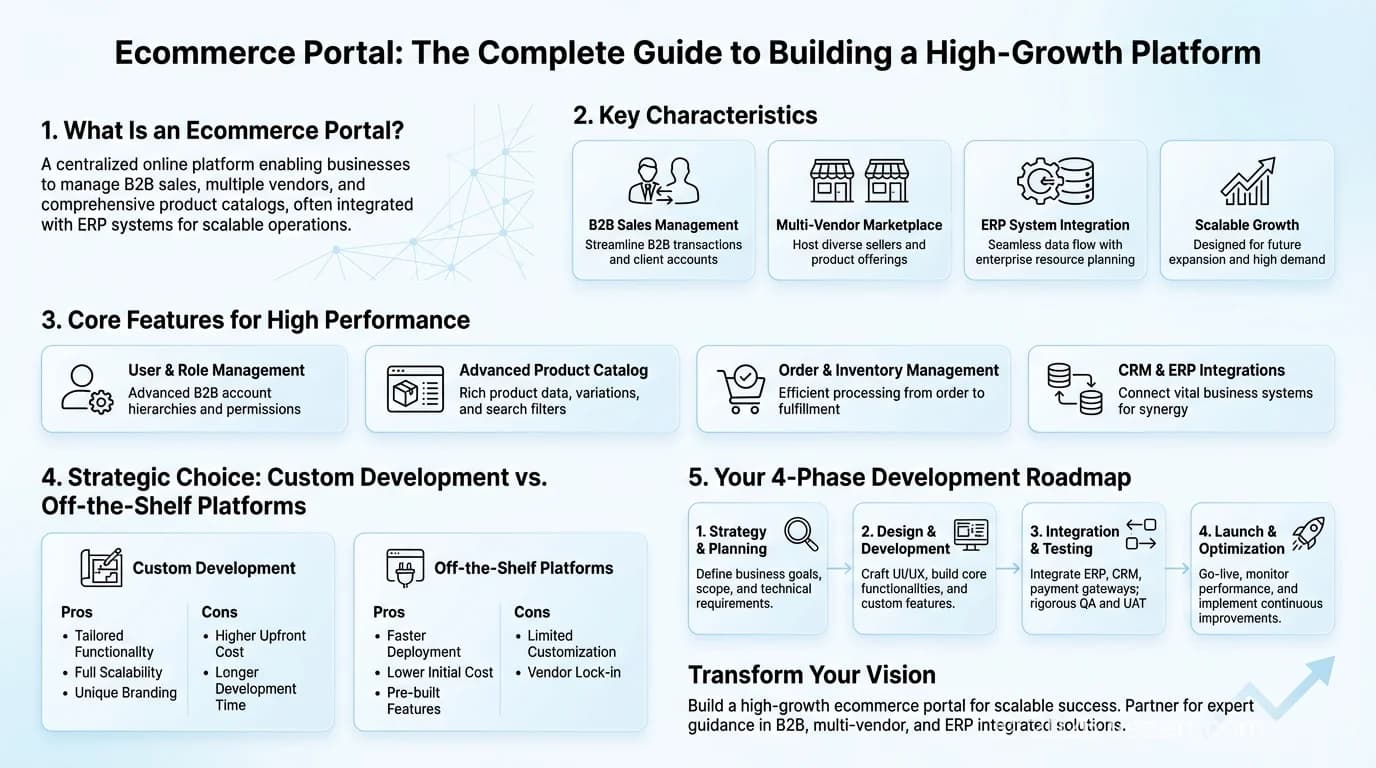
An ecommerce portal is a multi-role, integration-ready commerce platform built to handle operational complexity that standard online stores cannot support. While most business owners understand what e-commerce is — buying and selling online — a portal elevates this concept by adding structured user roles, dynamic pricing layers, and automated workflows for procurement, vendor management, and enterprise system synchronization.
As McKinsey & Company reports, B2B companies that have digitized their sales operations see 20–30% higher close rates compared to those relying on manual processes. An ecommerce portal is the infrastructure that makes that digitization possible at scale.
"The companies that win in B2B ecommerce are those that treat their digital platform as a strategic asset, not a technology project." — Forrester Research, B2B Commerce Report 2024
Ecommerce Website vs. Ecommerce Portal: A Clear Comparison
The distinction lies in complexity and business model fit. A standard store handles straightforward, one-directional transactions. A portal is engineered for complex, relationship-driven models that require role-based access, negotiated pricing, and multi-system integration.
| Feature | Standard Ecommerce Store | Ecommerce Portal |
|---|---|---|
| User Roles | Single seller to multiple customers | Multiple custom roles: vendors, distributors, sales reps, buyers |
| Pricing | Static, single-price-fits-all | Dynamic tiered pricing by customer group or order volume |
| Catalog | One open product catalog | Personalized, user-specific catalogs with visibility controls |
| Integrations | Basic payment and shipping | Deep ERP, CRM, PIM, and procurement system connections |
| Workflows | Linear checkout | Custom approval chains, RFQ flows, bulk ordering |
Signs You Have Outgrown Your Standard Ecommerce Store
Operational friction is usually a platform problem, not a people problem. Here are clear indicators that a more robust, conversion-focused solution is overdue:
- Your manual B2B order process has become a bottleneck — consuming team hours and generating errors.
- You need to offer different prices, payment terms, and product visibility to different customer groups but your platform cannot support it.
- You want to onboard third-party vendors and operate a centralized marketplace.
- Your store does not integrate cleanly with your ERP, PIM, or CRM, creating data silos that slow operations.
What Features Does a High-Performance Ecommerce Portal Need?
The architecture of a high-performance ecommerce portal is a dynamic framework tailored to your specific business model. According to the Baymard Institute, poor UX and missing functionality are responsible for an average cart abandonment rate of 70.19% — a number that drops significantly when portals are built around user intent from the ground up.
Building a successful platform requires a comprehensive ecommerce strategy that aligns technology directly with your operational model, whether B2B, B2C, or multi-vendor marketplace. Below are the essential features for each model.
Essential B2B Portal Features
B2B ecommerce is built on relationships and operational efficiency. These features must simplify complex procurement workflows and integrate with existing business systems.
- Corporate Account Management: Empower clients with self-service tools to manage multiple buyers, assign user roles with specific permissions, and establish spending limits under a single corporate account.
- Custom Catalogs and Tiered Pricing: Display unique product catalogs and contract-based pricing for different client tiers, ensuring a personalized and confidential buying experience.
- RFQ and Bulk Ordering: Facilitate large-scale purchases with Request for Quote (RFQ) workflows and quick-order forms that allow customers to buy via SKU or CSV upload.
- ERP and CRM Integration: Create a single source of truth by synchronizing customer data, inventory levels, and order history between your ecommerce portal and core business systems.
Advanced B2C Portal Features
In the B2C space, personalization and convenience drive retention. These capabilities build brand loyalty and deliver premium customer experiences.
- AI-Powered Personalization: Leverage machine learning to deliver hyper-relevant product recommendations, personalized content, and dynamic search results that adapt to individual user behavior.
- Loyalty and Subscription Tools: Drive repeat business with sophisticated loyalty programs, rewards, and flexible subscription management options for recurring revenue.
- Omnichannel Capabilities: Unify the customer experience across all touchpoints, enabling buy-online-pickup-in-store (BOPIS), cross-location inventory visibility, and consistent customer profiles.
- Robust Customer Self-Service: Reduce support overhead by providing customers an intuitive dashboard for order tracking, one-click returns, and account management.
Must-Have Multi-Vendor Marketplace Features
A successful marketplace balances the needs of customers, vendors, and administrators. The right features foster trust, simplify governance, and enable scalable growth.
- Individual Vendor Dashboards: Equip sellers with a dedicated back-end to manage product listings, track inventory, process orders, and view sales analytics.
- Automated Commission and Payouts: Implement a flexible system that calculates commissions by model (percentage, flat-fee) and manages scheduled vendor payouts automatically.
- Review and Rating Systems: Build social proof by allowing customers to rate vendors and review products — critical for marketplace credibility.
- Admin Moderation Workflows: Maintain quality control with tools for approving vendor applications, moderating listings, and managing disputes.

Security Is Non-Negotiable
Beyond features, ironclad security and data privacy are foundational requirements. Any high-performance platform must be built on PCI DSS compliance, GDPR/CCPA adherence, OWASP Top 10 secure coding practices, and proactive threat monitoring to protect your business and your customers' sensitive data.
Key Ecommerce Portal Statistics
B2B buyers now complete 57% of the purchase decision before ever engaging a sales rep, according to Gartner (2024). Companies with a self-service ecommerce portal reduce order processing costs by an average of 35% (Forrester, 2023). Marketplaces accounted for 67% of all global online retail sales in 2023 (Digital Commerce 360).
Custom Development vs. Off-the-Shelf: Which Is Right for You?
Choosing your foundational technology is the most consequential decision in your ecommerce journey. It determines not just your initial investment but your long-term scalability, performance ceiling, and capacity for differentiation. Both off-the-shelf platforms and a custom ecommerce portal offer real capabilities — but they serve fundamentally different strategic goals.
According to a 2023 Gartner survey, 68% of enterprise commerce leaders cite platform limitations as a primary barrier to digital growth. That statistic reflects the reality: most businesses outgrow their initial platform before they anticipated.
Option 1: Off-the-Shelf Platforms (Magento, Salesforce Commerce Cloud)
Platforms like Magento or Salesforce Commerce Cloud offer a deployable, pre-built foundation. They are a practical starting point for businesses with standard operational requirements that fit within the platform's existing structure.
- Pros: Faster time-to-market, extensive built-in feature sets, and large support communities.
- Cons: High recurring licensing fees, vendor lock-in that restricts future flexibility, and hard limits on deep customization.
Option 2: Custom Ecommerce Portal Development
A bespoke build creates a proprietary asset engineered for your specific workflows and customer experience goals. This strategy transforms your digital platform into a competitive advantage — one built to perform and convert at the architecture level, not adapted from a template.
- Pros: Complete flexibility, a highly scalable architecture, full IP ownership, and zero licensing fees at scale.
- Cons: Requires a higher initial investment and a longer development timeline.
The Decision Framework
The choice comes down to a strategic trade-off: speed and standardization versus control and long-term differentiation. A template solution will get you to market faster; a custom build will let you own your market. For businesses with complex B2B operations, multi-vendor models, or deep integration needs, custom development typically delivers stronger ROI within 24–36 months.
| Criterion | Off-the-Shelf | Custom Build |
|---|---|---|
| Time to market | 2–4 months | 4–9 months |
| Upfront cost | Lower | Higher |
| Total 5-year cost | Higher (licensing) | Lower (no fees) |
| Customization depth | Limited | Unlimited |
| Integration complexity | Moderate | Full control |
| Competitive differentiation | Low | High |
Not Sure Which Path to Take?
Get a direct assessment from our team on whether custom development or an off-the-shelf platform is right for your ecommerce portal goals.
Get a Free ConsultationHow Is an Ecommerce Portal Built? The 4-Phase Roadmap
Building a custom ecommerce portal is a structured engineering process, not a creative leap. A successful platform is built on clear strategy, user-centric design, and technology choices that serve your business model — not the other way around. The four-phase roadmap below removes guesswork and gives you a clear picture of what a professional agency delivers at each milestone when building a high-performing asset.
Phase 1: Discovery and Strategy
No code is written until the strategic foundation is solid. This phase ensures every subsequent decision is anchored to your business objectives and user needs:
- Defining business goals and the KPIs that will measure platform success.
- Mapping user journeys and building data-driven personas for each role type.
- Conducting a technical audit to design a scalable system architecture.
Phase 2: Conversion-First UX/UI Design
Every design decision must serve user action and business outcomes. The design process combines research-backed UX principles with conversion science to produce interfaces that are not only visually strong but operationally efficient. Interactive wireframes and prototypes are tested with real users before any development begins — ensuring the final product is intuitive across every device.
Phase 3: AI-Assisted Development and Integration
This is where strategy and design become a live, functional ecommerce portal. Front-end and back-end systems are built to specification, and critical integrations — ERP, CRM, payment gateways, PIM — are implemented via a structured API-first approach. AI-assisted development tooling accelerates delivery timelines without compromising code quality or test coverage.
Phase 4: Testing, Launch, and Ongoing Optimization
A rigorous QA process covers functional testing, load testing, security scanning, and cross-device validation before any deployment. Launch is a controlled, monitored process. Post-launch, the platform enters a continuous improvement cycle — analytics inform ongoing iteration so your ecommerce portal scales with your business. See how this process delivers in practice in our Document Signature and Payment Platform Case Study.

What a Professional Build Delivers
A professionally built ecommerce portal typically reduces manual order processing by 40–60%, increases average order value through personalization by 15–25%, and achieves full ROI within 18–30 months — depending on transaction volume and integration scope.
Transform Your Vision into a High-Growth Ecommerce Portal
Building a successful ecommerce portal is a strategic undertaking that requires clear understanding of your platform's core capabilities, a deliberate choice between custom and off-the-shelf approaches, and a structured development process that keeps quality and business outcomes at the center.
At Vezert, we specialize in exactly this. Our web portal development service is built around three principles: AI-assisted development that shortens timelines without cutting corners, a conversion-first design methodology that makes every interface element earn its place, and deep expertise in complex system integrations that produces platforms resilient enough to scale with your business for years.
Whether you're planning a B2B portal, a multi-vendor marketplace, or a high-volume B2C platform, the path starts with the right technical partner. View our portfolio to see how we've delivered for businesses across industries — or contact us to discuss your project directly.
Ready to Build an Ecommerce Portal That Drives Real Growth? Start Your Project with Vezert.