


On This Page
- Core Principles of High-Converting Web Page Design in 2026
- Anatomy of a Perfect Web Page: Key Design Elements Dissected
- Web Page Design 2026 vs 2024: What Changed
- UX/UI Best Practices for Web Page Design That Converts
- Visual Design That Sells: Color, Typography, and Imagery
- The Vezert Process: Building High-Converting Web Pages with AI
- Your Blueprint for Web Page Design Success in 2026
Your website is visually stunning, but is it actually driving growth? Many businesses invest heavily in beautiful aesthetics, only to be left wondering why their lead pipeline is dry and sales are stagnant. This frustrating gap between a great-looking site and a high-performing one is where most digital investments fail. The truth is, the best web page design in 2026 is not just about looks — it is about results. If you are tired of investing in a website that does not deliver a clear ROI, you have come to the right place.
In this ultimate guide to web page design for 2026, we move beyond fleeting trends to decode the science of conversion. You will discover the core principles, psychological triggers, and essential UX/UI elements that transform passive visitors into loyal customers. We provide a definitive blueprint for a high-converting digital experience, empowering you with the knowledge to evaluate any design, make confident decisions, and finally build a website that does not just look impressive — it delivers optimal, measurable business growth.

Core Principles of High-Converting Web Page Design in 2026
In the competitive digital landscape, a visually stunning website that fails to convert is merely a digital billboard in a desert. We champion a philosophy of Conversion-First Design, an approach where every pixel serves a purpose: to guide the user toward a specific, valuable action. This methodology moves beyond subjective beauty to focus on the core web design principles that generate measurable ROI. The most effective designs are not always the most complex; often, a simple, laser-focused page will outperform a visually elaborate but confusing competitor. To create the web page design best suited for growth in 2026, you must master the science of influence, not just the art of aesthetics.
Clarity and Simplicity: The Foundation of Action
A confused mind never converts. The cornerstone of a high-performing landing page is absolute clarity. This starts with a singular objective — one page, one primary goal, whether it is a newsletter sign-up, a demo request, or a direct purchase. We use strategic whitespace to reduce cognitive load, allowing key elements like your call-to-action (CTA) to stand out. Your headline and copy must immediately answer the user's critical question: "What is in it for me?" Ditch the jargon for clear, concise, and benefit-driven language.
Visual Hierarchy: Guiding the User to Conversion
Effective design is a conversation, and visual hierarchy dictates the flow. It is the art of using size, color, contrast, and placement to create an intentional path for the user's eye, leading them directly to the most important element — your CTA. Understanding common scanning behaviors like the F-Pattern (for text-heavy pages) and the Z-Pattern (for simpler, visual pages) allows us to strategically position key information where users are naturally inclined to look. This ensures your value proposition is seen, understood, and acted upon. The Baymard Institute's UX research provides extensive evidence on how visual scanning patterns influence click-through rates.
User-Centricity: Designing for Your Customer
You are not your user. The most critical mistake in web page design best practices is designing based on personal preference or for industry peers. True optimization comes from deeply understanding your target audience. What are their pain points? What is their intent when they arrive on your page? Your design must answer their questions and solve their problems instantly. This user-first approach extends to accessibility, ensuring your page is usable by the widest possible audience, which not only broadens your reach but also improves overall user experience and search engine rankings.
Key Takeaway
The best web page design in 2026 follows three pillars: clarity of purpose, visual hierarchy that guides users to CTAs, and user-centric thinking that puts your audience's needs above aesthetic preferences. When these three principles work together, conversion rates consistently improve by 30-50%.
Anatomy of a Perfect Web Page: Key Design Elements Dissected
A high-converting landing page is not magic; it is a calculated blend of psychology and strategic design. Understanding its anatomy is fundamental to implementing the web page design best practices that transform visitors into customers. Each element serves a distinct purpose, working in concert to guide users seamlessly from interest to action.
The Above-the-Fold Hero Section
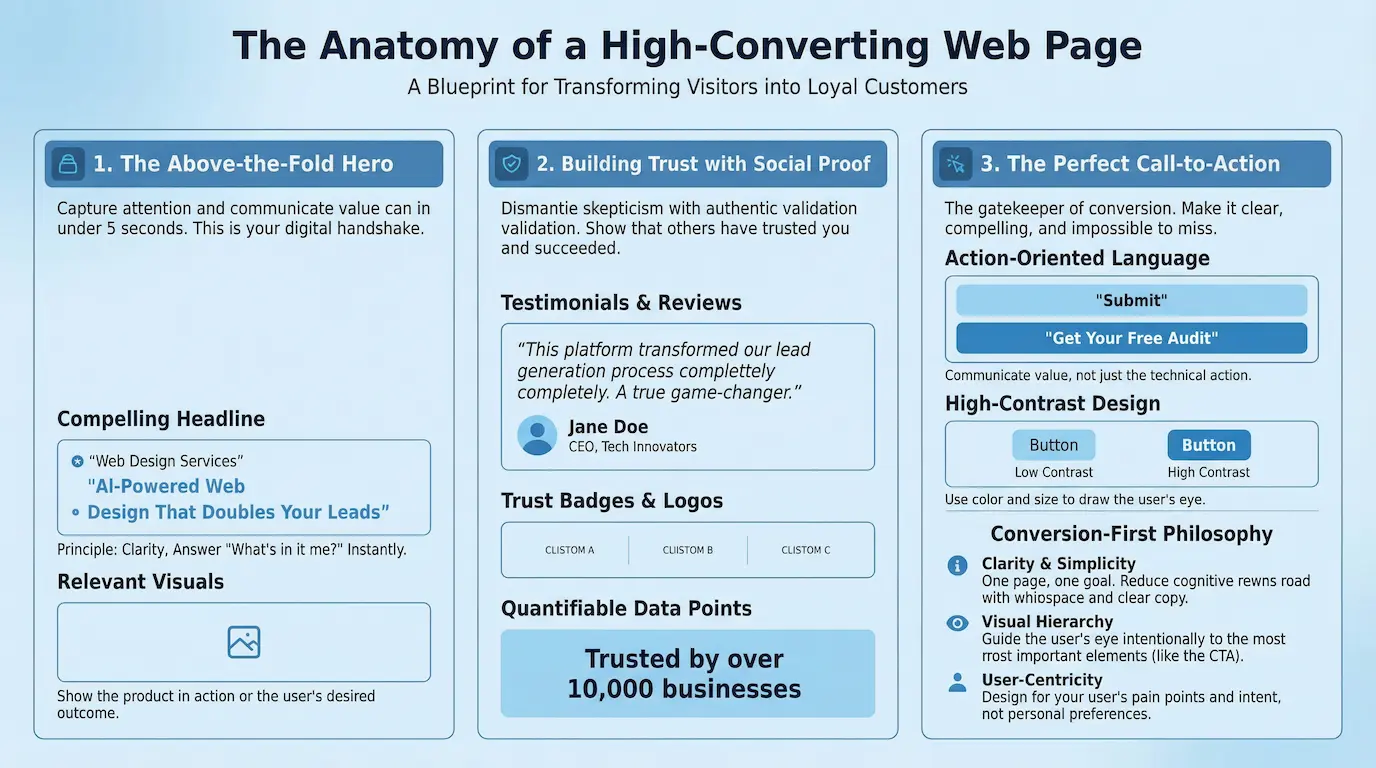
This is the first impression — the digital handshake. It must capture attention and communicate value in under five seconds. Its core components are:
- A Compelling Headline: Ditch vague statements. Your headline must articulate a clear, benefit-driven value proposition. Instead of "Web Design Services," use "AI-Powered Web Design That Doubles Your Leads."
- A Relevant Hero Image or Video: Use high-quality visuals that show your product in action or reflect your target audience's desired outcome. Stock photos of generic office meetings will not suffice.
- A Prominent Primary CTA: The user should know exactly what to do next without having to think. This button is their first entry point into your conversion funnel.
The Persuasive Call-to-Action (CTA)
Your CTA is the gatekeeper of conversion. An effective CTA is clear, compelling, and strategically placed. Use strong, action-oriented language that communicates value — "Get Your Free Audit" is infinitely more persuasive than a passive "Submit." The design itself matters; button color should create high contrast with the background to draw the eye, a principle supported by established usability guidelines. Place your primary CTA above the fold and repeat it after key sections on longer pages.
Building Trust with Social Proof
Users are inherently skeptical. Social proof is your tool for dismantling doubt and building credibility. It demonstrates that others have trusted you and achieved positive results. Integrating this element is a cornerstone of the web page design best practices. Effectively deploy it by:
- Showcasing Testimonials and Reviews: Use direct quotes from real clients, complete with names, companies, and photos for maximum authenticity.
- Displaying Trust Badges and Logos: Feature logos of well-known clients, industry awards, or security badges (like SSL certificates) to provide instant validation.
- Leveraging Data Points: Quantifiable proof is powerful. A simple line like "Trusted by over 10,000 businesses" can be more effective than a lengthy paragraph.
Explore our portfolio for real-world examples of landing pages that implement these elements and consistently deliver strong conversion metrics.
AI-Powered Web Page Design That Doubles Your Leads
We build high-converting websites with unmatched speed and precision. See our transparent pricing and fast delivery model.
Start Your ProjectWeb Page Design 2026 vs 2024: What Changed
The web page design landscape has evolved significantly between 2024 and 2026. Staying current with these shifts is essential for businesses that want their digital presence to remain competitive. Here is what changed and why it matters for your next project.
Don't Fall Behind
If your website still follows 2024 design standards, you risk losing ground to competitors who have adopted the 2026 web page design best practices. The shift toward AI-powered development, mobile-first layouts, and sub-second performance is not optional — it is the new baseline for competitive web design.
UX/UI Best Practices for Web Page Design That Converts
Although they are often used interchangeably, User Experience (UX) and User Interface (UI) are two distinct disciplines that together form the technical backbone of any landing page that converts visitors into customers. UX encompasses the overall experience a user has when interacting with your website — the flow, logic, and satisfaction of completing a task. Having a smooth UX means the user can locate what they need, get their questions answered, and fulfill their objectives without friction. UI refers to the visual interface elements — buttons, forms, typography, and layout — that users interact with directly. A polished UI makes users feel confident and in control, making every action feel simple and predictable.
When combined, optimal UX/UI design transforms a beautiful page into a high-performance conversion machine. Neglecting these principles is like building a supercar with a flawed engine; it looks great but goes nowhere.
Intuitive Navigation and Structure
Your landing page must provide the path of least resistance. A confused user will leave. This begins with a well-defined information architecture that organizes content logically, allowing users to find what they want without confusion. This principle of clarity is a cornerstone of established accessibility and usability standards, which emphasize creating digital experiences that work for everyone. To achieve this, focus on:
- Simple Menus: Adopt a "less is more" approach. Only include essential links that guide users toward your primary goal.
- Logical Flow: Arrange content hierarchically, with the most critical information presented first.
- Clear Orientation: Use breadcrumbs on multi-step pages and a clean footer to help users understand where they are at all times.
Mobile-First and Responsive Web Page Design
By 2026, designing for mobile devices first is non-negotiable. The majority of global web traffic comes from smartphones, and a poor mobile experience means lost revenue. The most significant aspect of great web page design in 2026 is ensuring a seamless experience regardless of screen size. This is not simply about shrinking your desktop site. It requires touch-friendly buttons, legible font sizes on small screens, and layouts that adapt naturally to vertical scrolling. According to Google's web.dev guidelines, mobile page experience directly influences search rankings.
Performance and Page Speed
Every second counts. Slow loading times damage your conversions and harm your SEO rankings. Users expect instant results; even a one-second delay can reduce conversions by up to 7%. Optimize everything for maximum speed: compress images, leverage browser caching, implement lazy loading, and minimize render-blocking resources. Performance is not an afterthought — it is a critical component of the web page design best practices that separate high-converting sites from underperforming ones.
Visual Design That Sells: Color, Typography, and Imagery
Once the logical structure of your landing page is complete, the next step is visual design. This is where science meets art. Good aesthetics are not about decoration — they are a strategic tool used to build trust, evoke specific emotions, and guide your visitor directly toward the call-to-action. The best web page design practices in 2026 ensure that every visual element contributes to turning visitors into customers.
Color Psychology in Web Page Design
Color is a powerful communication tool that directly affects how users think and behave. A carefully chosen color palette reinforces brand recognition and establishes a professional appearance. To create optimal balance, we apply the 60-30-10 rule: 60% dominant color for backgrounds and large surfaces, 30% secondary color for contrast and visual interest, and 10% accent color reserved for high-priority elements like CTA buttons. This structured approach creates clear visual pathways that users can follow intuitively. Research from Smashing Magazine consistently shows that strategic color usage can improve click-through rates by 15-25%.
Typography That Builds Trust
Your typography is the visual voice of your brand. Poorly readable or inconsistent fonts create friction and erode credibility instantly. A well-designed type system is key to making text easy to read and easy to scan. To achieve this, you must:
- Prioritize Readability: Choose clean, web-optimized fonts like Inter, Open Sans, or Lato for body text. Your message is useless if it cannot be easily read.
- Establish Hierarchy: Use font size, weight (bold, regular), and style to distinguish headlines from subheadings and body copy. This helps users scan and find information quickly.
- Limit Your Choices: Stick to a maximum of two or three font families to maintain a professional and uncluttered appearance.
Strategic Use of Imagery and Icons
Images communicate value faster than text. However, the wrong images can undermine trust. Avoid generic stock photography that feels inauthentic. Instead, use high-quality, authentic images of your team, your product in use, or real customers to create a genuine human connection. Complement images with simple, universally recognized icons that enhance scannability and visually represent key benefits or features.
Every visual choice — from the hue of a button to the weight of a font — contributes to your conversion rate. At Vezert, our AI-powered, conversion-first approach ensures your landing page is not only beautiful but engineered to drive measurable results. View our pricing to see how we make professional web page design accessible for businesses of all sizes.
Pro Tip: The 5-Second Test
Show your web page to someone for five seconds, then ask them what it is about and what action they should take. If they cannot answer both questions correctly, your visual hierarchy and messaging need improvement. This simple test is one of the most effective web page design validation techniques available — and it costs nothing.
Transform Your Web Page Design Today
Join hundreds of businesses that have upgraded to conversion-first web page design. Our AI-powered process delivers results in weeks, not months.
Get a Free Consultation
Your Blueprint for Web Page Design Success in 2026
As we look toward 2026 and beyond, it is clear that high-quality web design is more than just how things look. The future belongs to pages built on data-driven UX, compelling visuals, and a relentless focus on conversion. From the core principles of visual hierarchy and user-centricity to the anatomy of a perfect page and the strategic application of AI, mastering these elements is key to designing a web page that drives measurable business growth.
Putting this knowledge into action is the next critical step. At Vezert, we do not just follow trends — we set them. As an AI-first web design studio, we live by a conversion-first design philosophy. We combine cutting-edge technology with proven marketing science to build stunning, high-performing pages. Our commitment to transparent pricing and fast delivery eliminates the guesswork and accelerates your path to success.
Ready to build a website that transforms visitors into loyal customers? Let us discuss how our AI-powered process can bring your vision to life. Get a Free Consultation on Your Web Page Design Project today and start building the future of your digital presence. You can also explore our full services overview or browse our blog for more insights on web design, conversion optimization, and digital strategy.
On This Page
- Core Principles of High-Converting Web Page Design in 2026
- Anatomy of a Perfect Web Page: Key Design Elements Dissected
- Web Page Design 2026 vs 2024: What Changed
- UX/UI Best Practices for Web Page Design That Converts
- Visual Design That Sells: Color, Typography, and Imagery
- The Vezert Process: Building High-Converting Web Pages with AI
- Your Blueprint for Web Page Design Success in 2026


The Vezert Process: Building High-Converting Web Pages with AI
Understanding the principles of a high-converting landing page is the first step. Executing them with precision, speed, and data-backed strategy is what separates good from exceptional. At Vezert, we have engineered a Conversion-First process that transforms the best practices discussed in this guide into a tangible, revenue-generating asset for your business.
Our approach combines deep human expertise with the unparalleled efficiency of artificial intelligence, ensuring we deliver optimal digital solutions that do not just look great — they perform. This is what makes our web page design process uniquely suited for 2026 and beyond.
Step 1: Conversion-Focused Strategy and UX
Every successful page is built on a rock-solid foundation of strategy. We start by diving deep into your business objectives, target market, and competitive landscape. From there, we carefully map the ideal user journey, identifying potential friction points and creating a smooth flow from first click to conversion. This research culminates in data-informed wireframes that serve as the architectural blueprint for your page, ensuring every element has a clear purpose. Our UX/UI design service is built around this research-driven methodology.
Step 2: Data-Driven UI and Visual Design
With the strategy set, our design team translates the blueprint into a stunning, pixel-perfect interface. We apply the principles of visual hierarchy, color psychology, and persuasive design to create a compelling yet intuitive user experience. This is where we ensure web page design best practices are implemented to not only reflect your brand identity but to actively guide users toward your primary call-to-action.
Step 3: AI-Powered Development and Launch
This is where Vezert's AI-first approach revolutionizes the workflow. Our AI agents write clean, efficient, and W3C-compliant code at a speed traditional development cannot match, drastically reducing turnaround time without sacrificing quality. All pages are fully tested prior to launch to ensure every visitor has a flawless experience. This includes:
The result is a high-performing, technically sound landing page ready to drive sales and capture leads from day one. Explore our corporate website and web portal services for more complex projects.
Ready to build a page that converts? Start Your Project.