

On This Page
- Why Does AI-First Web Development Matter for Modern Businesses?
- AI-First Web Development Timeline: Key Milestones From 2020 to 2026
- How Does AI Fit Into Today's Website Development Workflow?
- AI-First Web Development for Routine Task Automation
- Faster Analysis, Planning, and Prototyping
- Stability and Accuracy Through AI-Assisted Delivery
- How Does AI-First Development Improve Conversion Optimization and UX?
- Balanced Human-AI Collaboration in Modern Website Development
- What Are the Practical Benefits of AI-First Website Optimization?
- Where AI-First Web Development Works Best
- Final Thoughts on the AI-First Approach
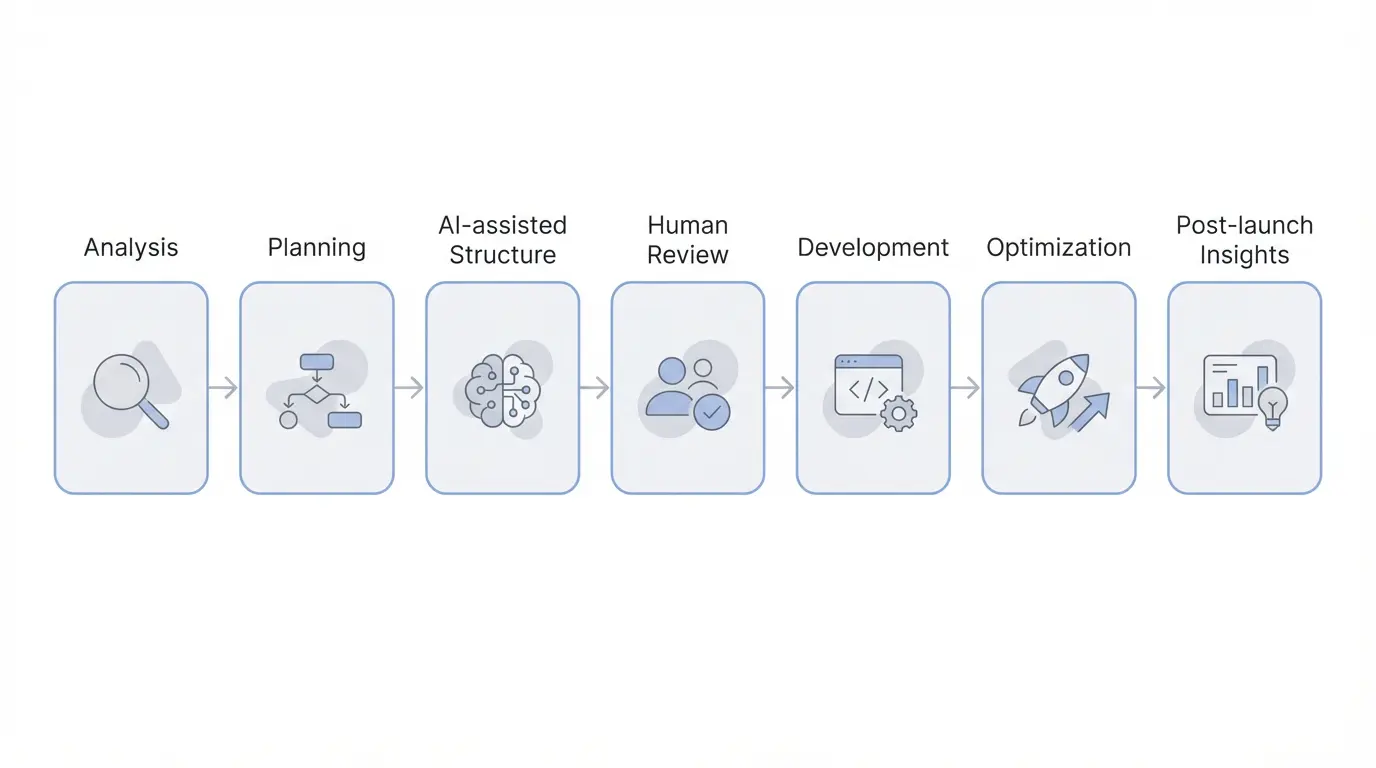
AI-first web development is a methodology where AI tools are embedded into every stage of the design and engineering workflow — from initial research and planning through build, testing, and post-launch optimization. Rather than treating AI as an optional add-on, this approach makes intelligent automation a foundational layer that helps teams eliminate repetitive tasks and focus on decisions that create measurable business value. According to McKinsey's 2024 State of AI report, organizations that integrate AI into core workflows report a 20–30% improvement in developer productivity.
In this article, you will learn how an AI-powered development process works in practice, why it strengthens human expertise rather than replacing it, and how it contributes to better outcomes in website optimization, UX quality, and long-term performance. Whether you are planning a new landing page or scaling a corporate website, understanding this approach will help you make better decisions about your next digital project.
Why Does AI-First Web Development Matter for Modern Businesses?
Digital products have evolved far beyond simple online presence. Companies now expect their websites to facilitate sales, streamline communication, and support day-to-day operations, which raises the bar for both quality and speed. Business owners and startups seek predictable results, clear structure, and the ability to iterate fast, but traditional website development workflows often fall short.
AI-first web development closes this gap by making processes more precise and adaptable. Modern teams apply AI to accelerate analysis, eliminate redundancies, and prepare structured data that designers and engineers can act on immediately. According to the McKinsey 2024 State of AI report, 65% of organizations now use generative AI in at least one business function — up from 33% in 2023. A separate GitHub Developer Survey (2024) found that 92% of developers already use AI coding tools, with those developers completing tasks 55% faster on average. As a result, web design agency teams can respond faster to changing business needs, maintain consistency across deliverables, and ship products that perform well from day one.
AI-First Web Development Timeline: Key Milestones From 2020 to 2026
Understanding how AI-first web development reached its current state helps explain why the methodology is now considered essential. Here is a condensed timeline of the most significant milestones.
Key Takeaway
The transition from AI-assisted to AI-first web development happened gradually over six years. By 2026, teams that have not adopted this model risk falling behind in both speed and quality compared to agencies that treat AI as a foundational workflow component.
How Does AI Fit Into Today's Website Development Workflow?
AI in website development has become a foundational part of how modern teams plan, build, and refine digital products. It enhances clarity, speeds up decision-making, and reduces workload on tasks that do not require creativity or strategic thinking. This frees up specialists to concentrate on aspects that have a direct impact on the success of website development and long-term website optimization.
According to Google's Web.dev performance guidance, modern web development increasingly relies on automation for performance auditing, accessibility checking, and code quality assurance — with studies showing that every 100ms improvement in page load time can increase conversions by up to 1% (Google, 2023). AI-first workflows take this further by embedding intelligent automation into every phase of the project lifecycle. Research from Nielsen Norman Group confirms that AI-assisted UX workflows reduce iteration cycles by an average of 30–40%, enabling teams to validate designs with users far earlier in the project timeline.

AI-First Web Development for Routine Task Automation
AI automates the activities that slow down the delivery process, including:
- Generating initial content drafts and page structure outlines.
- Organizing and categorizing project information from multiple sources.
- Preparing design variations for comparative analysis and A/B testing.
Engineers remain essential to this process. They:
- Define the technical direction and architecture.
- Review and refine AI-generated output.
- Ensure that every decision aligns with business objectives.
Human oversight ensures that AI-powered development serves the project goals. This balance guarantees both the quality of the finished product and the efficiency of the process.
Faster Analysis, Planning, and Prototyping
AI accelerates the initial project phases by:
- Processing large volumes of market research and competitor data rapidly.
- Generating initial wireframes, user flows, and logic sequences.
- Proposing multiple solution approaches for team evaluation.
These capabilities compress the discovery stage and allow teams to move into execution with a stronger roadmap. For a modern web design agency, this means faster progress without compromising analytical depth.
AI-enhanced planning helps projects begin with less uncertainty and more clearly defined priorities, reducing the risk of costly mid-project pivots.
Stability and Accuracy Through AI-Assisted Delivery
AI contributes to more stable development by:
- Detecting inconsistencies and missing elements early in the build.
- Validating implementation steps against the project specification.
- Reducing errors between iterations through automated regression checks.
This produces a more predictable and clean AI-powered development process, particularly when dealing with complex features or multi-page structures.
Combined with expert review, AI-assisted delivery enhances both the accuracy and consistency of the final product, strengthening reliability across the entire UX/UI design lifecycle.
How Does AI-First Development Improve Conversion Optimization and UX?
AI plays a practical role in conversion optimization by helping teams validate ideas quickly and understand how users interact with a digital product. It provides data-driven insights to support UX decisions without removing the creative and analytical contribution of human designers.
AI assists the process by:
- Running preliminary hypothesis tests and comparing variant performance.
- Analyzing user paths, drop-off points, and behavioral patterns.
- Suggesting layout and content adjustments to improve page logic and usability.
These insights help teams refine layouts, messaging, and interaction flows with greater precision. While AI provides directional guidance, human specialists make the final UX/UI decisions to ensure that designs remain on-brand, contextually appropriate, and aligned with business goals.
This combination of AI-driven analysis and human oversight produces stronger interfaces, more logical page structures, and a more consistent user experience that drives higher conversions.
Real-World Impact
Teams that adopt AI-first web development for conversion optimization typically reduce their testing cycle time by 40 to 60 percent. Faster testing means more iterations per sprint, which compounds into significantly better conversion rates over time compared to teams relying on manual analysis alone.
Balanced Human-AI Collaboration in Modern Website Development
In AI-first web development, both AI tools and human expertise contribute to the final outcome. AI enhances speed and consistency, while specialists provide the judgment, strategy, and design quality that automated systems cannot replicate. This partnership allows teams to maintain high standards without compromising depth or accuracy.
What AI Handles Well
Tasks that AI manages most effectively include:
- Accelerating repetitive processes to maintain development velocity.
- Evaluating multiple variants and identifying trends or potential issues.
- Structuring data, content, and page architecture for clarity and consistency.
These capabilities remove operational friction and provide a stronger starting point for design and development work.
What Specialists Deliver Better
Human expertise remains critical in areas where context, creativity, and judgment are essential:
- Interpreting brand identity and translating it into visual design.
- Solving complex technical problems that require architectural decisions.
- Setting strategic priorities, defining product logic, and mapping user flows.
Specialists ensure that every project stays grounded in real business needs and delivers long-term value in areas where AI alone cannot provide adequate guidance.
Why the Balance Matters
A balanced approach ensures that the AI-first methodology is both efficient and meaningful:
- Combining AI with expert oversight consistently produces better outcomes than either approach alone.
- Relying exclusively on AI tends to produce generic, templated results.
- Relying solely on manual processes slows delivery and limits scalability.
This combination delivers consistency, clarity, and long-term value across the various stages of website optimization. Projects benefit from both speed and precision, maintaining the quality level that businesses expect from a modern web design agency.

What Are the Practical Benefits of AI-First Website Optimization?
An AI-first approach to web development delivers tangible, measurable benefits for businesses that depend on their websites for growth. By incorporating AI into core processes, teams achieve faster and more consistent results, particularly in areas related to website optimization and long-term performance.
Faster time-to-market
AI accelerates analysis, content generation, and validation, shortening the gap between planning and delivery. Teams using AI-assisted workflows have reported 30–50% reductions in discovery and prototyping time. This is especially valuable when launching landing pages, publishing updates, or adapting to new business requirements.
Improved performance across pages
AI detects performance issues early — slow-loading assets, inefficient structure, or missing content elements — making it easier to maintain a consistent user experience from launch onward. According to Google's Core Web Vitals research, pages that pass Core Web Vitals thresholds see 24% fewer session abandonment events.
Better SEO structure from the start
AI facilitates the creation of clean information architecture, logical heading hierarchies, and consistent content patterns. These structural improvements make sites easier for search engines to crawl and help pages rank without requiring extensive manual SEO remediation after launch.
More efficient post-launch analysis
After launch, AI assists in analyzing user behavior, identifying friction points, and prioritizing improvement opportunities. This makes continuous optimization more systematic and less resource-intensive over the long term.
By embedding AI directly into the workflow, teams gain a higher level of clarity throughout the entire website optimization lifecycle. This leads to more predictable delivery and improved long-term outcomes for businesses that invest in stable, high-performing digital products.
Where AI-First Web Development Works Best
This AI-first methodology delivers the strongest results in areas where fast, well-organized, and precise execution directly affects business outcomes. The methodology is particularly valuable across three core product types: landing pages, corporate websites, and complex web portals.
Teams that combine AI capabilities with deep engineering knowledge consistently outperform those using either approach alone. The Vezert approach to AI-first development demonstrates how this model improves efficiency without compromising quality standards.
Framework selection also shapes what AI-assisted workflows can accomplish. Our Webflow vs Next.js practical comparison examines how both platforms perform in AI-augmented development scenarios, from content management to deployment flexibility.
Landing Pages That Need Clear Messaging and Speed
Landing pages must load fast and communicate value instantly. AI helps teams:
- Quickly generate wireframes and content outlines based on proven conversion patterns.
- Test multiple messaging directions before committing to a final version.
- Optimize content structure to keep messaging focused and relevant to the target audience.
These benefits reduce time-to-launch and enable faster concept validation.
Corporate Websites That Require Structure and Consistency
Corporate websites depend on clear hierarchy and professional credibility. AI supports these requirements by:
- Defining information architecture early in the planning phase.
- Maintaining uniformity across sections, page templates, and content modules.
- Simplifying project planning to keep development on track and scalable.
The result is stronger structural integrity and lower long-term maintenance costs.
Web Portals as Long-Term Digital Products
Web portals involve complex logic and require sustained stability and accuracy. AI assists engineering teams by:
- Detecting structural inconsistencies before they reach production.
- Validating interrelated features across multiple system layers.
- Reinforcing quality control throughout the development cycle.
These capabilities are essential for maintaining large-scale, data-driven systems where reliability is non-negotiable.
Important Consideration
The AI-first approach produces the strongest results when technology and human expertise work together. Using AI alone generates templated, generic output, while manual-only processes cannot match the speed and consistency that modern businesses require. The optimal approach combines both.
Final Thoughts on the AI-First Approach
AI-first web development helps teams deliver clearer, faster, and more stable results, making it increasingly relevant for businesses that rely on their websites as core digital assets. By accelerating early-stage analysis, supporting structured processes, and enhancing the quality of ongoing website optimization, this approach strengthens the entire development lifecycle.
For companies, the value lies in predictability, efficiency, and the ability to iterate quickly without losing strategic focus. An AI-powered development process also allows specialists to concentrate on creative and strategic work, which is where human judgment has the greatest impact.
The best outcomes emerge when AI and expert teams work together. This combination of speed and precision enables modern studios to maintain consistent quality across landing pages, corporate websites, and complex web portals.
In the current landscape, the majority of competitive agencies have already adopted this model as a core part of their practice. This approach is no longer experimental; it is a proven methodology for delivering high-quality digital products at the speed modern businesses demand.
If you are considering a new website project or looking to improve your existing digital presence, explore our pricing or reach out to discuss your goals.
Accelerate Your Website Project
Let Vezert combine AI-powered efficiency with expert craftsmanship to deliver a fast, optimized website that drives results.
Start a ProjectOn This Page
- Why Does AI-First Web Development Matter for Modern Businesses?
- AI-First Web Development Timeline: Key Milestones From 2020 to 2026
- How Does AI Fit Into Today's Website Development Workflow?
- AI-First Web Development for Routine Task Automation
- Faster Analysis, Planning, and Prototyping
- Stability and Accuracy Through AI-Assisted Delivery
- How Does AI-First Development Improve Conversion Optimization and UX?
- Balanced Human-AI Collaboration in Modern Website Development
- What Are the Practical Benefits of AI-First Website Optimization?
- Where AI-First Web Development Works Best
- Final Thoughts on the AI-First Approach