

On This Page
- How Much Does Web Portal Development Cost in 2026?
- What Are the 3 Cost Tiers? Simple, Mid, Enterprise
- What 5 Factors Drive Web Portal Cost?
- How Long Does Web Portal Development Take? Timeline by Type
- What Hidden Costs Most Buyers Miss
- How AI-Assisted Development Cuts 30-45% of Time
- How to Stay on Budget: 5 Practical Rules
- When Does a Custom Portal Pay Back? ROI Framework
- How to Choose a Web Portal Development Partner
Web portal development cost is the total budget required to design, build, integrate, secure, and launch a multi-user web portal — typically $30,000-$60,000 for mid-tier B2B portals over 8-12 weeks. Five factors drive the number: scope (page count + features), tech stack complexity, integrations, security and compliance level, and team composition.
Most cost guides give you a vague "it depends" answer with a $5K-$500K range. That is not useful for budgeting. This guide gives concrete tier ranges, breaks down the five factors that drive cost, lists hidden costs most buyers miss, and shows how AI-assisted development compresses typical 12-18 week portal timelines to 6-9 weeks. The numbers come from Vezert client portfolio data across 25+ portal launches in 2024-2026.
For broader context on portal types and architecture, see our complete web portal development guide. For B2B-specific portal scope, see client portal software development guide. For build vs SaaS comparison, see custom web portal vs SaaS portal builder. For a full pricing transparency view across Vezert services, see corporate website design pricing.
Web Portal Development Cost, The Numbers
Average mid-tier B2B portal: $45,000, 9.5 weeks (Vezert client portfolio average across 12+ recent projects, 2024-2026). According to Forrester research on B2B digital transformation, 67% of the B2B buyer journey is digital before sales contact. AI-augmented teams compress 12-18 week traditional builds to 6-9 weeks based on GitHub Copilot productivity research. Maintenance typically runs 10-25% of build cost per year, per HTTP Archive Web Almanac 2024 infrastructure cost benchmarks. 47% of timeline overruns trace to scope decisions made AFTER discovery (Vezert client retro 2024-2026).
How Much Does Web Portal Development Cost in 2026?
Three cost ranges cover most B2B web portal projects in 2026. The right tier for your project depends on user count, integration depth, and compliance scope. Most teams underestimate by skipping the integration count and overestimate by adding features that nobody uses.
Quick Answer for Budget Planning
- Simple web portal: $9,000-$20,000 one-time, 4-6 weeks. 5-10 pages, basic auth, no integrations, 50-100 users.
- Mid-tier B2B portal (most common): $30,000-$60,000 one-time, 8-12 weeks. 10-25 pages, RBAC, 2-3 integrations, 100-500 users.
- Enterprise portal: $80,000-$200,000+ one-time, 14-24 weeks. 25+ pages, multi-tenant, 5+ integrations, audit logs, SSO, 1,000+ users.
Per Vezert portfolio data, the average B2B portal lands at $45,000 over 9.5 weeks. That is the mid-tier sweet spot. Simple portals are usually too constrained for serious B2B use; enterprise portals are usually over-scoped for non-regulated industries. A paid 2-week discovery sprint ($5,000) typically narrows the final SOW range to within $10-15K before a single line of code is written.
Why "It Depends" Is Usually a Cop-Out
Agencies that quote "it depends, anywhere from $5K to $500K" without asking specific questions are guessing. After 30 minutes of structured discovery (user count, integration count, compliance scope, role count), a credible agency narrows the range to within $10-15K. If the agency cannot do that on the first call, they have not built enough portals to know.
What Are the 3 Cost Tiers? Simple, Mid, Enterprise
The full tier breakdown with what is included at each price level.
What 5 Factors Drive Web Portal Cost?
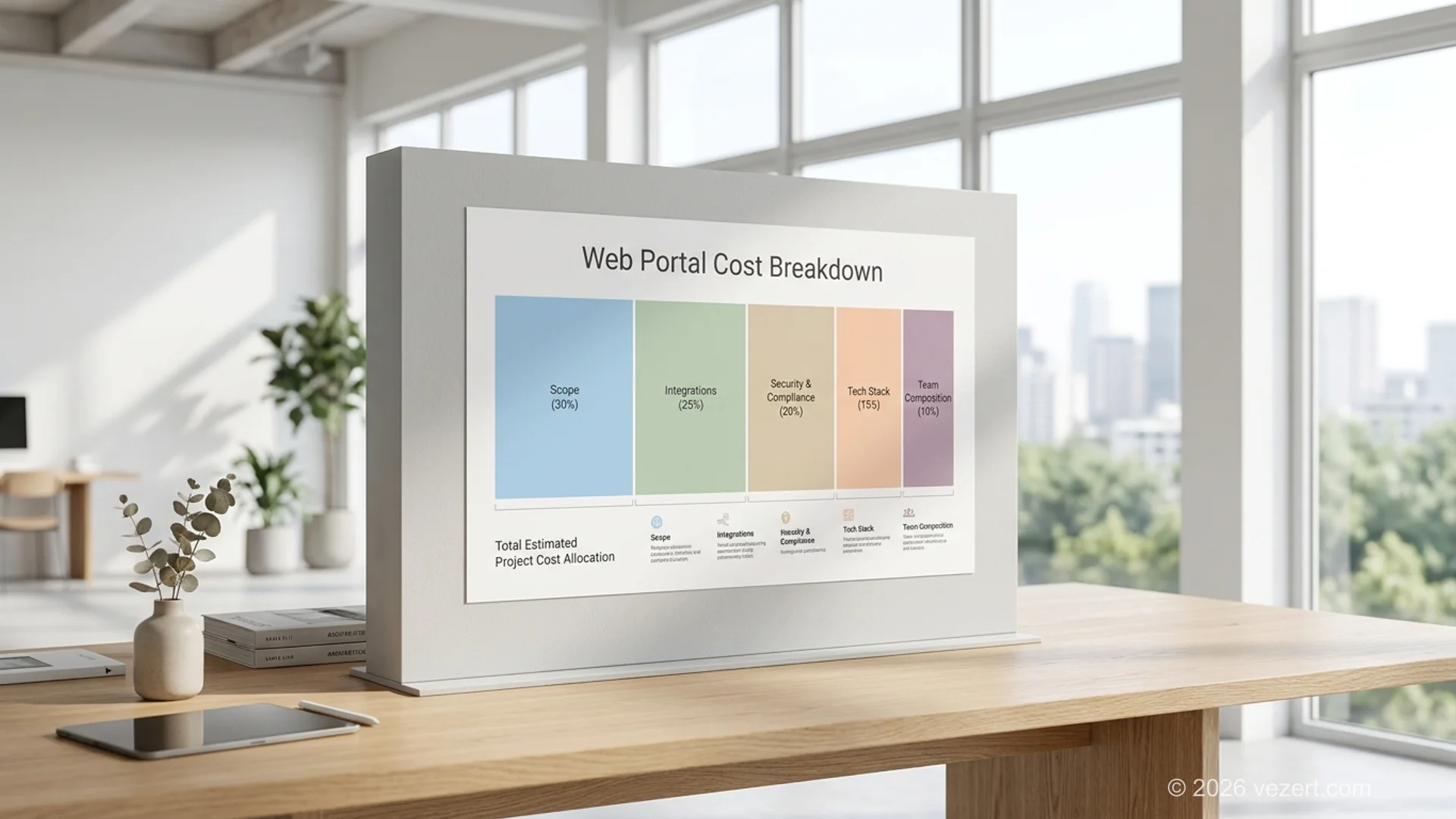
Five factors account for ~85% of cost variance across portal projects. Get accurate scope on each before signing a contract and the cost stops being a surprise.
1. Scope (Page Count + Features)
The most direct cost driver. A 5-page portal with auth costs less than a 25-page portal with dashboards, document hubs, and ticketing. Each additional feature is roughly 1-2 weeks of effort. Lock the feature list before kickoff or watch the budget drift.
2. Tech Stack Complexity
Greenfield Next.js + Postgres + Auth0 is the cheapest path. Adding microservices, Kafka pipelines, or custom auth doubles complexity and 30-50% of cost. Pick boring, proven technology unless you have a reason not to.
3. Integration Count
Each native integration (CRM, billing, e-signature, identity provider, email, document storage) is roughly 1-2 weeks of build plus ongoing maintenance. Vague "future integrations" become budget creep. Lock the day-one integration list, and queue future integrations as separate projects.
4. Security and Compliance Level
Generic SaaS-style security (TLS, password auth, basic RBAC) is included in mid-tier pricing. SOC2 Type II readiness adds ~10-20% to budget. HIPAA + BAAs adds ~20-35%. ISO 27001 readiness adds ~15-25%. FedRAMP doubles the project. Compliance scope is the single biggest cost-amplifier most buyers underestimate.
5. Team Composition
A senior agency team with 8-15 years of portal experience charges $175-300 per hour in 2026. A junior team or freelancer offshore charges $40-100 per hour. The 3-5x rate gap shows up in delivery quality, not the invoice. Pick the team for the project's risk profile, not the cheapest hourly rate.
How Long Does Web Portal Development Take? Timeline by Type
Timeline depends on portal type and team approach. AI-augmented teams compress every tier by roughly 30-45%.
How AI-Assisted Development Cuts 30-45% of Time
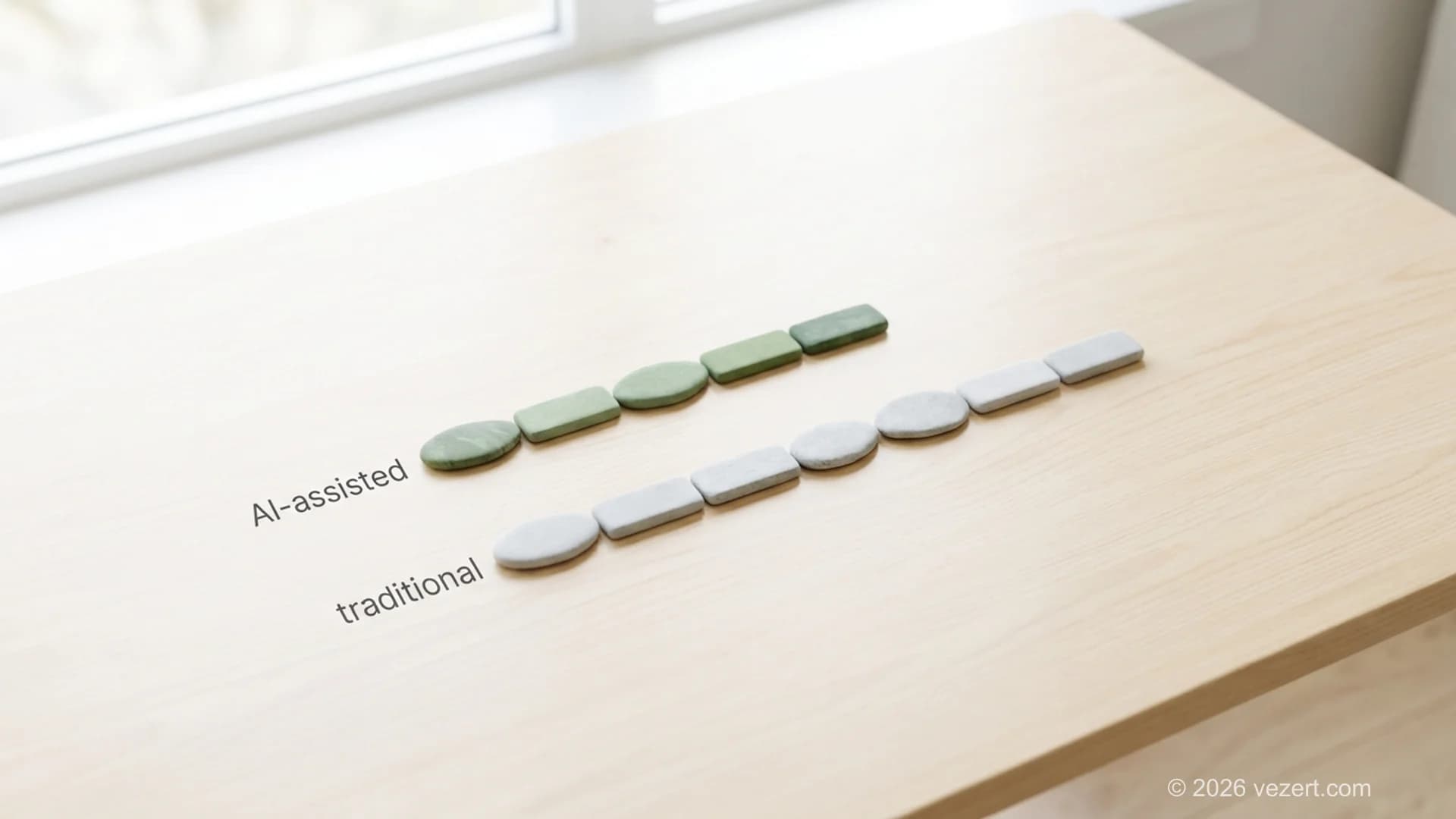
The 12-18 week portal build that was standard in 2022 is now 6-9 weeks for teams using AI assistance well. The compression is not from AI writing the portal end-to-end. It is from AI removing friction in specific phases.
How to Stay on Budget: 5 Practical Rules
Most portal cost overruns are not technical. They are scope decisions made too late. Five rules keep portal projects on budget.
1. Lock the Role Matrix in Week 1
"We need user roles" becomes 14 distinct permission tiers in week 6 if not locked early. Write the role matrix on paper before development starts. Get every stakeholder to sign off. Treat changes after week 1 as scope changes with cost.
2. List Day-One Integrations Explicitly
Decide which 2-4 integrations ship at launch. Every additional integration adds 1-2 weeks. Defer "nice to have" integrations to a Phase 2 retainer. Vague "we will figure it out" integrations become 30% budget overruns.
3. Define Compliance Scope Before Architecture
GDPR is included in mid-tier. SOC2, HIPAA, ISO 27001, FedRAMP each add cost. Decide which apply BEFORE the architecture phase. Compliance changes after architecture cost 3-5x more than compliance designed in from week 2.
4. Pick the Tier, Not the Features
Buyers often pick a feature list and let cost emerge. Better: pick the tier (Simple/Mid/Enterprise) and constrain features to fit. Tier-first thinking caps maximum cost.
5. Plan Maintenance Budget Before Launch
If you cannot afford 10-25% of build cost per year in maintenance, do not build the portal. Maintenance-starved portals decay faster than they appreciate. Budget the year-2 spend before signing the year-1 contract.
From the trenches
"Most cost-overruns we see are not underestimates of the build. They are underestimates of week 4, when 'we need user roles' becomes 'we need 14 permission tiers per role.' The fix is not more discovery. It is enforcing scope decisions in week 1 with a written role matrix everyone signs.", Vezert engagement lead, after 25+ portal cost negotiations
When Does a Custom Portal Pay Back? ROI Framework
A web portal pays back when the time it saves your team plus the support it deflects plus the retention it drives exceeds the build and maintenance cost. For most B2B portals, the math works in 12-18 months. Three calculations make the ROI concrete.
1. Internal Time Saved
Calculate hours per week your team spends on email triage, file delivery, status updates, and manual billing answers. Multiply by team hourly cost. Annualize.
Example: 4 partners × 8 hours per week × $200/hour × 50 weeks = $320,000 in partner-hours per year. A portal that cuts triage by 70% saves $224,000 per year. A $40K portal pays back in 2.2 months on internal time alone.
2. Support Ticket Deflection
Average cost per support ticket (industry data): $15-50. Calculate monthly tickets × cost × deflection rate × 12 months.
Example: 800 tickets/month × $25/ticket × 40% deflection × 12 months = $96,000 per year saved. A $40K portal pays back in 5 months on support deflection alone.
3. Retention and Expansion
Client retention improves when portals reduce friction. Even a 2% retention lift on a $1M ARR business is $20K per year per percentage point of ARR. Most B2B portal redesigns drive 3-7% retention lift in the first year.
Conservative estimate: $1M ARR × 3% retention lift = $30K per year. Combined with the above, ROI math typically shows mid-tier B2B portals paying back in 6-12 months.
When the Math Does Not Work
For businesses under 10 active clients, with low support volume, and high partner-time use already, the math may not justify custom portal investment. SaaS portal builders make sense at this scale. See our custom vs SaaS portal builder comparison for the decision matrix.
How to Choose a Web Portal Development Partner
The cost question matters less than the partner question. A great partner at the high end of the price range delivers more value than a cheap partner who ships a portal that needs rebuilding in 18 months. Five signals separate strong portal partners.
- They give specific cost ranges in the first call, not "it depends." After 30 minutes of structured discovery, the range should narrow to within $10-15K.
- They have an opinion on tech stack with reasons. Generic agencies build whatever you ask for. Senior partners have opinions: "We use Next.js + Postgres + Auth0 for 90% of B2B portals because [reasons]."
- They show portal case studies with concrete metrics. Not "we built a portal" but "we built a portal, deflected 47% of support, shipped in 9 weeks."
- They use AI assistance transparently. Senior engineers own architecture and security; AI accelerates components and tests. Hidden AI is bad; honest AI is good.
- They talk about maintenance from day one. Agencies that focus on the build and ignore maintenance leave you with a portal that decays. Strong partners offer maintenance retainers as part of scoping.
For a deeper agency-selection framework, see how to choose a web design agency. For a secure web portal development service with all five signals built in, start a conversation with Vezert. For pricing transparency across Vezert services, see corporate website design pricing and our website development timeline breakdown.
On This Page
- How Much Does Web Portal Development Cost in 2026?
- What Are the 3 Cost Tiers? Simple, Mid, Enterprise
- What 5 Factors Drive Web Portal Cost?
- How Long Does Web Portal Development Take? Timeline by Type
- What Hidden Costs Most Buyers Miss
- How AI-Assisted Development Cuts 30-45% of Time
- How to Stay on Budget: 5 Practical Rules
- When Does a Custom Portal Pay Back? ROI Framework
- How to Choose a Web Portal Development Partner