

On This Page
- PoC vs Prototype vs MVP: Why These Terms Matter
- What Is a Proof of Concept (PoC)?
- What Is a Prototype in Product Development?
- What Is an MVP (Minimum Viable Product)?
- PoC vs Prototype vs MVP: Side-by-Side Comparison
- PoC, Prototype, and MVP in Action: Real-World Examples
- PoC vs Prototype vs MVP Costs and Timelines in 2026
- How to Choose Between PoC, Prototype, and MVP
- PoC vs Prototype vs MVP: Mistakes That Waste Budget
- Start With Clarity, Build With Confidence
A Proof of Concept (PoC), prototype, and MVP are three distinct product validation stages, each answering a different strategic question before committing development budget. If you are planning a new web product, choosing the right approach is essential to avoid wasting months on unvalidated features.
Each one answers a fundamentally different question about your project. A proof of concept asks "can we build this?" A prototype asks "what should it look and feel like?" An MVP asks "will people actually pay for it?" Picking the wrong one, or skipping straight to development, is one of the most expensive mistakes I see businesses make.
This guide breaks down what each approach actually involves, when it makes sense to use one over another, and how much you should expect to spend. Whether you're a startup founder testing a new idea or a business owner planning a corporate website or web portal, this will help you make a smarter first move.
PoC vs Prototype vs MVP: Why These Terms Matter
Here is the fundamental truth most engineering leaders miss: PoCs, prototypes, and MVPs are not competing approaches. They are sequential tools in a disciplined risk reduction framework designed to validate complex product assumptions before burning capital. Each format answers a distinctly different business question at a different development stage.
Think of it this way:
- PoC removes technical risk, can the core idea actually work?
- Prototype removes design risk, will users understand and enjoy using it?
- MVP removes market risk, is there real demand for this product?
Not every project needs all three. A straightforward landing page doesn't need a proof of concept. A complex web portal with custom integrations probably does. The trick is knowing which risks are highest for your specific situation and addressing those first.
According to CB Insights research, 42% of startups fail because they build products nobody wants. That's a market risk problem, and it's exactly what an MVP is designed to catch before you've burned through your budget.
What Is a Proof of Concept (PoC)?
A proof of concept (PoC) is the simplest, most targeted test you can run to answer one single question: is this technically feasible? According to the Product Development Body of Knowledge, a PoC is built specifically to determine whether a proposed architecture, integration, or algorithm can actually work in reality.
It's not a product. It's not pretty. It's not something you'd show to customers. A PoC is an internal experiment, often just a few days of work, that validates whether a specific technical approach will hold up under real conditions.
Say you want to build a web portal that pulls real-time inventory data from three different warehouse systems. Before spending months on development, you'd build a PoC that connects to one of those systems and confirms the data transfer works as expected. No UI, no branding, no user flows, just a working proof that the hardest technical piece is solvable.
When a PoC Makes Sense
- You're working with unfamiliar technology or third-party APIs
- The idea depends on a specific technical capability that hasn't been tested
- Stakeholders need evidence that something is possible before approving budget
- You're evaluating whether to build custom or use an off-the-shelf solution
What a PoC Delivers
A working (but rough) demonstration that the core technical concept holds up. Typically documented with findings and recommendations for next steps. As the Product Development Body of Knowledge framework suggests, PoCs are most effective when scoped to a single technical hypothesis rather than trying to validate multiple assumptions at once.
Typical timeline: 1-3 weeks
Who sees it: Internal team, technical leads, decision-makers. Not customers.
What Is a Prototype in Product Development?
A prototype answers a completely different question in product development: what will this solution look and feel like to end users? As documented by Nielsen Norman Group, prototypes focus almost entirely on user experience, design flow, and visual validation rather than underlying production backend logic.
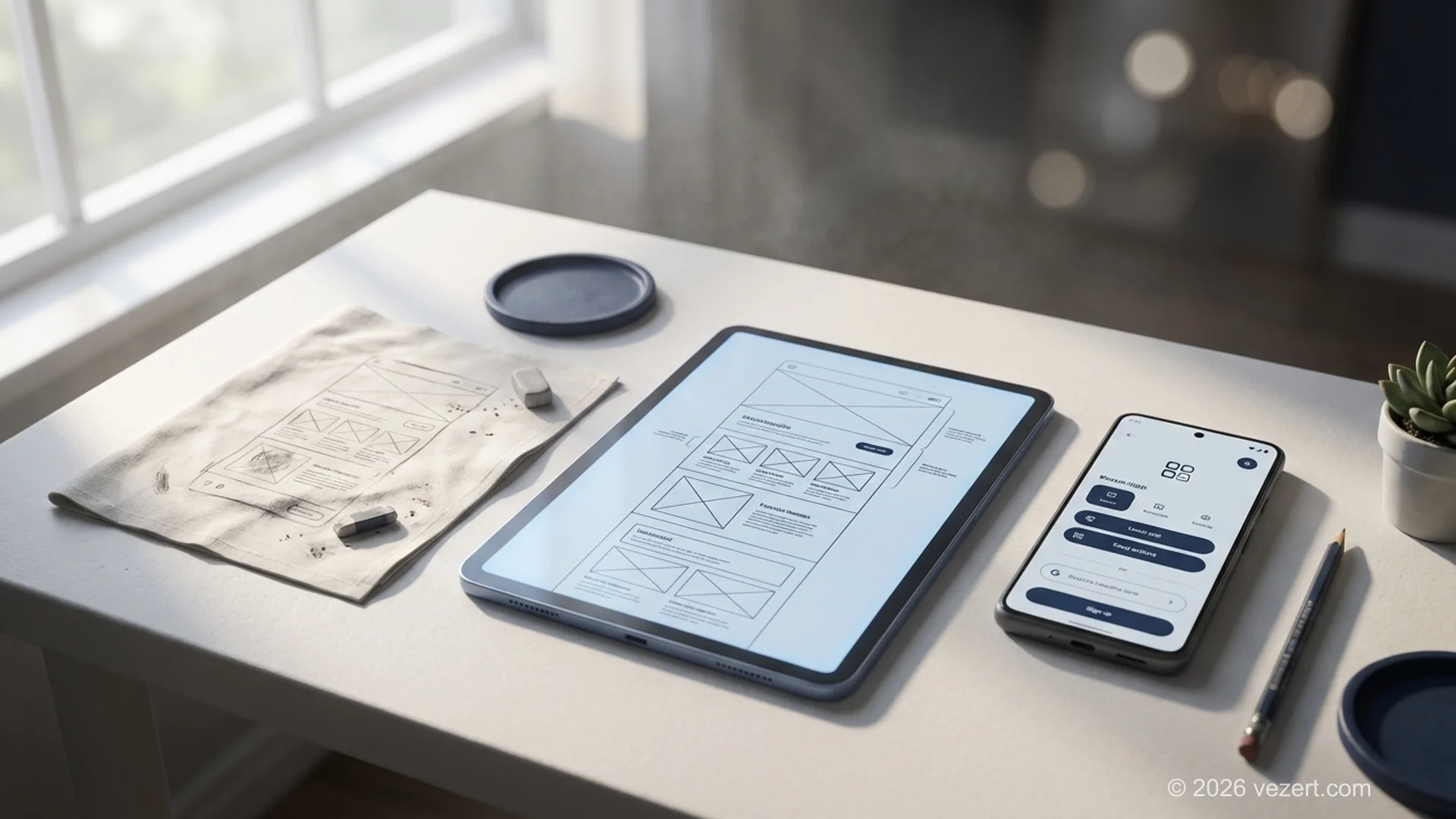
Unlike a PoC, a prototype is visual. It simulates the user experience, screens, navigation, interactions, without any working backend. Think of it as a detailed architectural model of a building. You can walk through the rooms and get a sense of the space, but the plumbing isn't connected.
Prototypes range from low-fidelity (wireframes, paper sketches) to high-fidelity (pixel-perfect clickable mockups in Figma or similar tools). The level of detail depends on what you're trying to learn.
When a Prototype Makes Sense
- You need to validate the user experience before writing any code
- Investors or stakeholders want to see what the product will look like
- You're deciding between multiple design directions
- Usability testing is needed to identify friction points early
Prototyping is particularly valuable for UX/UI design decisions. Research from the Nielsen Norman Group confirms that testing with prototypes catches usability issues at a fraction of the cost of fixing them in production code. I've seen teams skip this step and go straight to development, only to realize three months in that the navigation doesn't make sense or key user flows are confusing. Fixing those problems in code is five to ten times more expensive than fixing them in a prototype. Before prototyping begins in earnest, having a clear website design brief ensures that the design direction is aligned with business goals and stakeholder expectations.
What a Prototype Delivers
A clickable, visual representation of your product that real users can interact with and give feedback on.
Typical timeline: 2-6 weeks
Who sees it: Internal team, stakeholders, investors, and ideally a small group of target users for testing.
What Is an MVP (Minimum Viable Product)?
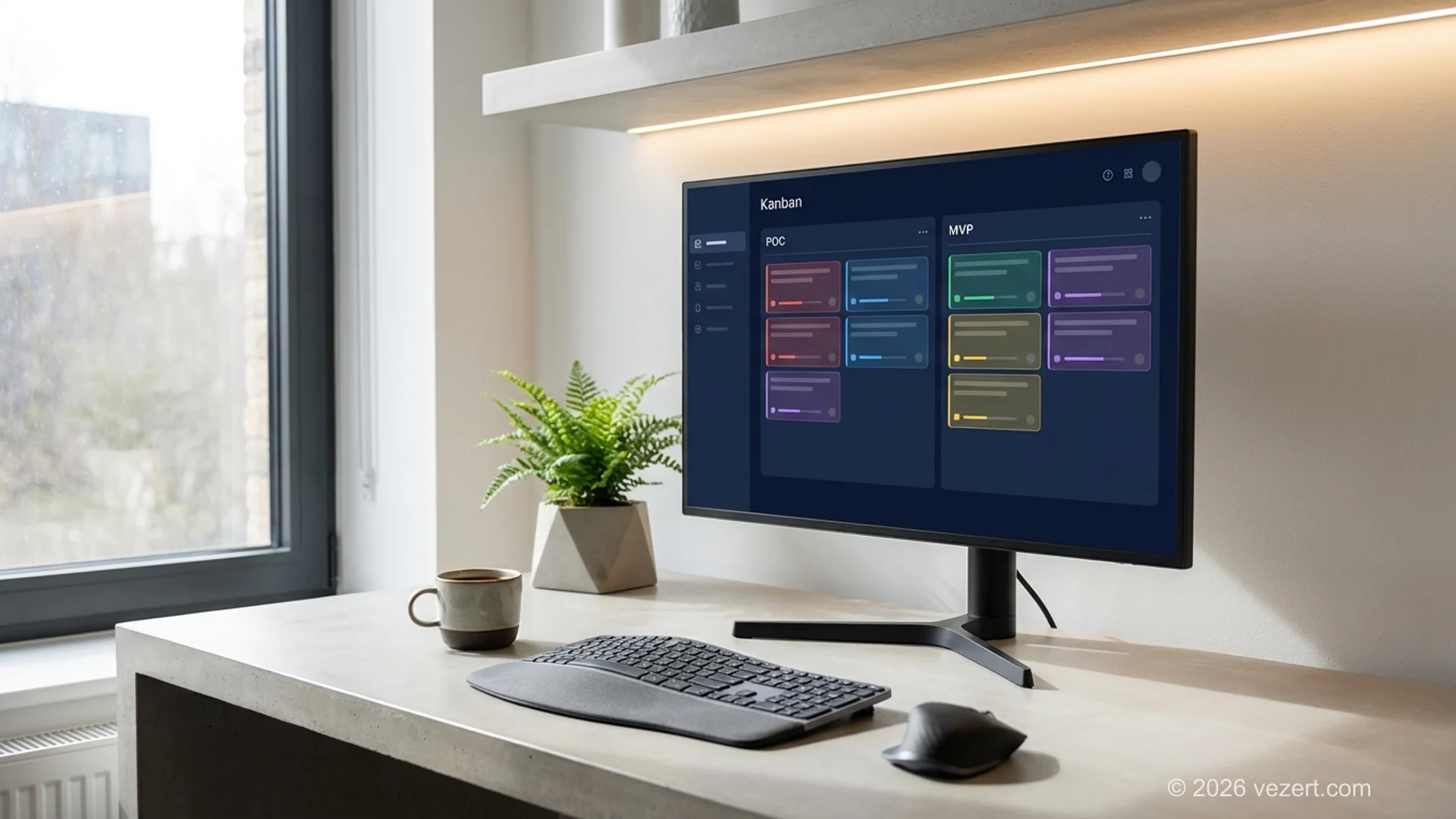
An MVP, or minimum viable product, represents the milestone where digital software meets real market reality. Unlike simulated prototypes or raw technical PoCs, an MVP is an actual working web application deployed to early customers with just enough core functionality to deliver genuine commercial value and generate verified behavioural feedback.
The keyword here is "viable." An MVP isn't a half-finished product full of bugs. It's a deliberately scoped-down version that does one or two things well. Everything non-essential gets cut. The goal isn't perfection; it's learning.
Eric Ries, who popularized the term in The Lean Startup, described it as the version of a new product that allows a team to collect the maximum amount of validated learning with the least effort. That definition still holds.
When an MVP Makes Sense
- You've validated feasibility (PoC) and usability (prototype), and now you need to test market demand
- You want real user feedback before committing to a full product roadmap
- You're looking to attract investors with demonstrated traction, not just an idea
- Time-to-market matters and you can't afford a 12-month development cycle
Around 72% of startups now use an MVP approach, and for good reason. Companies that validate assumptions with an MVP are roughly 20% more likely to survive their first five years.
What an MVP Delivers
A live, functional product with core features that real users can sign up for, use, and provide feedback on. Whether it's a landing page with a core transaction flow or a full corporate website with essential features, the MVP focuses on delivering genuine value to early adopters.
Typical timeline: 6-16 weeks
Who sees it: Real users, early adopters, potential investors, the market.
PoC vs Prototype vs MVP: Side-by-Side Comparison
Here's the clearest way to see how these three approaches differ:
| PoC | Prototype | MVP | |
|---|---|---|---|
| Core question | Can we build it? | What should it look like? | Do people want it? |
| Risk addressed | Technical | Design / UX | Market |
| Audience | Internal team | Stakeholders, test users | Real customers |
| Functionality | Minimal, rough | Simulated (no backend) | Working core features |
| Design quality | None | High (visual focus) | Functional, not polished |
| Timeline | 1-3 weeks | 2-6 weeks | 6-16 weeks |
| Typical cost | $2K-$15K | $5K-$30K | $15K-$150K+ |
| Deliverable | Technical report + demo | Clickable mockup | Live product |
Notice the progression: technical validation comes first, then design validation, then market validation. You don't always need all three, but you should never skip a step that's relevant to your project's biggest risk.
Quick Decision Rule
Ask yourself: what's the biggest unknown right now? If it's "can the technology handle this?", build a PoC. If it's "will users understand how to use it?", build a prototype. If it's "will anyone pay for this?", build an MVP. Start with your riskiest assumption.
PoC, Prototype, and MVP in Action: Real-World Examples
Abstract definitions only get you so far. Let's look at how real companies used these approaches.
Dropbox (MVP): Before writing a single line of backend code, Dropbox founder Drew Houston created a three-minute video showing how the product would work. That video was the MVP. It went viral, and sign-ups jumped from 5,000 to 75,000 overnight. No working product, just a demonstration that validated massive market demand.
Zappos (MVP): Nick Swinmurn didn't build an e-commerce platform. He put photos of shoes from local stores on a basic website. When someone ordered, he went to the store, bought the shoes, and shipped them. This zero-inventory MVP proved that people would buy shoes online, a concept many doubted in 1999.
Airbnb (PoC + MVP): Brian Chesky and Joe Gebbia started by renting air mattresses in their own apartment during a design conference. That was essentially a proof of concept, testing whether strangers would pay to stay in someone's home. Once validated, they built a simple website (the MVP) and expanded from there.
Notice a pattern? None of these companies started with a finished product. They identified their biggest risk, tested it with the cheapest possible approach, and only invested more when the data supported it.
Web project example: Suppose you're building a customer-facing landing page with a dynamic pricing calculator. The calculator pulls data from your ERP system. You might run a PoC to test the ERP integration, prototype the calculator UI to ensure it's intuitive, then launch an MVP with the calculator as the core feature.
PoC vs Prototype vs MVP Costs and Timelines in 2026
Budget allocation and delivery timelines are critical planning factors when choosing between a PoC, prototype, or MVP in 2026. Based on industry benchmarks and our agency delivery data across European digital projects, each development approach falls into predictable investment brackets based on scope, complexity, and testing fidelity.
Proof of Concept: $2,000-$15,000 depending on complexity. A simple API integration test might take a developer a few days. Testing a complex data pipeline across multiple systems could take two to three weeks with a small team.
Prototype: $5,000-$30,000. A set of low-fidelity wireframes is on the low end. A fully interactive, high-fidelity clickable prototype with user testing is on the higher end. Most web projects land somewhere around $8,000-$15,000 for a solid prototype.
MVP: $15,000-$150,000+. This is where the range gets wide because scope varies enormously. A simple web app MVP with one to two core features and basic UI can be done for $15,000-$40,000 in six to ten weeks. A more complex SaaS MVP with multi-tenant dashboards and third-party integrations? Expect $55,000-$140,000 and eight to fourteen weeks.
One stat worth noting: a 2024 Gartner report found that businesses using low-code platforms delivered MVPs 50-70% faster with cost reductions of 50-65% compared to traditional development. That doesn't mean low-code is always the right choice, but it shows how much the tooling landscape has shifted.
The real cost savings come from picking the right approach at the right time. Building a full MVP when you haven't validated the core technical assumption? That's how six-figure budgets disappear. As Smashing Magazine's guide to lean UX explains, lean validation methods, whether PoC, prototype, or MVP, help teams avoid building features that nobody needs.
Not Sure Where to Start?
Vezert helps you pick the right validation approach, PoC, prototype, or MVP, so you invest wisely from day one. Let's talk about your project.
Get a Free ConsultationHow to Choose Between PoC, Prototype, and MVP
Here's a practical framework I use when advising clients on where to start:
Start with a PoC if:
- Your idea relies on technology you haven't tested yet
- You need to prove feasibility to get internal buy-in or funding
- There's a single critical technical dependency that could make or break the project
- You're integrating with legacy systems or third-party platforms with uncertain APIs
Start with a Prototype if:
- The technology is straightforward, but the user experience is complex
- You have multiple stakeholders with different visions for the product
- User testing is essential before you commit development resources
- You're redesigning an existing product and need to validate the new direction
Start with an MVP if:
- The concept is proven (technically and from a UX perspective), but market demand is uncertain
- You want to generate revenue or traction as quickly as possible
- You need real user data to guide your product roadmap
- Investors want to see actual usage metrics, not just mockups
Use them in sequence if:
- Your project is high-stakes and high-budget
- You're entering an unfamiliar market with unproven technology
- The cost of failure is significant enough to justify staged validation
Most web projects we handle at Vezert don't need all three. A corporate website redesign might jump straight to prototyping. A complex web portal with real-time data feeds might need a PoC first. The right answer depends on where your biggest uncertainty lives. For corporate site projects moving from prototype toward build, thinking through website structure and information architecture early prevents expensive restructuring once development is underway.
The Sequential Approach Works
Teams that follow the PoC-to-prototype-to-MVP sequence report 30-40% lower total development costs compared to those who skip validation stages. The upfront investment in each stage pays for itself by catching problems before they become expensive to fix. Even a lightweight PoC or a two-week prototype sprint can save months of rework.
PoC vs Prototype vs MVP: Mistakes That Waste Budget
After guiding dozens of digital product initiatives, our engineering leaders consistently observe several costly validation mistakes that waste substantial corporate budgets. Recognizing these common execution traps early ensures your team invests in the appropriate deliverable without over-engineering features or launching unverified solutions to market.
Calling everything an MVP. A landing page with an email signup form isn't an MVP, it's a smoke test. An MVP has enough functionality for users to actually experience the core value. Labeling something an MVP when it's really just a prototype (or less) creates false confidence.
Skipping the PoC on technically risky projects. I've watched teams spend four months building an MVP only to discover the core integration doesn't work reliably at scale. A two-week PoC would have caught that.
Over-engineering the prototype. The point of a prototype is speed and learning, not perfection. If your prototype takes three months and looks production-ready, you've spent too much. High-fidelity is fine; production-quality is overkill.
Building features nobody asked for. This is the classic MVP trap. You add "just one more feature" until the minimum isn't minimal anymore. Seven out of ten digital products fail within twelve months, and feature creep is a major contributor.
Ignoring the feedback loop. The whole point of these validation stages is learning. If you build a prototype but never test it with real users, or launch an MVP but don't track how people use it, you've wasted the effort.
A Common Trap
Premature scaling kills more startups than bad ideas. Over 70% of startups that fail do so because they scale before they've validated demand. An MVP exists specifically to prevent this, but only if you actually listen to what the data tells you.
Stop Guessing, Start Validating
Whether you need a PoC, prototype, or MVP, Vezert builds the right validation step so you invest with confidence. Let's find the smartest starting point for your project.
Book a Strategy CallStart With Clarity, Build With Confidence
Understanding the distinction between PoC vs prototype vs MVP is ultimately about risk management and capital efficiency. By matching your validation method to your primary business uncertainty, you protect development resources and build scalable web solutions with sustained organizational confidence.
A PoC tells you whether the engine works. A prototype tells you whether people can drive the car. An MVP tells you whether anyone wants to buy it. Each one saves you from a different kind of expensive surprise.
The best projects I've worked on started with a clear understanding of their biggest risk and addressed it with the cheapest possible test. That discipline, test first, build second, separates products that succeed from those that burn through their budget and stall.
Whatever stage you're at, the goal is the same: reduce uncertainty before you scale investment. Whether you need a proof of concept for a complex web portal, a prototype for a new UX direction, or an MVP to validate market demand, the right validation approach saves time, money, and frustration. Explore our startup development case study or full portfolio to see how we've helped clients navigate the PoC vs prototype vs MVP decision, or get in touch to discuss your project.
On This Page
- PoC vs Prototype vs MVP: Why These Terms Matter
- What Is a Proof of Concept (PoC)?
- What Is a Prototype in Product Development?
- What Is an MVP (Minimum Viable Product)?
- PoC vs Prototype vs MVP: Side-by-Side Comparison
- PoC, Prototype, and MVP in Action: Real-World Examples
- PoC vs Prototype vs MVP Costs and Timelines in 2026
- How to Choose Between PoC, Prototype, and MVP
- PoC vs Prototype vs MVP: Mistakes That Waste Budget
- Start With Clarity, Build With Confidence