
On This Page
- What Is AI Web Design?
- How an AI Web Design Agency Works
- What AI Handles in the Workflow
- What the Human Team Owns
- AI Web Design vs. Traditional Agency: Key Differences
- AI Web Design Agency vs. AI Website Builders
- Who Benefits from an AI Web Design Agency
- From Idealogic Group to Vezert: How the Studio Was Born
- The Spin-Off Decision
- Why Websites Still Matter in 2026
- Rising Performance and Quality Demands
- Legacy Platforms vs. the AI Web Design Approach
- Platform Comparison at a Glance
- AI-Powered Monitoring and Ongoing Support
- Continuous Improvement Without Manual Overhead
- Conclusion: Why AI Web Design Matters for Your Business
What Is AI Web Design?
AI web design is a professional approach to building websites where artificial intelligence handles time-intensive tasks, content drafting, SEO structuring, performance analysis, UX pattern generation, and ongoing monitoring, while human designers and engineers focus on strategy, architecture, and quality oversight. The result is a faster, more consistent web design process that produces professionally finished sites without the inefficiencies of manual-only workflows.
According to McKinsey's 2024 State of AI report, companies that integrate AI into their core workflows reduce delivery time by 40-70% on average without reducing output quality. In web design specifically, that translates directly to faster launches, lower costs, and superior technical quality compared to studios still running purely manual processes.
Vezert is an AI web design agency that was built around this principle from the start. AI is not a bolt-on feature at Vezert, it is embedded in every stage of the workflow, from the initial UX/UI design brief through post-launch performance optimization.
AI Web Design Defined
AI web design is not about generating a website with one click. It is a professional methodology where AI agents accelerate the work of expert designers and engineers, delivering higher quality output in less time, with continuous automated monitoring after launch.
How an AI Web Design Agency Works
An AI web design agency like Vezert operates with a collaborative model: AI agents and senior engineers work in tandem throughout the entire project lifecycle. This is not a sequential hand-off where AI does one phase and humans do another. The two work simultaneously, each amplifying the other's strengths.
In practice, this means a client engaging an AI web design company gets the output quality of an experienced agency team, produced in roughly half the time. The AI handles high-volume, repeatable tasks with consistency; the engineers handle the judgment calls that actually define whether a website is good.
What AI Handles in the Workflow
AI agents take on every task that benefits from speed, consistency, and scale:
- Site architecture analysis, evaluating information architecture and identifying structural issues before a line of code is written
- Content generation and SEO optimization, drafting and refining copy targeted at search intent
- Performance benchmarking, continuous Core Web Vitals tracking and LCP, FID, CLS regression alerts
- A/B testing and CRO, automated hypothesis generation, variant testing, and data analysis
- Post-launch monitoring, 24/7 uptime, security scanning, and content freshness checks
- Conversational AI integration, implementing on-site chat agents (see how to add an AI agent to your website)
This automation cuts delivery time and reduces human error without sacrificing the depth of work a real agency brings.
What the Human Team Owns
Not everything should be delegated to algorithms. Architecture decisions, security implementation, brand visual language, and aligning the product with specific business objectives remain the domain of experienced professionals. The human team at Vezert reviews every AI output, makes judgment calls, and takes full accountability for the finished product.
This balance is what separates a true AI web design agency from a tool or a template generator. The AI accelerates execution; the team ensures the result is genuinely good.
See AI Web Design in Action
Browse Vezert's portfolio to see how AI-assisted workflows produce professionally finished, high-performance websites.
View Our PortfolioAI Web Design vs. Traditional Agency: Key Differences
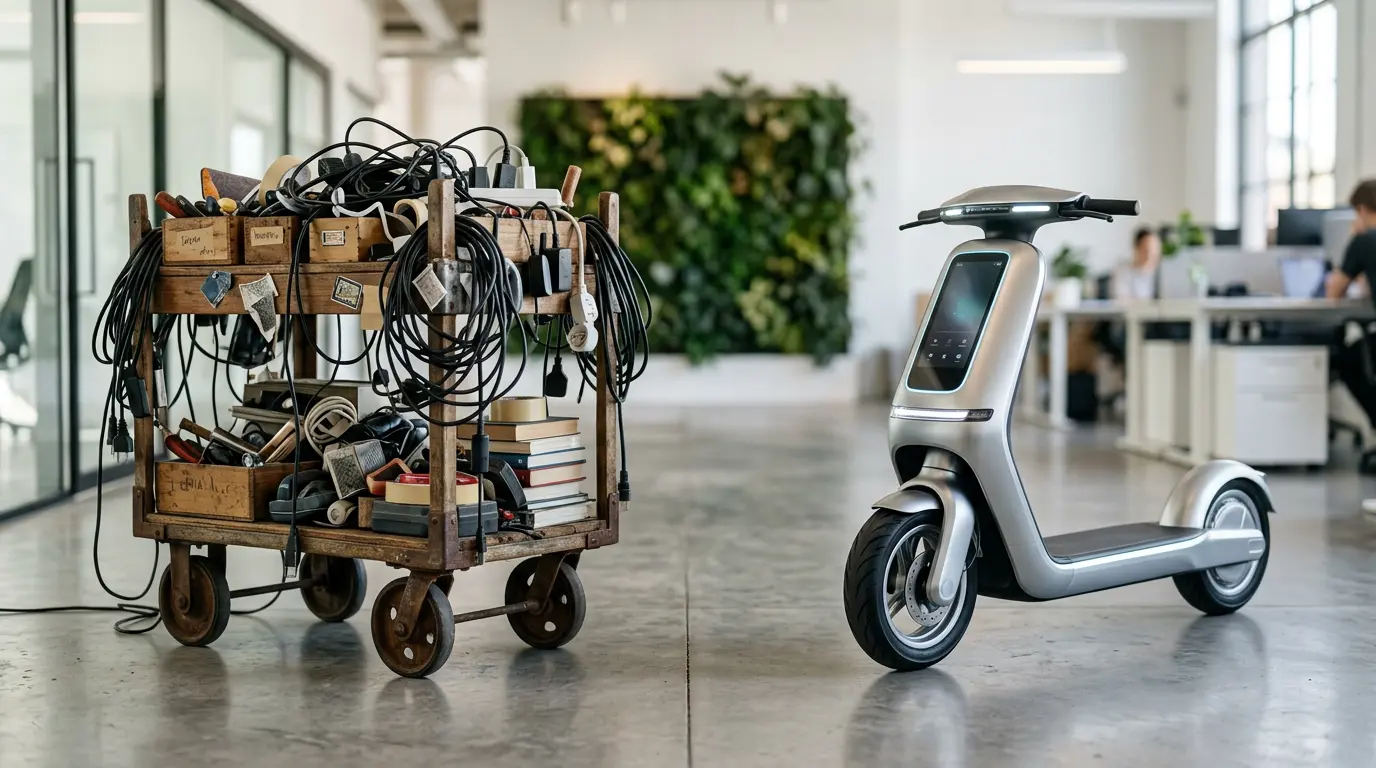
The comparison between AI web design and a conventional web agency is not about quality versus speed, it is about whether your agency has updated its process to match 2026 realities. Traditional agencies that have not integrated AI are still running manual content workflows, manual QA cycles, and reactive maintenance. That results in slower delivery, higher costs, and sites that age poorly.
A dedicated AI web design company like Vezert compresses the delivery cycle without cutting corners. According to the Nielsen Norman Group, AI-assisted UX workflows reduce iteration cycles by up to 60%, allowing design teams to validate more options in less time. For businesses, this means faster go-to-market and more design confidence at the same budget.
The critical difference is accountability. An AI web design agency gives you a professional partner who owns the outcome. A traditional agency gives you the same but without the speed. An AI tool gives you speed without the partner.
Speed Without Sacrifice
Vezert's AI web design workflow delivers production-ready websites faster than comparable traditional agencies, not because steps are skipped, but because AI handles the repetitive work at machine speed while engineers focus on the decisions that require judgment.
AI Web Design Agency vs. AI Website Builders
An AI web design agency is not the same as an AI website builder. Tools like v0, Lovable, and Framer AI are self-service products, they lower the barrier to entry and generate starting points rapidly. For simple personal projects or quick prototypes, they are excellent. For businesses that need a production website with custom architecture, brand-accurate design, performance optimization, and long-term support, they consistently fall short.
The gap shows up in three areas: first, AI builders produce template-level output that requires significant manual refinement for any real brand. Second, they have no accountability model, if the site underperforms, you own the problem. Third, they do not provide ongoing support, monitoring, or evolution of the product after launch.
Vezert as an AI web design company absorbs all of that complexity. The deliverable is not a template to configure, it is a finished, professionally built website with custom architecture, tested performance, and a team that stays engaged after launch. For a direct comparison of platform capabilities that often comes up in this decision, our Webflow vs. Next.js analysis is a useful reference.
Who Benefits from an AI Web Design Agency
The right client for an AI web design agency is a business or organization that needs professional quality at a competitive price but does not have the internal team, time, or appetite to manage all the technical complexity. That includes growth-stage startups launching their first corporate website, B2B companies redesigning for better lead generation via focused landing pages, and enterprises building client-facing web portals.
What these clients share is a need for a professional partner, not a tool. Vezert takes responsibility for the outcome from brief to launch and beyond, absorbing the coordination overhead that would otherwise fall on the client team.
Common Misconception
Many businesses assume that AI website builders and an AI web design agency are the same thing. They are not. AI builders give you tools to build yourself. An AI web design agency like Vezert uses AI as part of a professional workflow to build for you, with accountability, expertise, and a finished product you do not have to maintain alone.
From Idealogic Group to Vezert: How the Studio Was Born
Vezert did not emerge from a blank slate. It is built on years of experience developed within Idealogic Group, a software development company where web design was one of several service lines. As the web evolved, it became clear that modern websites were no longer a secondary deliverable, they had become independent digital assets that directly determine business growth, marketing performance, and brand credibility.
That shift demanded focused processes, specialized teams, and a methodology tailored specifically to web products. The answer was to spin off web development into a dedicated company.
The Spin-Off Decision
During a strategic restructuring at Idealogic Group, the decision was made to establish Vezert as an independent AI web design agency. Independence gave the team the freedom to specialize exclusively in modern web products and to adopt AI-native workflows from the ground up rather than retrofitting them into a general development culture.
Today Vezert operates as an autonomous business with a focused market position: high-performance websites built with AI precision and human engineering expertise. The partnership with Idealogic Group continues, but Vezert's processes, methodology, and client relationships are its own.
Why Websites Still Matter in 2026
Despite the proliferation of marketplaces, social platforms, and closed ecosystems, a website remains the only digital property a business fully owns and controls. Social platforms restrict reach algorithmically, marketplace accounts can be suspended, and platform rules change without notice. Your website is the one stable anchor in the digital ecosystem.
A website in 2026 is not a static brochure. It is the operational core of a company's digital presence: where analytics converge, marketing automation runs, AI tools integrate, and customer trust is established. According to Stanford Web Credibility Research, 75% of users admit to judging a company's credibility based on its website design. That number has not declined as AI tools have become widespread, if anything, expectations for professional quality have risen.
Rising Performance and Quality Demands
User expectations have increased sharply. Visitors require fast loading (meeting Core Web Vitals benchmarks), clean interfaces, and predictable behavior. Google's ranking algorithm now evaluates technical performance metrics, LCP, FID, and CLS, alongside content relevance.
This means a website is a full-fledged product requiring professional methodology and long-term thinking. It is precisely why AI web design produces better outcomes than either pure manual agency work or DIY AI tools: the methodology combines the speed of AI automation with the rigor of engineering standards.
Key Insight
Websites have not become irrelevant, they have increased in importance. They are the primary digital credibility signal for any business, and the bar for what counts as professionally built has risen substantially in the AI era.
Legacy Platforms vs. the AI Web Design Approach
The primary competition for an AI web design company is not other AI agencies, it is legacy platforms that once defined the market but no longer meet modern requirements. WordPress, Webflow, Wix, Squarespace, and Tilda built massive ecosystems. They remain widely used. But their architecture creates inherent limits on performance, security, and AI readiness that cannot be resolved by adding plugins.
According to the Web Almanac by HTTP Archive, WordPress powers over 43% of websites globally, yet Lighthouse performance audits show the median WordPress site scores below 50/100 on mobile. That gap is not about effort or expertise: it is structural. Platforms built for the 2010s cannot fully satisfy the technical demands of 2026.
For teams evaluating Webflow versus a custom Next.js build, our detailed comparison covers how each platform handles scalability, content management, and AI-assisted development workflows.
Platform Comparison at a Glance
The performance and capability differences between legacy platforms and an AI web design agency become concrete when examined side by side. Legacy platforms offer familiarity and large plugin marketplaces, but they cannot match the speed, flexibility, and built-in AI readiness of a purpose-built modern studio approach.
The table below compares the most decision-relevant factors for businesses choosing where to build their next website. Note that these are architectural differences, not configuration choices, switching from a legacy platform to an AI web design company mid-project is not practical, so the decision matters.
AI-Powered Monitoring and Ongoing Support
At Vezert, launch day is the beginning of a product's lifecycle, not the end of a project. Every website we build enters a continuous AI monitoring cycle that tracks performance, security, uptime, and search visibility, around the clock, without requiring manual intervention from the client.
This approach prevents the gradual decay that affects most websites over time: performance regressions from browser or platform updates, security vulnerabilities from unpatched dependencies, and SEO ranking drops from algorithm changes. According to Ahrefs data, 90.63% of web pages receive zero organic search traffic from Google, most because they were never optimized, and many more because they were optimized once and then left to drift.
Vezert's AI monitoring directly addresses that pattern through post-launch support that keeps sites performant and competitive long after launch.
Continuous Improvement Without Manual Overhead
The practical result is a website that evolves alongside the business without requiring constant manual attention. AI-driven monitoring identifies performance issues before users notice them. Security alerts are triaged automatically. Content freshness signals are flagged for review. The engineering team intervenes when judgment is required, not for every routine task.
This is a defining feature of the AI web design agency model compared to both traditional agencies and AI builders. Traditional agencies hand off and step away. AI builders leave you fully responsible. Vezert's ongoing AI monitoring keeps the product performing at the standard it was built to.
What AI Monitoring Covers
Vezert's post-launch AI monitoring includes Core Web Vitals tracking, uptime monitoring, automated security scanning, content freshness analysis, and SEO regression detection. Problems are flagged and addressed proactively, typically before they affect users or rankings.
Ready to Build with Vezert?
Whether you need a landing page, corporate website, or web portal, Vezert delivers professional results at AI speed.
Start Your ProjectConclusion: Why AI Web Design Matters for Your Business
Vezert exists for businesses that need professional web design without navigating all the technical complexity themselves. Companies that want fast, high-quality, and sustainable results, without choosing between delivery speed and professional standards.
The AI web design agency model solves a real problem. Old methods are too slow and expensive. Pure AI tools lack accountability and depth. Vezert sits at the intersection: professional quality delivered at AI speed, with human engineers accountable for every decision.
If your business needs a website that performs, scales, and evolves, built by a team that combines AI efficiency with engineering expertise, contact Vezert to discuss your project. If you are interested in joining the team, visit the careers page.
On This Page
- What Is AI Web Design?
- How an AI Web Design Agency Works
- What AI Handles in the Workflow
- What the Human Team Owns
- AI Web Design vs. Traditional Agency: Key Differences
- AI Web Design Agency vs. AI Website Builders
- Who Benefits from an AI Web Design Agency
- From Idealogic Group to Vezert: How the Studio Was Born
- The Spin-Off Decision
- Why Websites Still Matter in 2026
- Rising Performance and Quality Demands
- Legacy Platforms vs. the AI Web Design Approach
- Platform Comparison at a Glance
- AI-Powered Monitoring and Ongoing Support
- Continuous Improvement Without Manual Overhead
- Conclusion: Why AI Web Design Matters for Your Business