

Conversion optimization (CRO) is the data-driven practice of increasing the percentage of website visitors who complete a desired action, purchase, form submission, demo booking, signup. CRO is not about driving more traffic; it is about getting more value from the visitors you already have. The discipline pairs quantitative analytics, qualitative user research, and structured A/B testing to remove friction and make conversions more predictable.
You are spending $5,000 a month on ads. Traffic is up. Your analytics dashboard shows 15,000 sessions. And yet -- 37 leads. That math does not work, and you know it.
We have run CRO projects for B2B service companies, e-commerce stores, and SaaS platforms. The pattern is always the same: the traffic is there, but something between the landing page and the "thank you" page is broken. Sometimes it is a confusing layout. Sometimes it is weak copy. Sometimes it is a form that asks for 11 fields when 4 would do.
This guide covers the full process -- from diagnosing what is wrong to running tests that prove what works. No vague theory. Just the framework we use at Vezert to turn underperforming pages into pages that convert. For a UX-first lens on the same problem, see our UX/UI design audit approach.
CRO, The Numbers That Matter
Companies investing in CRO see 223% higher conversion rates vs those that don't (Hotjar State of CRO 2024). Average B2B website conversion rate: 2.1%; top decile: 5–10% (HubSpot 2025 State of Marketing).
From the trenches
"The cheapest CRO win is almost never a button color change. Nine times out of ten, it's removing the third paragraph above the form, or cutting the form from 7 fields to 3. Boring fixes outperform clever ones." — Vezert engagement lead
What Is Conversion Optimization, Really? Beyond the Buzzword
Strip away the jargon and conversion optimization is straightforward: CRO is the practice of getting a higher percentage of your website visitors to do the thing you want them to do. Buy something. Fill out a form. Book a demo. Sign up for a trial.
Notice what is not in that definition: changing button colors at random. Redesigning pages based on what your CEO's spouse thinks looks nice. Copying a competitor's landing page because they seem to be doing well. Real CRO is methodical. You look at data, form a hypothesis, test it, and measure the result. Then you do it again.
The core idea is deceptively simple: stop trying to buy more traffic and start getting more value from the traffic you already have.
CRO vs. SEO: Two Halves of the Same Problem
SEO gets people through the door. CRO makes sure they do not walk out empty-handed. We see companies pour $10,000/month into SEO and paid search, then send all that traffic to a landing page with a confusing layout and a "Submit" button that tells visitors nothing about what happens next. That is like hiring a top-tier sales team and putting them in a store with no cash register. For a broader view of how these pieces fit together, see our guide on What Is Digital Marketing?.
The Math That Makes CRO a No-Brainer
Here is the arithmetic: 10,000 monthly visitors, $5,000 ad spend, 1% conversion rate = 100 customers. Double the conversion rate to 2% and you now have 200 customers from the same budget. Your Customer Acquisition Cost just dropped by half. You did not spend a dollar more on traffic. That is why conversion optimization is one of the highest-ROI activities a business can invest in -- every percentage point improvement compounds across all your traffic sources.

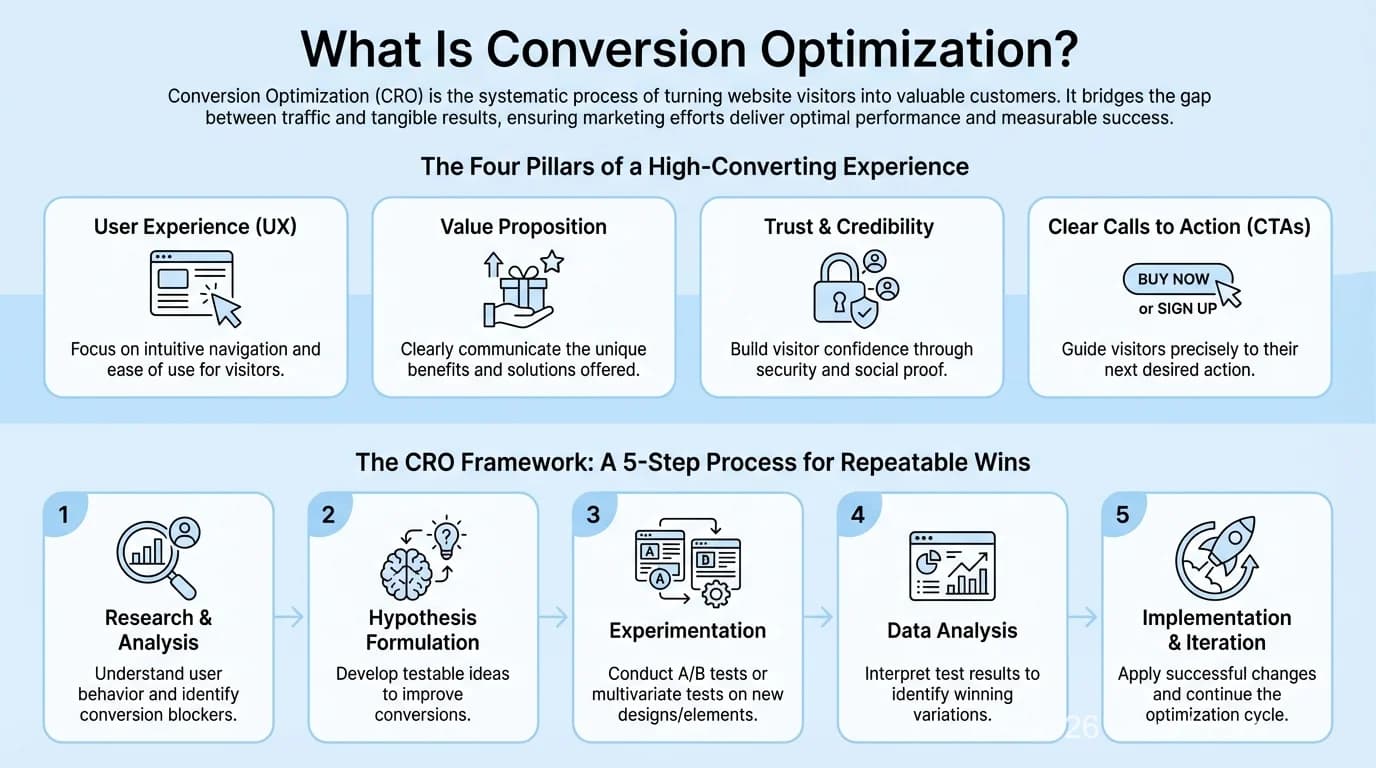
What Are the Four Pillars of a High-Converting Experience?
Every high-converting page we have built or optimized leans on four things working together. Not one of them is optional. Miss any single pillar and the others cannot compensate -- validated through rigorous A/B testing across hundreds of experiments.
UX Design: Remove the Friction or Lose the Visitor
People do not fight through bad UX to give you money. They leave. We audited a client's lead-gen page that had a 7-field form requiring a phone number upfront. We cut it to 3 fields (name, email, company) and added a checkbox for "I'd like a call." Form completions went up 68%. That is UX doing its job: clearing the path between arrival and action. For deeper design principles, see our guide on Landing Page Examples.
Copywriting: Say What Matters in Fewer Words
Your headline has about 3 seconds to answer one question: "Why should I care?" If the answer is not obvious, visitors scroll past or bounce. Strong copy leads with the benefit, not the feature. "Reduce your hosting costs by 40%" works. "Our innovative cloud-native infrastructure uses modern technology" does not. Every page needs a clear CTA that tells users exactly what happens when they click.
Visual Hierarchy: Direct the Eye, Do Not Decorate
Design is not decoration -- it is communication. Color, contrast, and whitespace should funnel attention toward your CTA and key value statements. We have seen pages where the most visually prominent element was a stock photo banner while the CTA button was buried below the fold in a muted gray. Swap the emphasis and conversions climb. Trust signals -- testimonials, client logos, security badges -- belong near the conversion point, not hidden in the footer.
Psychology: Work With How People Decide
People are not perfectly rational, and your pages should account for that. The tactics that consistently move the needle:
- Social proof: Real numbers beat vague claims. "Trusted by 847 companies" outperforms "Trusted by many businesses."
- Urgency with substance: "3 spots left this month" works if it is true. Fake countdown timers erode trust.
- Anxiety reduction: Put your refund policy, security certifications, and FAQ answers next to the form -- not on a separate page nobody visits.
Match the experience to the visitor's intent. Someone arriving from a comparison keyword needs different reassurance than someone coming from a brand search.
The CRO Framework: A 5-Step Process for Repeatable Wins
Random changes are not optimization. Changing your CTA button from blue to green because someone read a blog post about it is not a strategy. Conversion optimization works when you follow a repeatable process. Here is the one we use at Vezert -- the same framework whether we are optimizing a SaaS pricing page or a B2B lead-gen funnel.
Step 1: Dig Into the Data
Before we touch anything, we need to understand what is happening and why. We layer three types of analysis:
- Quantitative: Google Analytics 4 tells us what -- where users drop off, which pages have high exit rates, where the funnel leaks.
- Qualitative: Hotjar heatmaps and session recordings show us why -- where users hesitate, rage-click, or scroll past your CTA without noticing it. We also run usability tests when the stakes justify it.
- Expert review: Our team walks through the site as a first-time visitor and flags obvious friction points against established usability heuristics.
Step 2: Build Hypotheses Worth Testing
Data without a hypothesis is just trivia. We structure every test idea as: "If we change [X], we expect [Y], because [Z]." Example: "If we replace 'Submit' with 'Get My Free Quote' and move the form above the fold, we expect a 15-20% lift in submissions because the current placement requires scrolling and the button copy is generic." We then rank hypotheses by expected impact, confidence level, and effort to implement.
Step 3: Build the Challenger
Our designers and copywriters create the new page variant. This is not about tweaking a font size. The challenger is a deliberate response to a specific problem identified in research. If the data showed users were not scrolling past the hero section, the challenger might restructure the entire page layout -- not just adjust a headline.
Step 4: Run the Test
We split traffic between the original (control) and the new version (challenger) and let the data decide. No peeking at results early. No calling winners before we hit statistical significance. We have seen tests where one variant was winning by 30% at day 5 and lost by day 14 once the sample size was large enough. Patience is not optional here. Need help running proper tests? That is what we do.
Step 5: Learn, Ship, Repeat
When the test reaches significance, we implement the winner and lock in the gains. But the real value is in what we learn from every test -- including the losers. A test that fails tells you something important about your users. We feed those insights back into Step 1 and start the cycle again. CRO is not a project with an end date. It is an ongoing practice that compounds over time.
The AI Revolution in CRO: Faster, Smarter Optimization
The CRO process has not changed: hypothesize, test, learn. What has changed is the speed at which you can run that loop. AI tooling makes the analysis faster, the hypothesis generation sharper, and the testing more efficient. We use it daily at Vezert -- not as a replacement for thinking, but as an accelerator. For foundational CRO concepts, see our companion guide: What Is Conversion Optimization?
AI for Pattern Recognition in Data
A human analyst looking at Google Analytics might catch 3-4 patterns in a funnel report. An AI tool processing the same data alongside heatmaps, session recordings, and survey responses can surface dozens of friction points in minutes. We use this for the initial research phase -- it does not replace the expert interpretation, but it ensures we are not missing signals buried in large datasets.
AI in Testing and Personalization
The biggest practical change: AI can generate test variations at scale. Instead of our copywriter writing 3 headline options, we can produce 20, filter for quality, and test the best 5. During tests, multi-armed bandit algorithms allocate traffic dynamically to outperforming variants, which means you start capturing value before the test is even complete.
The next frontier is real-time personalization -- showing different page versions to different user segments based on behavior, traffic source, and intent signals. We are already running this on select client projects.
How We Use AI at Vezert
Our AI-first approach is practical, not theoretical:
- Faster test deployment: We build and launch A/B tests in days, not weeks, by using AI to accelerate front-end development and copy generation.
- Higher test velocity: More tests per quarter means more learnings, which means faster compounding gains.
- Better signal extraction: AI helps us find the non-obvious patterns in post-test analysis that inform the next round of hypotheses.
The result: conversion optimization stops being a slow, quarterly initiative and becomes a continuous improvement engine. See how this works in practice.

From Clicks to Customers: Your CRO Journey Starts Now
Here is what it comes down to: you are already paying for traffic. The question is whether your website is converting that traffic at 1% or 3%. That difference is not marginal -- it is the difference between a marketing budget that barely breaks even and one that funds growth.
Conversion optimization is not a one-time project you check off a list. It is an ongoing discipline. The companies that do it consistently -- running tests every month, learning from every experiment, iterating on every page -- are the ones that pull ahead while their competitors keep pouring money into more traffic.
For a deeper look at UX as a conversion lever, our analysis of why UX investment helps businesses win more clients digs into the data behind this.
We build this into every project at Vezert. Our Conversion-First Design approach means the optimization starts before launch, not after. And our AI-first development process means we can run tests faster, learn quicker, and compound those gains over time.
If your conversion rate has been flat for 6 months, something needs to change. Start a project with us and find out what that something is.