

On This Page
- What Is a Digital Marketing Agency? The Modern Growth Partner
- The Spectrum of Services: What Digital Marketing Agencies Offer
- Your Website: The Engine for All Digital Marketing Success
- Full-Service vs Specialized Agency: Which Is Right for You?
- How to Choose Your Digital Partner: 5 Essential Questions
- Your Next Move: Partnering for Digital Growth
A digital marketing agency is a service company that drives qualified traffic and conversions for client businesses through paid search, SEO, content marketing, social, email, and conversion rate optimization. The good ones tie every campaign back to a measurable business KPI, cost-per-lead, revenue, customer lifetime value, instead of vanity metrics like impressions or follower count.
You have probably Googled "what does a digital marketing agency do" because someone told you to hire one and you are not sure what you would actually be paying for. Fair. The industry does a terrible job explaining itself. Half the agencies out there bury their actual services behind jargon, SEO, PPC, CRO, and expect you to figure it out.
We wrote this guide because we sit on the web design side of the equation and work with marketing agencies constantly. We see which ones deliver and which ones burn through budgets with nothing to show for it. Below, we break down what a good digital marketing agency actually does day to day, which services matter for which business stage, how to vet partners before signing a contract, and why none of it works if your website is slow or confusing. For deeper context on agency selection, read our structured corporate website design process approach.
Digital Marketing Agency Spending, The Numbers
$521 billion projected global digital ad spend in 2025 (Statista 2024 Digital Advertising Outlook). 63% of marketing budgets now flow through digital channels (Gartner CMO Spend Survey 2024).
From the trenches
"The agencies that deliver consistent ROI for our shared clients have one habit in common: they ask about the website on the first call. The ones that don't are usually about to spend the client's budget on traffic that lands on a broken page.", Vezert engagement lead
What Is a Digital Marketing Agency? The Modern Growth Partner
Strip away the buzzwords and a digital marketing agency does one thing: it gets more of the right people to your business and convinces them to buy. The methods are digital, search ads, content, social, email, but the goal is the same one businesses have had for centuries.
The difference between digital marketing and a billboard on the highway? You can measure everything. Click cost. Conversion rate. Revenue per channel. When we partner with marketing agencies on shared client projects, the good ones open their dashboards on the first call and show exactly where the money goes. The bad ones talk about "brand awareness" and dodge ROI questions.
The Channels That Actually Move Revenue
A solid agency runs campaigns across a handful of proven channels. Not all at once, that is a common waste of budget, but in a sequence that matches the client's stage:
- Search engines (Google, Bing), SEO for long-term organic traffic, PPC for immediate visibility when you need leads this month
- Social media (LinkedIn, Instagram, TikTok), brand building and community engagement, plus paid campaigns targeting specific demographics
- Email, still the highest-ROI channel in most B2B verticals. A well-segmented email list converts at 3-5x the rate of social traffic
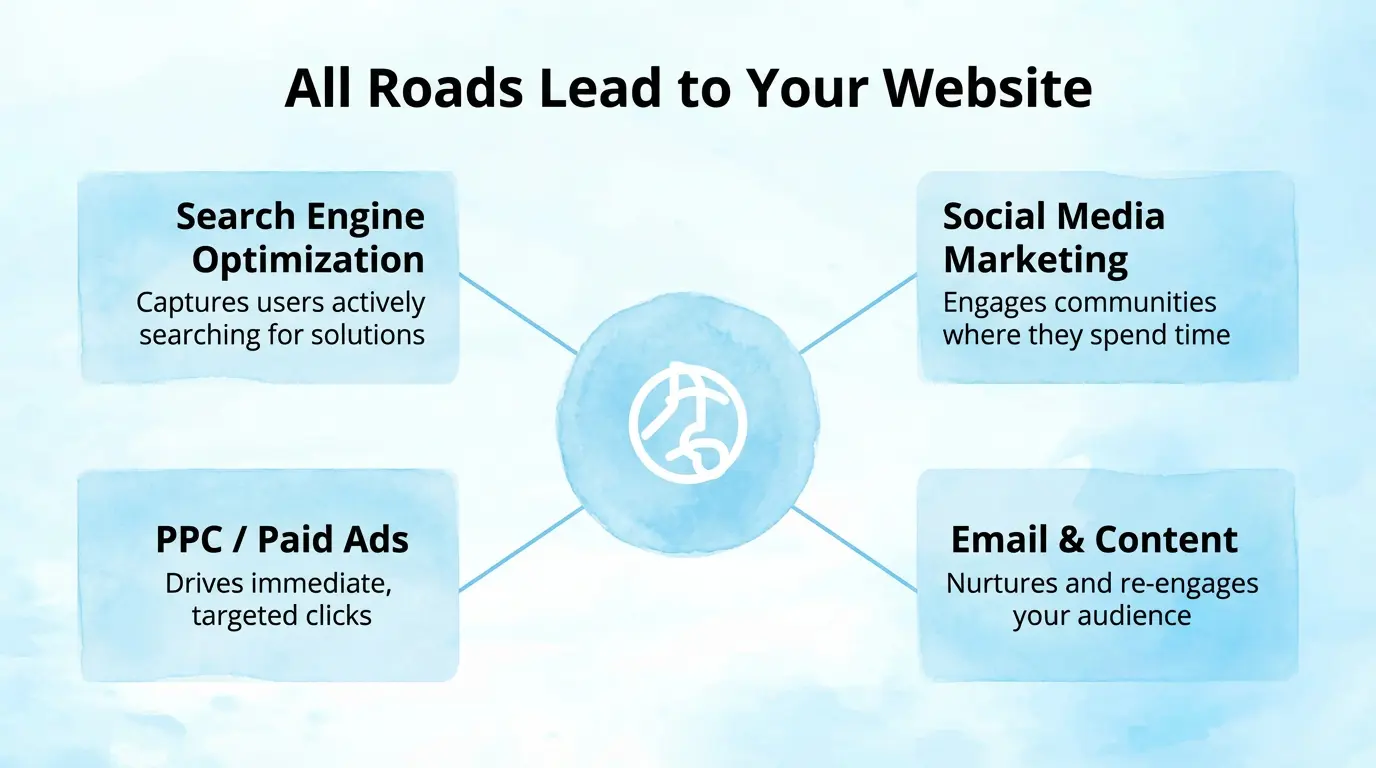
- Your website, the hub everything else points to. Every ad click, every email link, every social post CTA lands here. If the site is broken, the rest is wasted
Who Actually Works on Your Account
When you hire an agency, you are hiring a team. Knowing who does what helps you hold them accountable:
- Strategists figure out where to spend and why. They run competitor analysis, set KPIs, and build the quarterly plan. A good strategist says "we should pause Facebook ads and shift budget to Google Shopping because your ROAS data says so." A bad one follows last quarter's template
- Specialists do the hands-on work, writing ad copy, optimizing landing pages, building email sequences, managing bids. We collaborate with SEO specialists regularly on shared projects; the skilled ones obsess over search intent, not just keyword volume
- Account managers keep the project on track. They translate between your business language and the specialists' technical language. Without a strong AM, things fall through cracks fast

The Spectrum of Services: What Digital Marketing Agencies Offer
Most agencies package their services into tidy categories. That is fine for a sales deck, but here is what you actually need to understand: these services are not independent. SEO feeds content marketing. Content fuels email. Email drives return visits. And all of it breaks down if your website cannot convert. Think of it as a chain, one weak link kills the whole thing.
Here is how the services stack up in practice.
Getting People to Your Site
This is the acquisition layer. You cannot sell to people who do not know you exist.
- SEO (Search Engine Optimization), earning organic traffic by ranking for the terms your buyers actually search. We see this take 4-6 months to gain traction, but once it compounds, it is the cheapest traffic source you have. One client went from 200 to 3,400 organic visits per month in 8 months with a focused SEO campaign
- PPC (Pay-Per-Click) advertising, Google Ads, Bing Ads, paid social. You pay for every click, so the math has to work. A good agency targets cost-per-lead, not just cost-per-click. We have seen poorly managed PPC burn through EUR 8,000/month with a 1.2% conversion rate, and watched a competent agency take the same budget to 4.7%
- Social media marketing, organic posting builds trust over time, paid social drives targeted traffic. The channel mix depends on your audience. B2B? LinkedIn and maybe X. DTC consumer brand? Instagram and TikTok
Turning Visitors into Customers
Traffic without conversion is just an expensive vanity metric.
- Content marketing, blog posts, whitepapers, video, case studies. The purpose is dual: build trust with readers and feed the SEO engine with rankable pages. We publish roughly 20 articles per month across our clients and the ones that perform best solve a specific problem, not just summarize a topic
- Email marketing, the workhorse of retention. Average ROI sits around 36:1 according to DMA data. Segmented sequences (not blast newsletters) are what drive that number. We partner with agencies that A/B test subject lines, send times, and CTA placement on every campaign
- CRO (Conversion Rate Optimization), the practice of making your existing traffic convert better. Heatmaps, session recordings, A/B tests. On one project, changing a form from seven fields to four increased submissions by 62%. Small changes, big revenue impact
The Foundation: Your Website
Here is where our perspective as a web design studio matters. We watch digital marketing agencies pour ad spend into sites that load in 6 seconds on mobile, have broken contact forms, or bury the CTA below three paragraphs of corporate jargon. That money evaporates. A fast, clear, conversion-focused website is not a nice-to-have, it is the prerequisite for everything else on this page working.
Your Website: The Engine for All Digital Marketing Success
We say this to every client and every digital marketing agency we collaborate with: fix the website first. Do not spend EUR 5,000/month on Google Ads pointing to a site that loads in 4.8 seconds and has a form that breaks on Safari. We have literally paused ad campaigns on day one of a project because the landing page was doing more harm than good.
Conversion-first design is not a philosophy, it is engineering. Where does the CTA sit relative to the scroll depth where 70% of visitors drop off? Is the form above the fold on mobile? Does the headline match the ad copy that brought the visitor here? We test all of this before a single euro goes into paid traffic.
Web Design Directly Affects SEO Rankings
Google's ranking algorithm cares about user experience now more than ever. We track Core Web Vitals on every site we manage, and the pattern is consistent: sites that pass all three metrics (LCP under 2.5s, FID under 100ms, CLS under 0.1) rank higher than competitors with similar content but worse performance scores.
- Technical health, crawlability, mobile responsiveness, page speed. We run Lighthouse CI on every deploy. If a build regresses LCP by more than 200ms, it does not ship
- Engagement signals, bounce rate, time on page, pages per session. Google uses these as quality proxies. We redesigned one client's blog layout and dwell time went from 1:40 to 3:12, their keyword rankings improved across the board within six weeks
- Site architecture, internal linking, URL hierarchy, breadcrumbs. A clean structure helps Google understand what your site is about and which pages matter most
PPC Fails Without Good Landing Pages
Here is a number that should scare any business running ads: the average landing page converts at 2.35%, but the top 25% convert at 5.31% or above (Unbounce data). That gap means the same ad spend produces 2x the leads if the page is built right. We build dedicated landing pages for every major PPC campaign, no generic homepage traffic. Each one matches the ad's headline, mirrors its value proposition, and has exactly one CTA. See how a high-converting landing page changes the economics of paid ads.
Content and Social Media Need a Home Base
Your blog posts, case studies, and whitepapers live on your website, not on LinkedIn, not on Medium. Social channels distribute the content, but the conversion happens on your domain. We have watched brands build huge social followings with zero sales because they never drove that audience back to a site that could capture leads. Your website is where email signups happen, where gated content converts, and where a visitor turns into a contact in your CRM.
Full-Service vs Specialized Agency: Which Is Right for You?
This question comes up in almost every sales call we take: "Should I hire one big agency for everything or several specialists?" Honest answer: it depends on where you are.
When a Full-Service Agency Makes Sense
Full-service shops run everything, SEO, PPC, social, email, content, sometimes even web development, under one roof. The upside is coordination. One team, one strategy, one invoice. The downside is depth. When you spread a 10-person team across six disciplines, nobody is truly elite at any of them. Go full-service if:
- You need multiple channels running at the same time and do not want to manage three vendors
- Your budget is large enough (we typically see EUR 8,000+/month) to fund meaningful activity across channels
- You want a single team accountable for the overall number, not just their slice
When Specialists Win
A specialized agency goes deep on one thing. We are biased here, Vezert is a specialist. We do web design and development, and we do it very well. We do not pretend to run your Google Ads or manage your Instagram. When you need the foundation built right before spending on traffic, a specialist is the move. Hiring an AI-first web design studio like Vezert means your site is engineered for conversion before the first ad dollar flows. Pick a specialist when:
- You have one high-priority problem to solve, a slow site, a landing page that does not convert, a brand that needs a visual overhaul
- You would rather work with a small team of senior people than a large team of juniors
- You plan to pair the specialist with a marketing agency later, once the foundation is solid
Plenty of our clients work with us for the site build, then bring in a marketing agency for traffic. That handoff works well when both sides know their lane.

How to Choose Your Digital Partner: 5 Essential Questions
We have watched clients get burned by agencies that talk a big game in the pitch and disappear after the contract is signed. Here are the questions we wish every business owner asked before handing over a monthly retainer.
Questions That Expose Whether They Know What They Are Doing
Pay attention to how they answer, not just what they say. Specifics beat generalities every time.
- "What does success look like for a client like me, and how do you measure it?", If they say "increased visibility" or "brand awareness" without mentioning cost-per-lead, conversion rate, or revenue, walk away. You want a digital marketing agency that ties its work to numbers on your P&L
- "Show me a case study from my industry with actual data.", Not a logo wall. Not a testimonial. A before-and-after with traffic numbers, conversion rates, and timeline. If they cannot produce one, they are either new to your space or hiding weak results
- "Walk me through how you would build my strategy in the first 30 days.", Good agencies describe a structured discovery process: audit, competitor analysis, goal alignment, channel selection. Bad ones say "we will figure it out as we go"
Questions That Reveal How They Actually Work
Process is what separates a professional operation from a freelancer with a website.
- "What happens in the first two weeks after I sign?", You want a clear onboarding sequence: access requests, kickoff call, audit deliverables, timeline. If they wing it, your project will drift
- "What tools do you use, and will I have access to the dashboards?", GA4, SEMrush, Ahrefs, HubSpot, whatever their stack is, you should be able to log in and see your own data. Agencies that gate your analytics are a red flag
- "Who is my day-to-day contact, and how often will we talk?", The person on the sales call is rarely the person running your account. Meet the actual team before you commit
One more, and this is the question we think matters most: "What is your stance on website performance?" Ask whether they follow a conversion-first approach. If a digital marketing agency does not care whether your site actually converts the traffic they send, they are optimizing for their own metrics, not yours. Learn about our conversion-first design process and why we think it should be the starting point for any marketing investment.
Your Next Move: Partnering for Digital Growth
Here is the takeaway in one sentence: hire a digital marketing agency for traffic and conversion, but make sure your website can handle what they send you.
We have seen too many businesses spend six months and five figures on marketing only to realize their site was the bottleneck all along. A 2% conversion rate on a site that gets 10,000 visits means 200 leads. Bump the conversion rate to 4% with a better-designed site and you doubled your leads without spending an extra cent on ads. That is the math we care about.
At Vezert, we build the foundation. AI-assisted development for speed, conversion-first design for results, and a team that has shipped enough projects to know where the common pitfalls are. If you are about to invest in marketing, get the site right first.
Start your project, we will tell you if your site is ready or needs work first
On This Page
- What Is a Digital Marketing Agency? The Modern Growth Partner
- The Spectrum of Services: What Digital Marketing Agencies Offer
- Your Website: The Engine for All Digital Marketing Success
- Full-Service vs Specialized Agency: Which Is Right for You?
- How to Choose Your Digital Partner: 5 Essential Questions
- Your Next Move: Partnering for Digital Growth