
On This Page
- What a Restaurant Website Has to Do When Platforms Own Discovery
- What a Good Restaurant Website Has on It
- Why the Menu Page Is the Whole Website
- What Pages Actually Fill Tables
- How to Wire Up Reservations Without Losing the Guest Data
- Why Hours and Location Beat a Beautiful Hero Video
- What a Restaurant Website Costs
- How Builder, Hospitality Vendor and Custom Build Compare
- What Goes Wrong Most Often
Restaurant website design is the creation of a mobile-first hospitality platform featuring HTML-indexed menus instead of PDFs, commission-free table reservation and direct ordering flows, sub-2-second mobile page loads, and Restaurant Local SEO schema to convert local diners for European investments of €2,500 to €7,500+.
Someone standing on a street corner with a smartphone, or sitting at a desk booking Friday dinner, needs four answers in under 60 seconds: what you cook, what it costs, whether you are open tonight, and how to lock in a table in two taps. A hospitality website that delivers those four answers fast fills covers; one that opens with a 15-megabyte background video of rising steam loses the guest back to Google Maps.
This guide examines the pages that actually drive covers, why HTML menus with allergen filters outperform downloadable PDFs, how to integrate SevenRooms, OpenTable, Zenchef, or Formitable without losing guest CRM ownership, how commission-free direct ordering saves 15% to 30% in delivery fees, and what each build tier costs in 2026.
What a Restaurant Website Has to Do When Platforms Own Discovery
Delivery apps, review platforms and the map own first discovery, and that is a fight worth conceding rather than losing slowly. Almost nobody finds a new restaurant by typing its name into a search box. They find it on a map, in a list, or from a friend, and then they check the website before deciding.
That check is the whole job. By the time somebody reaches your site they already know you exist and are looking for a reason to come or a reason not to. A menu they cannot read, a reservation link that fails, or hours that contradict the map all supply the second reason instantly.
The third job is margin. Every booking taken on your own site rather than through a platform, and every order placed directly rather than through a delivery app, keeps the commission in the business. A restaurant site that makes direct booking and direct ordering the easiest visible option is not a marketing expense; it is a margin decision that compounds every week.
Commission math makes the business case unmistakable. Third-party delivery apps such as Uber Eats, Deliveroo, and Just Eat charge 15% to 30% per order, while marketplace reservation networks charge per-cover fees when a diner books through their directory instead of your own widget. Routing repeat takeout orders, private dining inquiries, and digital gift voucher sales through your own web portals or direct checkout flow retains thousands of euros in net operating margin every month.
What a Good Restaurant Website Has on It
A restaurant website earns its keep when a stranger can answer four questions on a phone in under a minute: what is on the menu, what it costs, whether you are open tonight, and how to book a table. Everything else on the site is decoration. The six items below are the working definition we hold every hospitality build against, and each one gets its own section further down.
- The menu as text, not a PDF. Grouped by course, prices next to the dishes, allergen marks where they apply.
- Today's hours in words. The same hours the map listing and the booking platform show, holidays included.
- One booking route, two taps. No account requirement, no dead link, working on mobile data.
- Photographs of your own room. The actual space and the actual plates, not bought pictures of somebody else's kitchen.
- Editable in house. Whoever changes the menu on a Tuesday morning should not need to call the agency.
- Readable in low light. Contrast and text size that hold up for guests of every age, on a phone, at a table.
None of those points is a matter of taste. Each one is either present or missing, and an existing site can be checked against the list in ten minutes.
The pavement test
Open your website on your own phone while standing outside, in daylight, on mobile data. Can you read the menu without zooming, see today's opening hours, and book a table in two taps? Most restaurant sites fail at least two of the three, and the menu is usually the one that fails first.
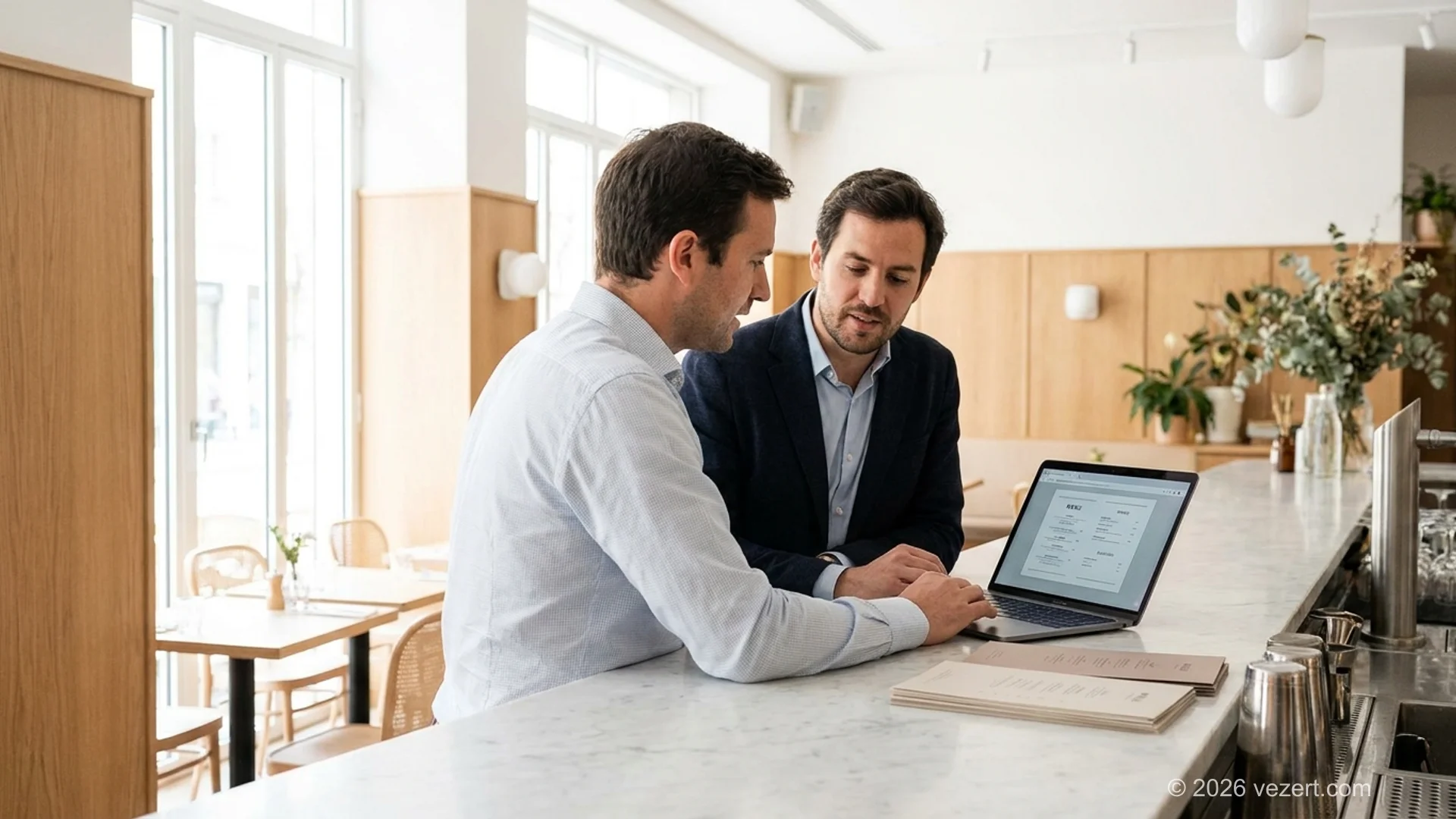
Percentage of mobile diners who verify each website element before completing an online table reservation or direct takeout order. Source: TouchBistro Diner Trends & Google Local Hospitality UX Benchmarks.
What Pages Actually Fill Tables
Five page types produce almost every booking a restaurant website generates. A homepage that carries the first three of them above the fold is doing most of the work already.
- The menu, as text, current, with prices. Separate pages for lunch, dinner and drinks if they differ meaningfully.
- Hours and location. Today's hours, not a weekly grid the visitor has to decode, plus how to arrive and where to park.
- Reservations. One obvious route, working on a phone, without an account requirement.
- The room. Photographs of the actual space and actual plates, which is the one place where atmosphere belongs.
- Groups and events. Private dining, larger parties and set menus, because those enquiries are worth several times a normal cover and almost always arrive by email.
The last one is routinely missing. A restaurant that takes group bookings and publishes nothing about capacity, set menus or deposits leaves the highest-value enquiries to guesswork.
How to Wire Up Reservations Without Losing the Guest Data
Reservations decide whether the website earns its cost. Three routes exist and they differ less in price than in who ends up owning the guest relationship.
A reservation platform is embedded, brings its own audience and keeps the guest list on the platform's side. A booking module from your point-of-sale or table-management vendor keeps everything in house but depends on that vendor offering a decent web interface. A simple request form with no live availability is the cheapest and pushes the work back to the phone.
Three points settle before choosing. Who holds the guest data and whether you can export it, because a mailing list of past guests is an asset and platform lock-in quietly removes it. Whether bookings write into the table plan the floor staff actually use. And whether a guest can book without creating an account, since an account requirement reliably loses the walk-past booking.
Whatever you choose, state the rules on the page: the largest party bookable online, how long you hold a table, and whether deposits apply at weekends. A booking widget without those rules produces reservations the team then has to unpick by phone.
In European hospitality, the leading reservation engines (SevenRooms, OpenTable, Zenchef, Formitable, Resengo, and TheFork Manager) offer embedded modal widgets that open directly on the page without redirecting the diner to an external marketplace domain. When scoping custom web development, ensure the booking widget syncs in real time with your floor POS (such as Lightspeed, Toast, or Square), supports Apple Pay or Google Pay for weekend no-show deposits, and writes verified guest emails and dietary notes into your own CRM.
Why Hours and Location Beat a Beautiful Hero Video
Restaurant search is local, immediate and frequently mobile. People search a cuisine and a place, or they search for somewhere open now. Neither of those queries is answered by a hero video, and both are answered by text most restaurant sites treat as an afterthought.
The structure that works names the cuisine and the neighbourhood in ordinary sentences, publishes hours as text rather than inside an image, and keeps a page per location where a group runs more than one venue. Dish names in text on the menu page do a surprising amount of this work by themselves.
The machine-readable side matters too. Restaurant structured data lets the cuisine, price range, hours and menu link appear in search results directly, which is exactly the information the visitor wanted anyway.
One unglamorous detail outranks all of it. Hours must be identical on the website, the map listing and the reservation platform. When they disagree, the map usually wins, and a guest who arrives at a closed door does not check which source was wrong. Holiday hours are where this breaks most often, and nobody remembers to update all three.
Just as hyper-local neighbourhood pages drive real estate website design and small business web design, multi-venue hospitality groups need a dedicated location page for each neighbourhood they serve. High-performing corporate websites for restaurant groups combine Restaurant JSON-LD schema (servesCuisine, priceRange, hasMenu, acceptsReservations, and openingHoursSpecification) with AVIF food photography that loads in under 1.8 seconds on 4G.
What a Restaurant Website Costs
Price is the question search results on this topic mostly avoid, and it is the first thing every operator asks. Because a neighbourhood bistro and a multi-concept hospitality group are not buying the same technical scope, 2026 European hospitality web budgets fall into three transparent tiers.
On our published pricing, an Independent Restaurant or Bistro Website (5 to 12 pages with a CMS-editable HTML menu, allergen filters, embedded 2-tap table reservation widget, and Google Business Profile schema sync) runs €2,500 to €4,500. A Multi-Concept Hospitality Group Platform (15 to 30 pages with individual venue pages, private dining and event inquiry flows, digital gift voucher checkout, and bilingual HTML menus) runs €4,500 to €9,000. A Custom Ordering and Loyalty Web Portal with POS-integrated commission-free pickup/delivery ordering, table deposit management, and guest CRM automation runs €9,000 to €18,000+.
Four variables move the budget more than page count: professional food and interior photography, whether the HTML menu is connected to your POS or edited in a custom CMS, which reservation and direct-ordering APIs are integrated, and how many languages the menu supports.
Budget the following year separately. Hosting, technical updates, and seasonal menu support typically run 15% to 20% of the initial build cost annually.
How Builder, Hospitality Vendor and Custom Build Compare
Suppliers in this market fall into three groups whose prices differ by a factor of twenty, and the quotes rarely separate them clearly enough for a comparison to mean anything.
A website builder with a restaurant template is paid monthly and goes live in days. It suits a café that needs a menu, hours and a phone number, and it stops being enough when reservations, several menus and a group need to coexist. A hospitality vendor bundles the website with the reservation or ordering system, knows the category and delivers a site that looks like every other venue using the same vendor, which matters in a business where guests compare three places in one sitting. A custom build costs most and earns it only when there are several venues, real brand work, or ordering that has to stay off the platforms.
The tipping point is rarely visual. It is who edits the menu on a Tuesday morning and whether the guest data stays with the business.
What Goes Wrong Most Often
The same five faults appear in almost every restaurant site review, and only one of them is about design.
The first is the PDF menu, which loses readers, search visibility and screen-reader users in one move. The second is hours published inside an image or a weekly grid nobody decodes on a phone. The third is a hero video that delays the first useful pixel by several seconds on mobile data, which is precisely the connection most of your visitors are using.
The fourth is stock photography. Guests recognise a stock plate immediately, and it undermines everything else on the page. Photographs of your actual room and your actual food, even imperfect ones, outperform polished images of somebody else's food.
The fifth is abandonment: a menu from two seasons ago, a New Year's message in March, a booking link to a platform you left. Accessibility belongs here too. Level AA of WCAG 2.1 covers contrast and text sizing, and on a menu read in dim light by guests of every age, that is a commercial matter rather than a compliance one.
Want a quote with the menu, reservations and hours named in it?
We scope restaurant sites with the menu structure, reservation route and photography written into the quote, and the price published before the call.
See our pricingOn This Page
- What a Restaurant Website Has to Do When Platforms Own Discovery
- What a Good Restaurant Website Has on It
- Why the Menu Page Is the Whole Website
- What Pages Actually Fill Tables
- How to Wire Up Reservations Without Losing the Guest Data
- Why Hours and Location Beat a Beautiful Hero Video
- What a Restaurant Website Costs
- How Builder, Hospitality Vendor and Custom Build Compare
- What Goes Wrong Most Often