

Picture this: you check your analytics on Monday morning. 12,000 sessions last month. Paid ads are running. SEO traffic is growing. Everything looks healthy -- until you look at conversions. 89 leads. A 0.74% conversion rate. Your marketing is working; your website is not.
That gap between traffic and revenue is what conversion optimization exists to close. Not by buying more clicks, but by fixing the experience those clicks land on. A clearer headline. A shorter form. A faster page load. A CTA that actually tells people what they get. Small changes, compounding returns.
This guide walks through the full conversion optimization process -- from diagnosing friction to running A/B tests to scaling what works. We wrote it based on what we have learned running CRO projects for service businesses, SaaS companies, and e-commerce brands at Vezert. No fluff, no theory that does not translate to real results.

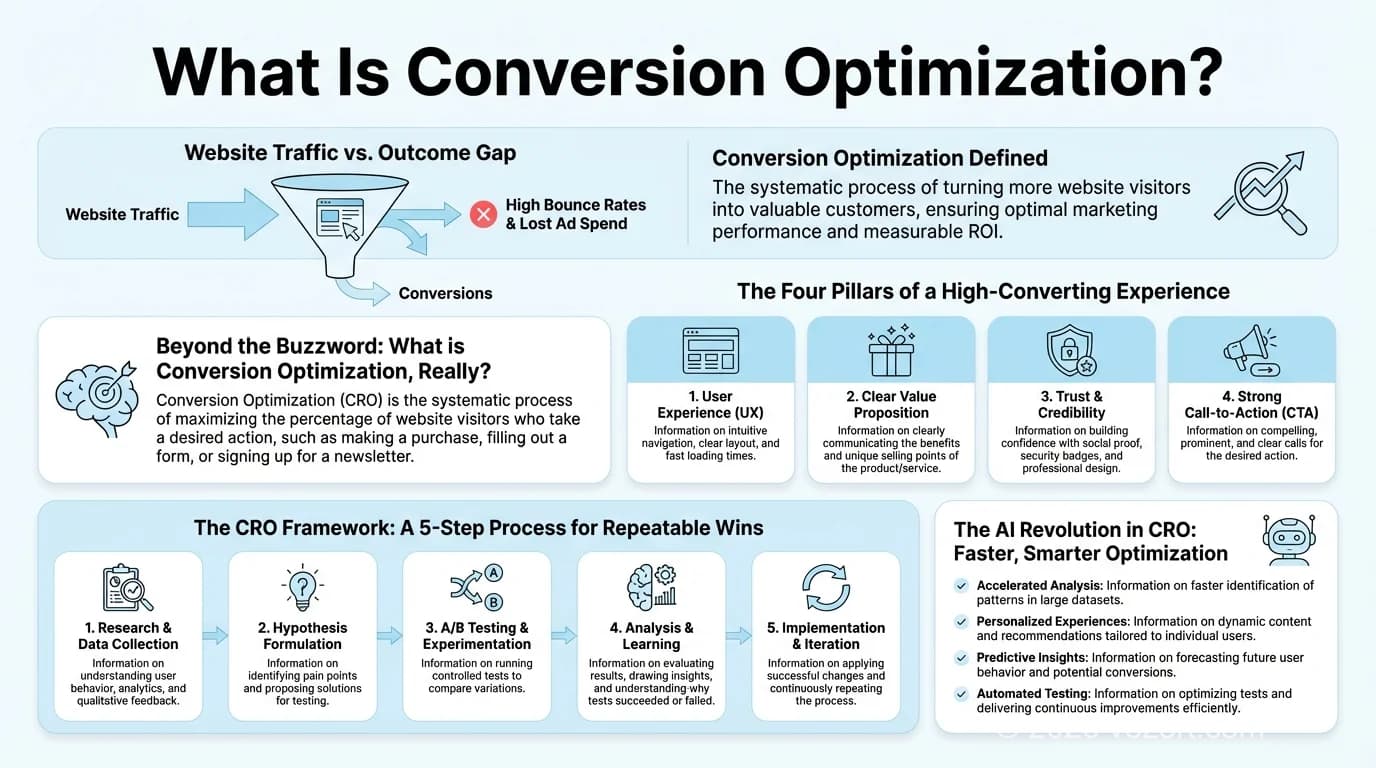
Beyond the Buzzword: What Is Conversion Optimization, Really?
Let us cut through the marketing speak. Conversion rate optimization (CRO) means one thing: getting more of your existing visitors to take the action you want. Purchase. Sign up. Request a quote. Download a resource. Whatever your "conversion" is, CRO is the systematic process of increasing its rate.
This is not about gut feelings or copying what your competitor does. It is about observing real user behavior, forming a testable hypothesis, and measuring the result. The principle behind it is simple: extract more value from the traffic you already have before spending another dollar to acquire new traffic.
CRO vs. SEO: They Solve Different Problems
We talk to business owners every week who invested heavily in SEO, saw their traffic double, and then wondered why revenue barely moved. The answer is almost always the same: they optimized for getting visitors but never optimized for converting them. SEO fills the top of the funnel. CRO fixes the leaks in the middle and bottom. You need both, but if your conversion rate is below 1%, more traffic just means more people leaving without buying.
Why CRO Is the Highest-ROI Marketing Activity You Can Do
The math is straightforward. 10,000 visitors/month. $5,000 ad spend. 1% conversion rate = 100 customers. Improve the conversion rate to 2% and you have 200 customers. Same traffic. Same spend. Double the output. Your Customer Acquisition Cost drops by 50%.
But it goes further than that. Every CRO test -- even the ones that fail -- teaches you something about your audience. What language resonates. What objections they have. Where they get confused. That data feeds back into your product, your sales process, and your marketing copy. The insights compound.
Let Our Experts Handle CRO for You
Our data-driven approach transforms your website into a high-performance conversion engine.
Start Your ProjectThe Four Pillars of a High-Converting Experience
We have tested hundreds of page variations across dozens of client projects. The pages that convert well always have these four elements working together. The ones that underperform are always missing at least one. This is not a theory -- it is a pattern we see validated through A/B testing data over and over.
UX Design: Make the Path Obvious
Every unnecessary step between landing and converting costs you a percentage of visitors. We worked on a lead-gen page where the form was hidden behind a "Learn More" button that opened a modal that scrolled to a second form. Three steps where one would do. We flattened it to a single visible form and completions jumped 45%.
Frictionless UX means: fast page loads, mobile-first layout, navigation that does not confuse, and forms that ask only for what you actually need at this stage. Everything else is decoration that costs you money.
Copywriting: Benefits First, Always
Your visitors are asking one question: "Does this solve my problem?" Your headline needs to answer that in under 5 seconds. Lead with the outcome, not the process. "Cut your support ticket volume by 40%" beats "AI-powered customer service automation platform" every time. End with a CTA that describes what happens next -- not a generic "Submit" or "Click Here."
Visual Hierarchy: Design as Direction
Good conversion design is not about looking pretty. It is about guiding the eye. The CTA should be the most visually prominent element on the page. Key benefits should be scannable. Trust signals -- real client logos, specific testimonials with names, security badges -- should appear near the point of conversion, not buried in a footer nobody scrolls to.
We have run tests where simply increasing the contrast on a CTA button and adding 40px of whitespace around it produced a double-digit lift. Design is leverage.
Psychology: Understand How People Actually Decide
People are influenced by patterns they may not even be aware of. The ones that consistently move conversion metrics:
- Specific social proof: "Used by 1,247 marketing teams" is more credible than "Trusted by thousands."
- Real urgency: Genuine limited availability or deadline-based offers. Fake scarcity (countdown timers that reset) damages trust.
- Anxiety removal: Place your guarantee, privacy policy summary, and FAQ answers near the form. Do not make users hunt for reassurance on a separate page.
Different traffic sources bring different intent levels. A visitor from a branded search query needs less convincing than someone from a generic comparison keyword. Match the page experience to their mindset.

The CRO Framework: A 5-Step Process for Repeatable Wins
A framework only works if you actually follow it. Too many teams test one thing, get distracted, and never build the habit. Here is the 5-step process we run at Vezert on every CRO engagement -- the same loop whether we are optimizing a pricing page, a lead capture form, or an entire checkout flow.
Step 1: Research First, Opinions Later
We do not touch the design until we understand the problem. Research combines three layers:
- Analytics (the what): Google Analytics 4 funnel reports, exit page data, scroll depth, and click maps show us where users drop off and which pages underperform.
- Session data (the why): Hotjar recordings and heatmaps reveal the behavior behind the numbers -- where people hesitate, what they skip, where they rage-click. Usability testing gives us direct user feedback.
- Expert audit (the obvious): Sometimes the problem is sitting in plain sight. A CTA below the fold. A form asking for a phone number on first visit. We walk through the site fresh and flag friction that data alone might not quantify.
Step 2: Hypothesize With Structure
Every test needs a reason. We write hypotheses in this format: "If we [specific change], we expect [measurable outcome], because [evidence from research]." This forces discipline. "Let's make the hero section bigger" is not a hypothesis. "If we replace the generic hero image with a product demo screenshot and move the CTA above the fold, we expect a 15% increase in demo requests because heatmap data shows 70% of users never scroll past the current hero" -- that is a hypothesis worth testing. We rank them by expected lift, confidence, and implementation effort.
Step 3: Design the Challenger Variant
Our designers and copywriters build the test variant based on the hypothesis. This is not tweaking a shade of blue. If research showed that visitors do not understand the pricing model, the challenger might restructure the entire pricing section with comparison tables and a "most popular" badge. The change should be substantial enough to produce a measurable difference.
Step 4: Split Test and Wait for Significance
We run the control and challenger side by side, splitting traffic evenly. The critical discipline here: do not stop the test early. We have seen promising results at day 7 reverse completely by day 21 once weekday/weekend traffic patterns evened out. Statistical significance is non-negotiable. See this approach in action with a real case study.
Step 5: Ship the Winner, Learn From Everything
Winning variant gets implemented permanently. But every test -- winners and losers -- generates insight. A failed test that reveals users do not trust your pricing page is more valuable than a successful button color test. We document every learning and feed it back into Step 1. This cycle never stops. The companies that maintain it consistently see conversion rates climb quarter over quarter.
The AI Revolution in CRO: Faster, Smarter Optimization
The CRO playbook has not changed. Hypothesis, test, learn, repeat. What has changed is how fast you can execute each step. AI tooling is making the biggest practical difference in three areas, and we use all three at Vezert.
Faster Analysis, Better Hypotheses
A human CRO analyst reviewing a month of analytics, heatmaps, and session recordings might spend two full days building a picture of user behavior. AI-assisted tools can surface the key friction points in hours -- flagging pages with unusual drop-off patterns, identifying form fields where users hesitate, and clustering survey responses by theme. The analyst still interprets the findings and decides what to test. But they start with better inputs, faster.
Smarter Testing at Scale
AI changes testing in two practical ways. First, variation generation: instead of manually crafting 3 headline options, you can produce 15 and pre-filter for quality. Second, traffic allocation: multi-armed bandit algorithms shift traffic toward outperforming variants during the test, so you capture value sooner.
The next step -- and we are running this on select projects now -- is real-time page personalization. Different visitors see different content based on their traffic source, behavior signals, and where they are in the buying cycle. It is not science fiction. It is production-ready.
How This Plays Out in Our Work
At Vezert, AI speeds up the boring parts so our team can focus on the strategic parts:
- Test deployment in days, not weeks. AI-assisted development means we build challenger variants faster.
- Higher test volume per quarter. More experiments = more data = faster compounding gains.
- Post-test analysis with teeth. AI helps us find the non-obvious patterns in results that inform the next cycle.
Conversion optimization remains a human-driven discipline. AI just removes the bottlenecks that used to slow it down. See our AI-first development approach in detail.

From Clicks to Customers: Your CRO Journey Starts Now
Stop treating conversion optimization as something you will get to eventually. Every day your site runs with a sub-1% conversion rate, you are leaving money on the table -- money you already spent to acquire those visitors.
The framework is not complicated: research what is broken, hypothesize a fix, test it, measure the result, and repeat. The discipline is doing it consistently, month after month, and letting the gains compound.
At Vezert, we build conversion thinking into the design process itself. Our Conversion-First approach means your site launches optimized, and our AI-first development process means we can iterate faster than traditional agencies. Transparent pricing. Clear process. Measurable results.
If your website has traffic but not enough revenue, the problem is solvable. Talk to us about turning your traffic into customers.